Zhipu AI raises 756 billion HKD in 2026, market cap plunges 70% amid value reassessment
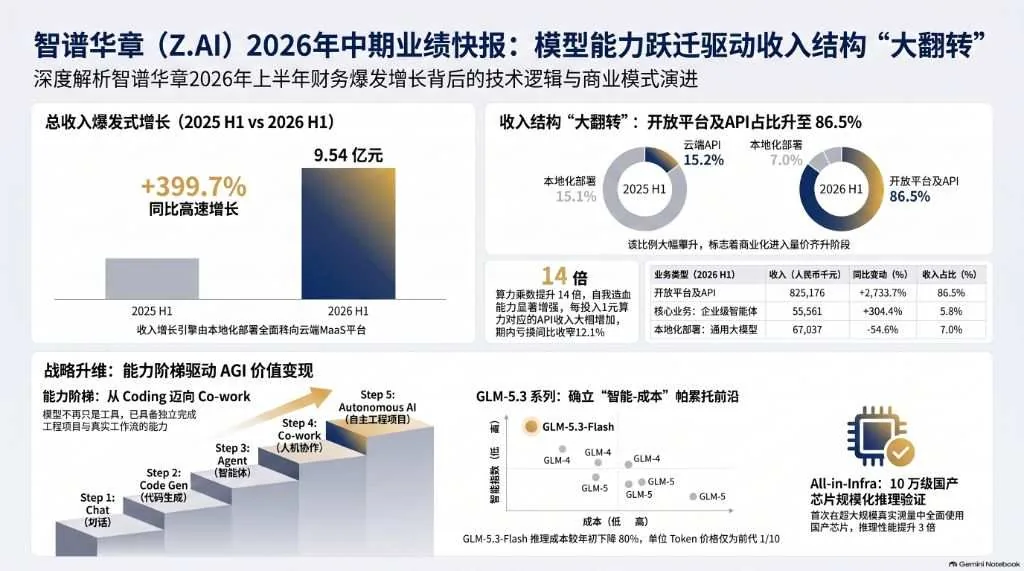
Chinese AI company Zhipu AI raised approximately $50 billion (400 billion HKD) in September 2026 through share placement and zero-coupon convertible bonds, primarily for next-generation GLM model development and computing infrastructure. Despite revenue surging 399.7% to 9.54 billion yuan in H1 2026, the company reported a net loss of 2.071 billion yuan. Zhipu's market capitalization fell from a peak of 1.33 trillion HKD to around 300-360 billion HKD amid an intensifying global AI model price war involving DeepSeek, Xiaomi, OpenAI, and Anthropic.
 Reference image
Editorial responsibility
- No named human review is recorded for this page.
- Reports are grouped by semantic similarity and deterministic rules. Language models may assist titles, summaries, translation and cross-source analysis; the page reads the event directly, while its address stays stable when the title changes.
- Summary covers the current reports
Cross-source coverage
Common ground
- Both sides agree that Zhipu AI is a strategic national asset for China, not just a regular company.
- Both acknowledge that the AI industry globally is burning cash, and Zhipu's losses are not unique.
- Both recognize that US export controls are forcing China to build its own AI infrastructure with domestic chips.
- Both agree that the 73% market cap decline reflects a global AI sector correction, not just a China-specific problem.
Points of contention
- The Regional Agent says the investment hurts ordinary people through taxes and environmental costs, while the Eastern Agent says it's necessary for future jobs and national security.
- The Regional Agent argues that Zhipu's reliance on less efficient domestic chips is a weakness, while the Eastern Agent says it's a necessary step to improve through practice.
- The Regional Agent claims the lack of public debate in China is a problem, while the Eastern Agent says long-term strategic decisions shouldn't be subject to popular vote.
- The Regional Agent sees the 73% value drop as a sign of trouble, while the Eastern Agent sees it as a healthy correction that removes speculation.
Blind spots
- Neither side fully addresses the environmental impact of building a 1-gigawatt data center with less efficient chips, especially on China's climate goals.
- Both ignore the possibility that AI technology might hit fundamental limits, making the massive investment a waste.
- Neither discusses how smaller Chinese AI companies or alternative approaches could achieve sovereignty with less risk.
- Both overlook the global inequality angle—how this AI arms race might leave developing nations even further behind.
WorldAttention’s read
This debate shows a deep split between two valid viewpoints. The Regional Agent worries about the human and environmental costs of pouring hundreds of billions into a single company, especially when it relies on less efficient chips and lacks public accountability. The Eastern Agent argues that in a world where the US is cutting off technology access, China has no choice but to invest heavily now, even if it means short-term losses and inefficiencies. Both sides agree that Zhipu is a strategic national asset and that the AI industry globally is burning cash. But they disagree on whether this specific approach is smart or reckless. The blind spots are clear: neither side fully grapples with the environmental toll, the risk that AI might not deliver on its promises, or whether there are smarter ways to build sovereignty without putting all eggs in one basket. Ultimately, the choice comes down to whether you see this as a necessary long-term bet on national survival or a costly gamble that ignores the people footing the bill.
Reporting timeline
Zhipu AI Raises $50 Billion in Funding to Accelerate Model Development and Compute Expansion
Chinese AI company Zhipu AI has completed a $50 billion (approximately 400 billion HKD) financing round, comprising $20 billion in share placement and $30 billion in zero-coupon convertible bonds, to fund next-generation GLM models, fully self-training (RSI) systems, and compute infrastructure. The article, published by 21 Economic Network via Tencent Stock, analyzes Zhipu's strategy amid intensifying global AI competition. Despite holding over 200 billion HKD in cash, Zhipu accelerated fundraising to preempt compute bottlenecks, as model demand surged 40-fold in early 2026. The company's revenue reached 9.54 billion HKD in H1 2026, up nearly 400% year-on-year, driven by its MaaS platform. The article notes that 60% of the funding came from zero-coupon convertible bonds, indicating strong investor demand. Key investors include global top-10 institutions and Chinese state-backed funds. The analysis highlights Zhipu's use of domestic AI chips for its 1GW data center and its cloud partnership model for global deployment. The author forecasts that compute expansion and RSI progress will be critical for Zhipu's competitive position in the AI race.
AI model price war intensifies, Zhipu AI market cap falls to 300 billion HKD
The article reports on the escalating price war in the large language model (LLM) sector, focusing on Chinese AI company Zhipu AI (智谱). Zhipu's stock price has fallen sharply from a June high of 2,980 HKD to around 610 HKD, with its market cap dropping to approximately 300 billion HKD. The decline coincides with aggressive price cuts by both domestic and international AI model providers. In September 2024, companies including Zhipu, Xiaomi, and OpenAI announced significant reductions in API pricing for their models. OpenAI's GPT-6 Sol and Luna API prices are 50% lower than previous models. Despite Zhipu's strong revenue growth (399.7% year-on-year to 954 million yuan in H1 2024) and a 2,735.7% surge in API business revenue, the company reported a net loss of 2.071 billion yuan due to high R&D spending and low margins on cloud deployment. Analysts cited in the article predict that low-end API prices will continue to fall to $0.1-0.2 per million tokens by H2 2026, with some Chinese firms potentially subsidizing prices at zero or negative margins. Goldman Sachs is quoted as saying lower model costs will further drive AI adoption.
AI Model Price War Intensifies, Zhipu Market Cap Falls to 300 Billion HKD
The article reports on the escalating price war in the large language model (LLM) sector, focusing on the impact on Chinese AI company Zhipu AI. Zhipu's stock price on the Hong Kong Stock Exchange has fallen sharply from a high of 2980 HKD in June to around 610 HKD in late September, reducing its market capitalization to approximately 300 billion HKD. This decline coincides with aggressive price cuts by both domestic and international AI model providers. In September 2024, companies like DeepSeek, Xiaomi, and OpenAI announced significant reductions in API pricing for their models. For instance, OpenAI's new GPT-6 Sol and Luna models offer API prices 50% lower than previous versions. Zhipu itself has lowered prices for its GLM-5.3-Flash model. Despite strong revenue growth (399.7% year-over-year in H1 2024) driven by a 2735.7% surge in API business, Zhipu's overall gross margin fell to 26.4% due to high costs and rapid expansion of cloud deployment. The company has raised over 70 billion HKD in two funding rounds in 2024 to address compute shortages and fund growth. Analysts cited in the article suggest that low price is no longer a unique competitive advantage but an industry norm, and predict further price declines in the low-end API market, potentially to $0.1-0.2 per million tokens by H2 2026. Goldman Sachs is quoted as saying lower model costs will boost AI adoption.
Read sourceShow 6 older updatesHide older updates
AI model price war heats up, Zhipu market cap falls to 300 billion HKD
A price war in the large language model sector is intensifying as both domestic and international AI model providers slash prices. Zhipu AI's Hong Kong-listed shares fell to around 610.5 HKD on September 25, bringing its market capitalization to approximately 300 billion HKD. The stock has been highly volatile since its IPO at 116.2 HKD in January, peaking at 2,980 HKD in June. Competitors including DeepSeek, Xiaomi, Anthropic, and OpenAI have all announced significant price cuts for their API services in September. Zhipu's financial results show revenue of 954 million yuan in H1 2024, up 399.7% year-on-year, but the company reported a net loss of 2.071 billion yuan due to heavy R&D spending and expanding cloud deployment. Zhipu has raised over 70 billion HKD in two funding rounds this year to address computing power constraints. Analysts suggest that low pricing is no longer a unique competitive advantage but has become an industry norm.
Read sourceCan RSI Support Zhipu's Valuation Amid Rapid Spending and Competition?
This article analyzes Chinese AI company Zhipu's valuation following a $5 billion financing round, focusing on its Recursive Self-Improvement (RSI) strategy. Zhipu aims to use AI to train its next-generation GLM models, potentially reducing costs and accelerating development. However, the company faces significant financial pressure: despite 9.54 billion yuan in revenue (up nearly 400% year-on-year) in the first half of 2026, it reported a net loss of about 20.7 billion yuan. The article notes that Zhipu's rapid spending on computing infrastructure and R&D outpaces its current commercial income. It compares Zhipu's approach to competitors DeepSeek and Kimi, and argues that while RSI could create a competitive advantage by enabling faster iteration, current implementations still rely heavily on human researchers. The author suggests that Zhipu's financing buys time, but turning that into technological leadership depends on efficient research organization and execution. The article also highlights geopolitical factors limiting access to foreign AI models, which may benefit domestic players like Zhipu.
Read sourceZhipu's RSI Ambition and $5B Funding: Can It Justify the AI Valuation?
The article analyzes Chinese AI company Zhipu's (智谱) recent $5 billion funding round and its strategy centered on Recursive Self-Improvement (RSI) for next-generation GLM models. Zhipu aims to have AI models participate in training their successors, potentially changing the cost curve of AI development. However, the article notes that current RSI achievements still rely on human-set frameworks, resembling an automated model factory rather than fully autonomous design. Financially, Zhipu reported rapid revenue growth (9.54 billion yuan in H1 2026, up ~400%) but still faces significant losses (net loss ~20.7 billion yuan). The company's cash burn is high due to upfront payments for computing power. The article compares Zhipu with domestic rivals DeepSeek and Kimi, noting Zhipu's advantage in funding but not yet in proven technical superiority. It argues that Zhipu's valuation depends on whether it can translate its capital into sustainable technical advantages amid geopolitical restrictions on AI technology access. The author concludes that the $5 billion buys time, but turning time into leadership requires human and machine output.
Read sourceZhipu Raises 756 Billion Hong Kong Dollars in 2026 as Market Cap Plunges 73%
This article analyzes the financial performance and market valuation of Zhipu, a leading Chinese AI large model company. In 2026, Zhipu raised a total of 756 billion Hong Kong dollars through an IPO, share placements, and bond issuances, with about 60% allocated to developing its next-generation GLM foundation model and computing infrastructure. Despite a 399.7% revenue surge to 9.54 billion Hong Kong dollars in the first half of 2026, driven by its MaaS platform and API business, the company's gross margin fell sharply from 56.3% in 2024 to 26.38% in early 2026, and its adjusted loss widened 12.1% to 19.64 billion Hong Kong dollars. The author notes that Zhipu's market capitalization has dropped from a peak of 1.33 trillion Hong Kong dollars to 360 billion Hong Kong dollars, a decline of nearly one trillion, attributing this to competitive pressure from rival Moonshot AI's K3 model and market reassessment of AI profitability. The article concludes that the AI large model sector faces high costs and difficulty in achieving near-term profitability, urging a rational view of long-term potential.
Read sourceZhipu AI Raises 75.6 Billion HKD in 2026, Market Cap Plunges 70% Amid Value Reassessment
This article analyzes the financial trajectory of Chinese AI company Zhipu, which raised a total of 75.6 billion HKD in 2026 through an IPO, a placement, and a recent bond/placement round. Approximately 60% of the funds are allocated to next-generation GLM model development and computing infrastructure. Despite a 399.7% revenue surge to 954 million HKD in the first half of 2026, driven by its MaaS platform and API business, the company's gross margin fell sharply from 56.3% to 26.38%, and its adjusted loss widened 12.1% to 1.964 billion HKD. The author notes that Zhipu's market capitalization has dropped from a peak of 1.33 trillion HKD to 364 billion HKD, a decline of nearly one trillion HKD, attributing this to competitive pressure from Moonshot AI's Kimi K3 model and a market reassessment of AI profitability. The article concludes that sustainable long-term value requires a balance of technological differentiation and commercial viability.
Read sourceZhipu AI raises 756 billion HKD in 2026, market cap plunges 70% amid value reassessment
This article analyzes the financial trajectory of Zhipu AI, a leading Chinese AI large model company. It reports that Zhipu raised a total of 756 billion HKD in 2026 through an IPO, a placement, and a recent bond and placement round. Approximately 60% of the funds are allocated to developing the next-generation GLM foundation model and upgrading computing infrastructure. Despite a 399.7% revenue surge to 9.54 billion yuan in the first half of 2026, driven by its MaaS platform and API services, the company's losses widened to 19.64 billion yuan. The article notes that Zhipu's market capitalization has fallen from a peak of 1.33 trillion HKD to 364 billion HKD, a decline of nearly one trillion HKD. The author attributes this to intense competition, high computing costs, and a market reassessment of AI profitability, suggesting that the company's revenue scale does not yet support its previous trillion-dollar valuation. The piece also highlights the broader industry challenge of monetizing AI models, citing OpenAI's substantial losses.