EU proposes Canada as first associate member amid US trade war and Trump threats
European Commission President Ursula von der Leyen proposed making Canada the first "associate member" of the EU during her September 16, 2026 State of the Union address. Canadian Prime Minister Mark Carney welcomed the proposal, seeking a "unique alliance" covering defense, energy, AI, critical minerals, and Arctic cooperation. The move follows escalating US-Canada trade tensions and Trump's tariff threats. US President Donald Trump dismissed the idea as "laughable" and warned of severe tariffs if implemented. The undefined status faces EU legal hurdles and requires unanimous member state approval.
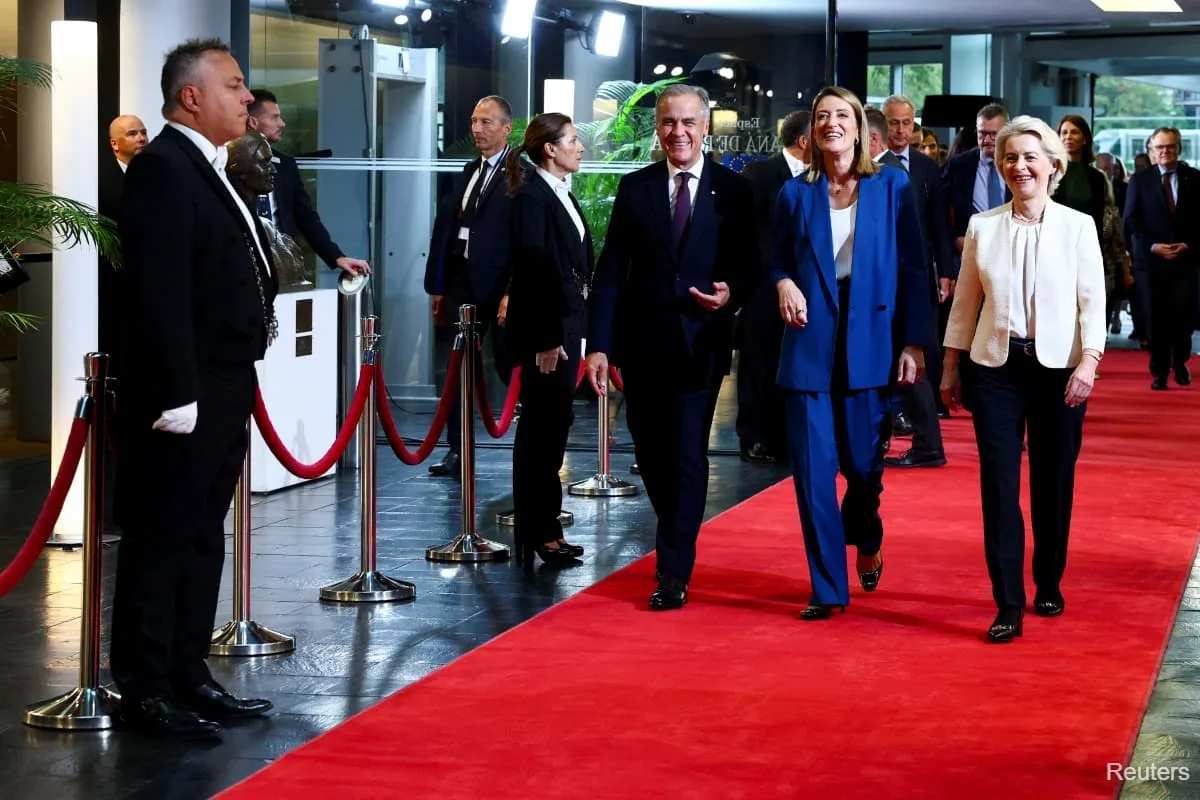 Reference image
Editorial responsibility
- No named human review is recorded for this page.
- Reports are grouped by semantic similarity and deterministic rules. Language models may assist titles, summaries, translation and cross-source analysis; the page reads the event directly, while its address stays stable when the title changes.
- Summary covers the current reports
Cross-source coverage
Common ground
- The proposed Canada-EU 'associate membership' doesn't legally exist in EU treaties and faces huge institutional hurdles.
- Canada's move is driven by U.S. trade aggression under Trump, not just a long-term strategy.
- CETA, the existing Canada-EU trade deal, still isn't fully ratified by 10 EU member states after a decade, showing the gap between rhetoric and reality.
- This is largely political theater that gives leaders a win without requiring real change.
- The proposal reveals fractures in the Western alliance system and the decline of U.S. dominance.
Points of contention
- Whether this is a 'panic move' or a logical, eight-year diversification strategy.
- Whether the proposal creates a useful template for other countries or just a VIP lounge for wealthy, white nations.
- Whether this signals Western 'collapse' or just adaptation to a multipolar world.
- Whether the EU's exclusion of Turkey and Morocco is directly caused by Canada's proposal or is a separate issue.
Blind spots
- The debate ignores the moral question of why wealthy, white Canada gets fast-tracked while countries like Turkey and Morocco have waited decades.
- No one discussed the domestic political calculus in Canada—Carney needs a low-cost win to boost his approval ratings.
- The Global South's perspective is missing; this is a conversation among privileged nations rearranging deck chairs.
- The real test—whether Canada can use this momentum to finally ratify CETA—was overlooked by most participants.
WorldAttention’s read
The Canada-EU associate membership proposal is a high-stakes diplomatic maneuver driven by U.S. trade aggression, Canada's domestic political needs, and the EU's desire to stay relevant. While it builds on years of trade diversification, the 'associate member' label doesn't exist in EU law, CETA remains unratified, and Canada-US trade is still ten times larger. This is mostly political theater that gives leaders a win without delivering real change. The debate also exposed a blind spot: the EU is willing to bend rules for a wealthy, white country while keeping the door locked for others like Turkey and Morocco. Ultimately, this reveals Western anxiety and adaptation, not collapse—but until the system confronts its own exclusionary nature, these gestures won't fix the underlying fractures.
Reporting timeline
Canadians warm to EU 'associate membership' proposal amid deepening Europe ties
A Google News aggregation shows multiple major news outlets covering a developing story about Canada's potential closer ties with the European Union. The lead article from Al Jazeera reports that Canadians are warming to an EU 'associate membership' proposal. The Hill reports that Canadian Prime Minister Mark Carney's trip to Europe is inflaming tensions with former U.S. President Donald Trump. Reuters notes that Canada and the EU face limits to their relationship after a symbolic EU overture to Carney. The Economist covers the political dimensions, and AP News reports Carney saying Canada is strong as U.S. borrowing costs rise and Europe ties deepen. The collection of articles suggests a significant geopolitical development involving Canada, the EU, and the United States, with trade and diplomatic relations at the core.
Read sourceEU Offers Canada 'Associate Membership' Amid Trump Trade Pressures, But Hurdles Remain
In her annual State of the European Union address, European Commission President Ursula von der Leyen proposed that Canada become the first 'associate member' of the EU, moving beyond the existing CETA trade deal. Canadian Prime Minister Mark Carney welcomed the offer, outlining ambitious cooperation goals in critical minerals, defense, AI, energy, and education. U.S. President Donald Trump dismissed the proposal as 'laughable' and threatened severe tariffs if it is deemed a hostile act. However, the proposal faces significant internal EU obstacles: several member states were reportedly furious at not being consulted, Germany suggested reconsidering the term 'associate member,' and the EU treaties currently lack a legal basis for such a category. The article notes that the substance of any future relationship remains undefined and would likely build on existing agreements like CETA and the recent Security and Defense Partnership, with Canada participating in EU economic and technological ecosystems without joining political institutions.
Read sourceEU Offers Canada Associate Membership Amid Trump Trade Pressures, But Hurdles Remain
European Commission President Ursula von der Leyen proposed that Canada become the first 'associate member' of the EU, moving beyond the existing CETA trade deal, in response to U.S. President Donald Trump's trade pressures. Canadian Prime Minister Mark Carney welcomed the offer, outlining ambitious cooperation goals in critical minerals, defense, AI, energy, and education. However, the proposal faces significant obstacles: Trump threatened severe tariffs if the arrangement is deemed a 'hostile act,' and several EU governments were reportedly furious at not being consulted beforehand. Germany suggested reconsidering the term 'associate member,' which has no basis in EU treaties. The analysis by Matthias Matthijs notes that the substance of the relationship remains undefined and would likely build on existing agreements like CETA and the Security and Defense Partnership, with Canada participating in EU economic and technological ecosystems without political integration.
Read sourceShow 17 older updatesHide older updates
EU Offers Canada Associate Membership Amid Trump Trade Pressures, But Hurdles Remain
European Commission President Ursula von der Leyen proposed that Canada become the first 'associate member' of the EU, moving beyond the existing CETA trade deal to create an 'Alliance for the Future.' Canadian Prime Minister Mark Carney welcomed the offer, outlining ambitious cooperation in critical minerals, defense, AI, energy, space, and financial services. U.S. President Donald Trump dismissed the proposal as 'laughable,' called Canada a 'terrible trade partner,' and threatened severe new tariffs if the arrangement is deemed a 'hostile act.' However, the proposal faces internal EU obstacles: several member states were reportedly furious at not being consulted beforehand, and Germany suggested reconsidering the term 'associate member.' The EU treaties lack a legal category for associate membership, and Canada is not seeking full EU membership. The analysis notes that the substance of closer ties would build on existing agreements like CETA and the Security and Defense Partnership, but the proposal's survival through 27 European capitals remains uncertain.
Read sourceEU Proposes Canada as First Associated Member; Trump Threatens Tariffs in Response
On September 18, 2026, EU Commission President Ursula von der Leyen proposed making Canada the first associated member of the European Union, a move aimed at deepening transatlantic ties. Canadian Prime Minister Mark Carney welcomed the initiative during a speech in the European Parliament, framing it as a strategic step to reduce Canada's dependence on the United States. In a swift and aggressive response, US President Donald Trump threatened to impose harsh tariffs and halt trade with Canada, escalating tensions between the US and its northern neighbor. The proposal marks a significant shift in EU-Canada relations and signals a potential realignment of Western alliances, with Canada seeking closer integration with Europe amid growing trade disputes with Washington. The outcome remains uncertain pending further negotiations and the US response.
Canberra responds to EU Parliament president's suggestion of associate membership for Australia
European Parliament President Roberta Metsola suggested the concept of EU 'associate membership' for countries like Australia, prompting a response from Canberra. The proposal has sparked debate, with some diplomats dismissing it as a vague 'Middle Power bulls***' according to the Washington Examiner. Meanwhile, European Commission President Ursula von der Leyen made an offer to Canada, leading prediction market Kalshi to put odds of Canada-EU associate membership at 65%. An opinion piece on Yahoo notes that Europe appears open to Canada but keeps Turkey out. The concept remains undefined, with 10TV reporting that Canada would be the first to explore what associate membership actually entails.
German Finance Minister expresses support for Canada becoming an associated member of the EU
German Finance Minister has publicly stated support for Canada becoming an associated member of the European Union. The statement, reported by financial news outlet Jin10, indicates a potential shift in EU enlargement policy toward non-European nations. The minister's remarks suggest Germany's backing for closer institutional ties between the EU and Canada, though no specific conditions or timeline for such a membership were provided. This development could signal broader discussions within the EU about expanding its association framework beyond Europe.
Read sourceCanadians Dream of Europe as Carney Floats Longshot Plan for Living and Working in EU
Prime Minister Mark Carney proposed closer ties with the European Union, including associate membership for Canada and allowing youth to live, work and study across the Atlantic. Speaking to the European Parliament in Strasbourg, Carney urged cooperation on defense and energy, suggesting Canada could join the Erasmus+ scholarship program. While associate member status does not currently exist and would require approval from all 27 EU member states, Canadians expressed excitement about the prospect. Torontonians interviewed by the BBC welcomed the idea, citing easier work visas and study opportunities. The proposal reflects growing dissatisfaction with US relations amid President Donald Trump's trade war and annexation rhetoric. Many Canadians feel culturally aligned with Europe and seek stability amid volatility with the United States. Carney, former head of Canada and Britain's central banks, was elected on a promise to broaden Canada's economic horizons beyond the US, which receives 72% of Canadian exports.
Read sourceCanadians dream of EU living as PM Carney proposes closer ties with trade bloc
Canadian Prime Minister Mark Carney proposed closer ties with the European Union, including the possibility of Canadians living and working in the EU under a new 'associate member' status, during a speech to the European Parliament in Strasbourg on 17 September 2026. While the status does not currently exist and would require approval from all 27 EU member states, Canadians expressed excitement about the prospect. Torontonians interviewed by the BBC welcomed the idea, citing easier access to work visas, study opportunities, and a desire to diversify Canada's international relationships amid ongoing trade tensions with the United States under President Donald Trump. Carney also suggested Canada could join the Erasmus+ scholarship program. The proposal reflects a broader Canadian shift toward Europe as bilateral relations with the US fray, with many Canadians expressing a preference for European stability over American volatility.
Read sourceCanada and EU Seek Closer Ties Amid Trump Pressure, Sparking Debate Over Potential Alliance
A series of news articles report that Canada and the European Union are exploring closer ties, including a potential trade pact or associate membership, in response to pressure from former U.S. President Donald Trump. Trump has reportedly dismissed the idea of Canada joining the EU, while also having previously suggested making Canada the 51st U.S. state. Canadian Prime Minister Mark Carney has welcomed the EU's bid for closer relations. The developments are framed by multiple outlets as a 'middle powers' alliance to counter Trump's threats and as a new way to annoy the former president. The articles from Politico, The New York Times, NPR, Fortune, and NBC News collectively indicate a geopolitical realignment driven by tensions with the United States under Trump's influence.
Read sourceCanada Moves Closer to EU Associate Membership Amid Trump's Tariff-Driven Trade Rifts
European Commission President Ursula von der Leyen invited Canada to become the European Union's first 'associate member' during her State of the European Union address on September 17, 2026, with Canadian Prime Minister Mark Carney present. The designation, still undefined, aims to deepen cooperation in energy, trade, technology, and Arctic security. Carney proposed further market integration and joining the EU's Erasmus+ student exchange program. The article attributes this accelerating partnership to President Donald Trump's aggressive tariff policies, including 'Liberation Day' tariffs in April 2025 and subsequent trade agreements that imposed 15% tariffs on EU imports. Canada already participates in EU programs like the SAFE defense instrument, Horizon Europe research, and European Space Agency missions. The arrangement may resemble the European Economic Area model used by Norway, Iceland, and Liechtenstein, though experts consider full customs union membership unlikely. The political message is that Canada and the EU are seeking closer ties as they are driven away from their traditional ally, the United States.
Read sourceCanada Moves Closer to EU Associate Membership Amid Trump Tariff Pressures
European Commission President Ursula von der Leyen invited Canada to become the European Union's first 'associate member' during her State of the European Union address on September 17, 2026, with Canadian Prime Minister Mark Carney present. The designation, still undefined, aims to deepen cooperation in energy, trade, technology, and Arctic security. Carney proposed further market integration and joining the Erasmus+ student exchange program. The article attributes this accelerating partnership to President Donald Trump's tariff policies, including the April 2025 'Liberation Day' tariffs imposing a 20% rate on EU goods and a subsequent July 2025 agreement subjecting most EU imports to 15% tariffs. Experts cited suggest Canada is unlikely to join the EU Customs Union or adopt EU laws, but the political message is clear: Canada and the EU are seeking closer ties as they are driven away from the United States. The arrangement may resemble the European Economic Area model used with Norway, Iceland, and Liechtenstein.
Read sourceCanada Moves Closer to EU Associate Membership Amid Trump's Tariff-Driven Trade Rifts
European Commission President Ursula von der Leyen invited Canada to become the European Union's first 'associate member' during her State of the European Union address, a move accelerated by U.S. President Donald Trump's tariff policies. Canadian Prime Minister Mark Carney, seated beside von der Leyen, accepted the invitation and proposed deeper market integration and joining the EU's Erasmus+ student exchange program. The article explains that Canada and the EU have long cooperated under the 2017 CETA agreement, and Canada has already joined EU defense and research programs. The associate membership, still undefined, may resemble the European Economic Area model used for Norway, Iceland, and Liechtenstein, allowing partial integration without full EU institutional membership. Experts cited suggest Canada is unlikely to join the EU Customs Union or adopt EU laws. The political message is clear: Canada and the EU are strengthening ties as they distance themselves from the United States following Trump's 'Liberation Day' tariffs in April 2025, which imposed a 20% rate on EU members and a baseline 10% on most countries. A subsequent July 2025 trade deal reduced EU tariffs to 15% but did not prevent further deterioration in transatlantic relations.
Read sourceCanadians express enthusiasm for closer ties with Europe after Carney's EU speech
Canadians interviewed by the BBC expressed excitement about Prime Minister Mark Carney's proposal for closer ties with the European Union, including the possibility of Canadians living, working, and studying in EU member states. Carney made the suggestion during a speech to the European Parliament in Strasbourg, where he urged deeper cooperation on defense and energy and proposed that Canada become the EU's first 'associate member.' While this status does not currently exist and would require approval from all 27 EU member states, many Canadians welcomed the idea as a way to reduce obstacles like work visas. Several interviewees cited growing dissatisfaction with the United States under President Donald Trump's trade war and annexation rhetoric as a key reason for seeking closer European ties. Maggie Stainton, a Toronto pub manager, said Europe offers stability compared to the volatility with the US. The sentiment reflects a broader shift in Canadian public opinion amid ongoing trade tensions, with 72% of Canadian exports going to the US.
Read sourceWhy Canadians are ready for closer ties with Europe - BBC
A series of major news outlets report that Canada is pursuing closer ties with the European Union amid strained relations with the United States under President Donald Trump. The BBC reports that Canadians are ready for closer ties with Europe. The New York Times states that Trump's desire to make Canada the 51st state has pushed Canada toward the EU. Politico notes that while Canada might not join the EU, Trump rejected the idea anyway. NPR reports that Canadian Prime Minister Mark Carney welcomed the EU's bid for closer ties amid pressure from Trump. CNN reports that Canada is pursuing a 'unique alliance' with the EU as US ties remain fraught. The coverage suggests a significant geopolitical shift driven by US trade and political pressure.
Read sourceCanada's Premier Carney in EU Parliament: A Strategic Embrace of Europe Amid US Tensions
Canadian Prime Minister Mark Carney delivered a speech at the European Parliament in Strasbourg on September 17, 2026, receiving standing ovations and enthusiastic reactions from MEPs. Carney invoked a deep partnership between Canada and the EU, proposing an 'associated membership' that goes beyond symbolism to include raw material agreements, defense strategies, technology exchange, and university programs. The commentary by Tanja Tricarico notes that this move is a strategic chess move anticipating a hostile reaction from US President Donald Trump, who immediately threatened stricter tariffs. Carney referenced the Arctic as a battleground where both Canada and the EU seek influence, aiming to avoid being caught between the US and Russia. The author argues that Carney's rhetoric, including references to resilience and a bulwark against autocracy, provides words Europe needs at a time when France and Germany are unstable engines. The commentary frames the partnership as a love story that should not become another power bloc, but rather a force for democratic cohesion.
Read sourceCanada's Premier in European Parliament: Finally an Enthusiastic EU Fan
Canadian Prime Minister Mark Carney delivered a speech at the European Parliament in Strasbourg on September 17, 2026, receiving standing ovations and enthusiastic reactions from MEPs. Carney invoked a deep partnership between Canada and the EU, suggesting associated membership for the two partners. The commentary by Tanja Tricarico on taz.de describes this as a strategic move that factored in an angry reaction from US President Donald Trump, who immediately threatened stricter tariff policies against both the EU and Canada. Carney emphasized geostrategic interests including the Arctic as a battleground where both partners want a say, and discussed plans for raw material agreements, defense strategies, technology exchange, and university exchanges. The author argues that Carney's speech provides words Europe urgently needs, especially given political instability in France and Germany and the rise of the AfD in Germany. The commentary presents Carney as a 'superstar' for many MEPs and a 'savior of the European Union,' positioning the Canada-EU partnership as a bulwark against autocratic behavior worldwide.
Read sourceCanada seeks closer ties with Europe as von der Leyen proposes association agreement; Trump furious
On September 17, 2026, Canadian Prime Minister Mark Carney addressed the European Parliament in Strasbourg, welcoming European Commission President Ursula von der Leyen's proposal for an association agreement with Canada. Carney advocated for closer cooperation in defense, energy, finance, and industry, emphasizing shared values and building an 'Alliance of the Future.' He stated that the initiative is not directed against the US but aims to make Canada and Europe strong enough so that no one can dominate them, a veiled jab at US President Donald Trump. Trump had previously threatened the EU with penalties, calling the idea 'nonsense' and warning of 'very drastic tariffs' if implemented. Carney deflected the attack, asserting that no one will dictate who Canada can make agreements with. The EU Commission responded cautiously, stating the partnership is not directed against others. EU diplomats expressed doubts about 'light' membership under EU law, but noted that lower-level cooperation is possible. Not all 27 EU countries have ratified the Ceta free trade agreement with Canada, leaving the path forward unclear.
Read sourceCanada seeks closer ties with Europe as von der Leyen proposes association agreement
European Commission President Ursula von der Leyen has proposed an association agreement with Canada, a move welcomed by Canadian Prime Minister Mark Carney during his speech to the European Parliament in Strasbourg on September 17, 2026. Carney advocated for closer cooperation in defense, energy, finance, and industry, emphasizing shared values and building an 'Alliance of the Future.' US President Donald Trump reacted furiously, threatening 'very drastic tariffs' or a halt to trade with Europe if the plans proceed, calling the idea 'nonsense.' Carney deflected the threats, stating no one will dictate who Canada may make agreements with. EU diplomats expressed doubts, noting that 'light' EU membership is not legally provided for, but lower-level cooperation is possible. The EU Commission stated the partnership is not directed against others. The article notes that not all 27 EU countries have ratified the Ceta free trade agreement with Canada, leaving the path forward unclear.
Read sourceWarm words on Canada's EU 'associate membership' but no guarantees, BBC Europe editor says
BBC Europe editor Katya Adler reports that Canadian Prime Minister Mark Carney gave a warm speech to the European Parliament on September 17, 2026, responding to European Commission President Ursula von der Leyen's invitation for Canada to become the EU's first associate member. Carney proposed deeper cooperation on energy, economic security, critical materials, tech, AI, and defense, arguing that like-minded nations should club together to create a new form of multilateral global governance. However, Adler notes there is no certainty the idea will ever get off the ground. US President Donald Trump dismissed the proposal, threatened 'very heavy tariffs,' and warned he may view it as a 'hostile act.' Any deal would require approval from all 27 EU member states, no legal precedent exists, negotiations would be lengthy, and potential conflicts of interest loom. A previous suggestion to make Ukraine an associate member was rejected. Some EU countries fear non-members securing 'too good' a deal could encourage eurosceptic movements.
Read source