China Probes Broadcom Switch Use in State Data Centers to Boost Domestic AI Chips
China's State-owned Assets Supervision and Administration Commission (SASAC) has been investigating the use of Broadcom switches in state-owned data centers, finding they may account for up to 90% of equipment. The probe supports a "domestic chips for domestic use" policy to reduce reliance on foreign AI infrastructure. SASAC may issue non-binding guidance to cut Broadcom usage, potentially benefiting local suppliers. The investigation does not apply to private companies like ByteDance and Alibaba, and existing equipment will not be removed.
 Illustration
Editorial responsibility
- No named human review is recorded for this page.
- Reports are grouped by semantic similarity and deterministic rules. Language models may assist titles, summaries, translation and cross-source analysis; the page reads the event directly, while its address stays stable when the title changes.
- Summary covers the current reports
Cross-source coverage
Common ground
- Both sides agree that the US started the decoupling dance with export controls on Nvidia, ASML, and Huawei, which forced China to respond.
- Both acknowledge that Broadcom's 70-80% global market share in switch chips creates a structural vulnerability for any nation relying on them.
- Both recognize that the US and China are building parallel, incompatible tech ecosystems that will raise costs and slow innovation.
- Both agree that industrial policy and state guidance are used by all major economies, including the US with its CHIPS Act.
Points of contention
- The Western Agent argues China's response is a forced domestic procurement purge of inferior products, while the Eastern Agent insists it's a transparent, strategic investigation with non-binding guidance.
- The Western Agent claims China's domestic chips are not competitive and the state must nudge because the market would choose Broadcom; the Eastern Agent counters that the playing field is unfair due to US export controls and that ZTE's 51.2T chip is a remarkable achievement under those conditions.
- The Western Agent sees China's push as driven by a long-standing desire for autarky, while the Eastern Agent frames it as a rational, proportional response to US weaponization of supply chains.
- The Western Agent believes the gap between Broadcom and Chinese chips is widening, while the Eastern Agent argues the gap is closing and points to Huawei's Kirin 9000S as proof.
Blind spots
- Neither side fully addresses the impact on global consumers and businesses who just want affordable, working AI technology.
- Both overlook the possibility that a multipolar tech order could actually foster innovation through competition rather than just fragmentation.
- The debate ignores the role of other nations and companies outside the US-China rivalry that could offer alternative supply chain solutions.
WorldAttention’s read
This debate reveals a deep, mutual distrust driving both the US and China toward tech decoupling. The US started it with export controls, but China's response—investigating Broadcom dependency and nudging state enterprises toward domestic chips—is seen by one side as rational sovereignty and by the other as protectionism. Both agree the outcome will be higher costs and slower innovation, but they disagree on who's to blame and whether domestic alternatives can truly compete. The real blind spot is the consumer and the global tech ecosystem, which are caught in the middle of a geopolitical struggle that neither side seems willing to de-escalate.
Reporting timeline
China Probes State Data Centers' Use of Broadcom Hardware to Boost Domestic AI Chips
According to sources cited by the semiconductor industry outlet, China is investigating the use of Broadcom hardware in state-owned data centers as part of a broader policy to reduce reliance on foreign artificial intelligence infrastructure and promote domestic semiconductors. The State-owned Assets Supervision and Administration Commission (SASAC) has been surveying the number of Broadcom switches in state data centers, with preliminary findings suggesting penetration may be as high as 90%. The investigation could lead to non-binding guidance to reduce Broadcom switch usage, supporting a 'domestic chips for domestic use' policy. While state data centers are no longer allowed to use Nvidia products, they still contain large amounts of Broadcom equipment. The probe also examines whether Broadcom uses its market leadership to bundle products or impose large purchase requirements. Existing equipment is not expected to be removed. The potential restrictions would not apply to private companies like ByteDance and Alibaba. The report notes that domestic switch manufacturers have made progress in improving connectivity crucial for training and running AI models.
Read sourceBroadcom Faces China Probe; Switch Chip Localization Urgent for AI Infrastructure
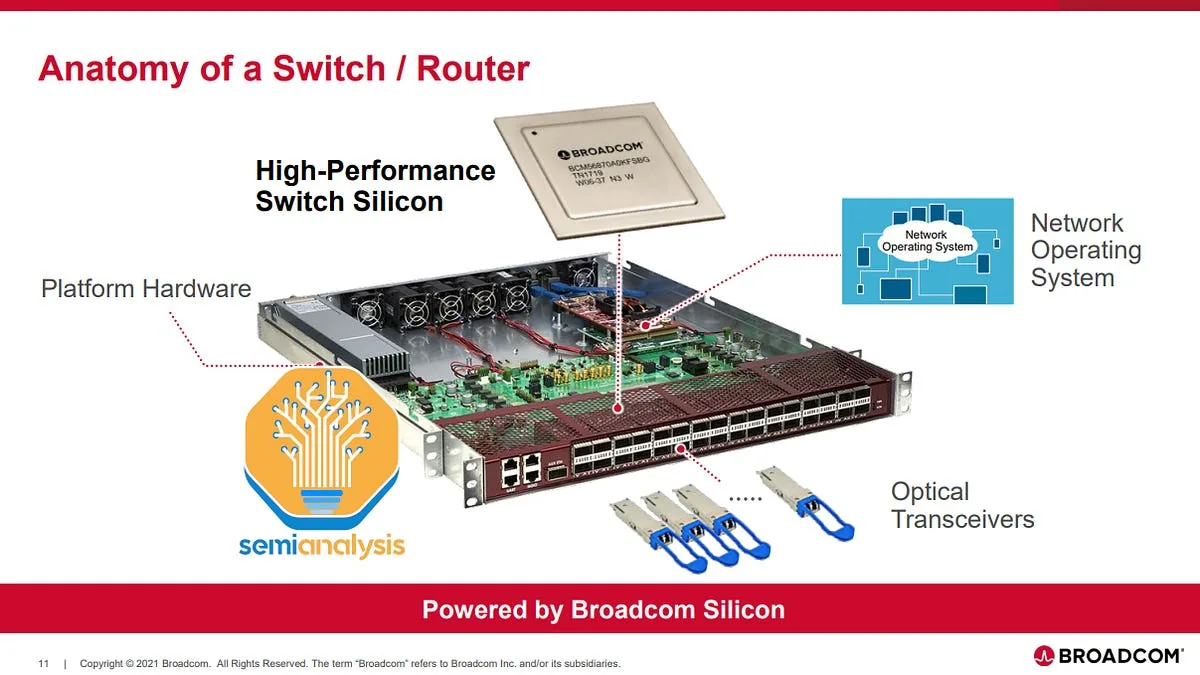
According to a report by Tencent Stock citing foreign media, Broadcom, the world's second-largest chip company with a market cap of about $1.74 trillion, is facing a domestic investigation in China. The probe focuses on the use of its chips in switches deployed in state-owned data centers. Broadcom's Tomahawk and Trident series hold an estimated 70-80% share of the global commercial switch chip market. The article argues that this dependence makes switch chip localization urgent for AI infrastructure, as switches are critical for routing data between GPUs during AI training. While Chinese switch makers like Huawei, H3C, and Ruijie dominate the domestic market, a chip-level gap persists: Broadcom's 102.4T Tomahawk 6 chip is two generations ahead of domestic competitor Shengke Communication's 25.6T chip. However, ZTE Microelectronics' 51.2T switch chip has passed verification with major cloud providers and is expected to begin mass external supply in Q3 2026.
Read sourceChina Probes State Data Centers' Use of Broadcom Switches to Boost Domestic AI Chips
Sources say China's State-owned Assets Supervision and Administration Commission (SASAC) has been investigating the number of Broadcom switches in state-owned data centers over recent weeks. The probe aims to support a 'domestic chips for domestic use' policy, reducing reliance on foreign AI infrastructure. Initial findings suggest Broadcom's penetration in state-owned enterprises may be as high as 90%. This could lead to informal guidance to cut Broadcom switch usage, potentially opening billions in sales for local suppliers. While Nvidia products are already banned in state data centers, Broadcom switches remain prevalent. China is also examining whether Broadcom uses its market position to bundle products or impose large purchase requirements. The investigation does not apply to private companies like ByteDance or Alibaba, and existing equipment will not be removed, according to sources. The move is part of a broader 'supply chain nationalization' policy.
Read sourceShow 2 older updatesHide older updates
China Probes Broadcom Switch Use in State Data Centers to Boost Domestic AI
According to a Financial Times report on Wednesday, citing sources, Chinese authorities are investigating the use of Broadcom hardware in state-owned data centers. The probe, conducted by the State-owned Assets Supervision and Administration Commission (SASAC) in recent weeks, aims to assess the deployment of Broadcom switches. The investigation found that Broadcom switches may account for up to 90% of equipment in use. Based on these preliminary findings, SASAC may issue non-binding guidance to reduce the use of Broadcom switches as part of Beijing's 'domestic chips for domestic use' campaign. This initiative seeks to expand the public sector's adoption of Chinese-made semiconductors and AI technologies, reducing reliance on foreign AI infrastructure amid US-China competition. Reuters could not independently verify the report. Broadcom and SASAC did not immediately respond to requests for comment. The report notes that Broadcom, along with Nvidia and China's Huawei, sells high-end switches domestically, and while Nvidia products are already banned from state data centers, Broadcom switches remain widely present.
China weighs curbs on Broadcom switches used in up to 90% of state-backed data centres
The Financial Times reports that China's State-owned Assets Supervision and Administration Commission (SASAC) has spent recent weeks surveying Broadcom switch use across state-controlled data centres. The review targets high-speed switches that move data between accelerators during AI training and inference, a crucial layer of AI infrastructure. The report notes that Broadcom switches may account for up to 90% of state-backed data-centre deployments, and that China is now weighing curbs on them as part of its broader focus on hardware independence.
Read source