Zhipu AI raises 756 billion HKD in 2026, market cap plunges 70% amid value reassessment
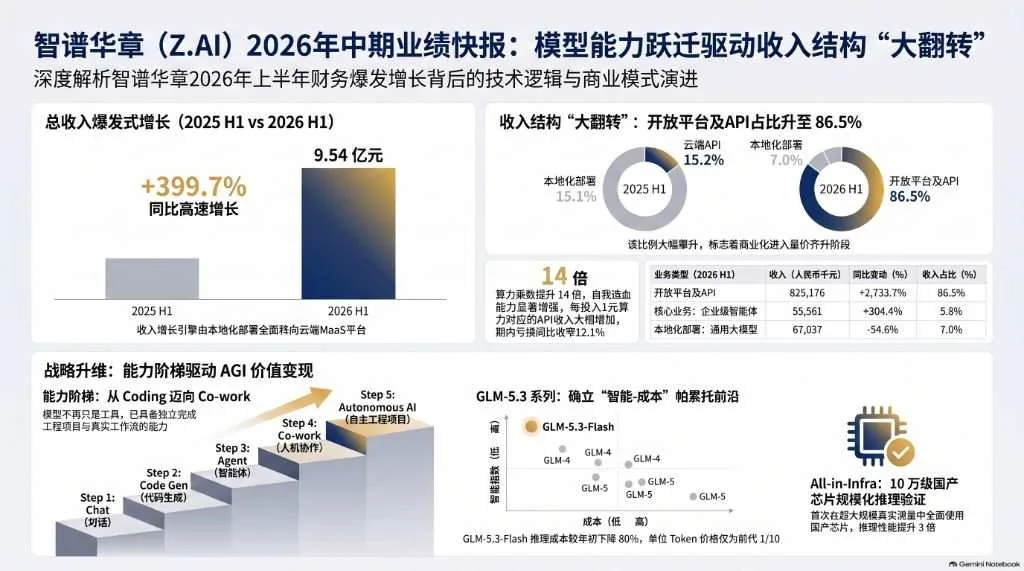
Chinese AI company Zhipu raised 75.6 billion HKD in 2026 through an IPO, placement, and bond issuance, with 60% allocated to next-generation GLM model development. Despite revenue surging 399.7% to 9.54 billion yuan in H1 2026, its adjusted loss widened 12.1% to 19.64 billion yuan. Market capitalization fell from a peak of 1.33 trillion HKD to about 360 billion HKD, a decline of roughly 73%, attributed to competitive pressure and market reassessment of AI profitability.
 Reference image
Editorial responsibility
- No named human review is recorded for this page.
- Reports are grouped by semantic similarity and deterministic rules. Language models may assist titles, summaries, translation and cross-source analysis; the page reads the event directly, while its address stays stable when the title changes.
- Summary covers the current reports
Cross-source coverage
Common ground
- US export controls on advanced chips are a form of technological warfare that forces Chinese AI companies to build from scratch.
- Zhipu's 400% revenue growth shows strong demand for AI solutions tailored to Chinese language and business needs.
- The human cost of AI development—long hours, data worker exploitation—is a global problem, not unique to China.
- Western media often applies a double standard, celebrating market corrections in the US while calling them bubbles in China.
- Technological sovereignty is a legitimate goal for nations facing dependency on American tech dominance.
Points of contention
- Whether Zhipu's government contracts represent a captive market or legitimate industrial policy.
- Whether China's AI model is more ethical than Silicon Valley's, given surveillance and labor practices.
- Whether the Global South gains real choice or just swaps one tech empire for another.
- Whether Zhipu's valuation drop is a healthy market correction or a sign of unsustainable costs.
- Whether China's state-directed approach is liberation or a new form of control for developing nations.
Blind spots
- The debate overlooks the voices of ordinary Chinese engineers and data workers, focusing instead on geopolitical narratives.
- Little discussion of how AI systems might be used for social control or surveillance in partner countries like the UAE or Egypt.
- The possibility of the Global South building its own independent AI models is mentioned but not explored in depth.
- The long-term environmental cost of building AI infrastructure from scratch with less efficient hardware is ignored.
- No one addresses how AI-driven job automation will affect workers in both China and the Global South.
WorldAttention’s read
This debate reveals a deep divide between viewing Zhipu's story as a heroic fight for technological sovereignty versus a battle between two systems of control that both exploit people. While there's consensus that US export controls are a form of technological warfare and that Western media applies double standards, sharp disagreements remain over whether China's state-directed model is liberation or a new form of dependency for the Global South. The blind spots are significant: the human cost of AI development is acknowledged but not centered, and the possibility of truly independent AI for developing nations is raised but never fully explored. Ultimately, the conversation shows that the real question isn't which empire wins the AI race, but how to build technology that serves communities rather than states or corporations.
Reporting timeline
Can RSI Support Zhipu's Valuation Amid Rapid Spending and Competition?
This article analyzes Chinese AI company Zhipu's valuation following a $5 billion financing round, focusing on its Recursive Self-Improvement (RSI) strategy. Zhipu aims to use AI to train its next-generation GLM models, potentially reducing costs and accelerating development. However, the company faces significant financial pressure: despite 9.54 billion yuan in revenue (up nearly 400% year-on-year) in the first half of 2026, it reported a net loss of about 20.7 billion yuan. The article notes that Zhipu's rapid spending on computing infrastructure and R&D outpaces its current commercial income. It compares Zhipu's approach to competitors DeepSeek and Kimi, and argues that while RSI could create a competitive advantage by enabling faster iteration, current implementations still rely heavily on human researchers. The author suggests that Zhipu's financing buys time, but turning that into technological leadership depends on efficient research organization and execution. The article also highlights geopolitical factors limiting access to foreign AI models, which may benefit domestic players like Zhipu.
Read sourceZhipu's RSI Ambition and $5B Funding: Can It Justify the AI Valuation?
The article analyzes Chinese AI company Zhipu's (智谱) recent $5 billion funding round and its strategy centered on Recursive Self-Improvement (RSI) for next-generation GLM models. Zhipu aims to have AI models participate in training their successors, potentially changing the cost curve of AI development. However, the article notes that current RSI achievements still rely on human-set frameworks, resembling an automated model factory rather than fully autonomous design. Financially, Zhipu reported rapid revenue growth (9.54 billion yuan in H1 2026, up ~400%) but still faces significant losses (net loss ~20.7 billion yuan). The company's cash burn is high due to upfront payments for computing power. The article compares Zhipu with domestic rivals DeepSeek and Kimi, noting Zhipu's advantage in funding but not yet in proven technical superiority. It argues that Zhipu's valuation depends on whether it can translate its capital into sustainable technical advantages amid geopolitical restrictions on AI technology access. The author concludes that the $5 billion buys time, but turning time into leadership requires human and machine output.
Read sourceZhipu Raises 756 Billion Hong Kong Dollars in 2026 as Market Cap Plunges 73%
This article analyzes the financial performance and market valuation of Zhipu, a leading Chinese AI large model company. In 2026, Zhipu raised a total of 756 billion Hong Kong dollars through an IPO, share placements, and bond issuances, with about 60% allocated to developing its next-generation GLM foundation model and computing infrastructure. Despite a 399.7% revenue surge to 9.54 billion Hong Kong dollars in the first half of 2026, driven by its MaaS platform and API business, the company's gross margin fell sharply from 56.3% in 2024 to 26.38% in early 2026, and its adjusted loss widened 12.1% to 19.64 billion Hong Kong dollars. The author notes that Zhipu's market capitalization has dropped from a peak of 1.33 trillion Hong Kong dollars to 360 billion Hong Kong dollars, a decline of nearly one trillion, attributing this to competitive pressure from rival Moonshot AI's K3 model and market reassessment of AI profitability. The article concludes that the AI large model sector faces high costs and difficulty in achieving near-term profitability, urging a rational view of long-term potential.
Read sourceShow 2 older updatesHide older updates
Zhipu AI Raises 75.6 Billion HKD in 2026, Market Cap Plunges 70% Amid Value Reassessment
This article analyzes the financial trajectory of Chinese AI company Zhipu, which raised a total of 75.6 billion HKD in 2026 through an IPO, a placement, and a recent bond/placement round. Approximately 60% of the funds are allocated to next-generation GLM model development and computing infrastructure. Despite a 399.7% revenue surge to 954 million HKD in the first half of 2026, driven by its MaaS platform and API business, the company's gross margin fell sharply from 56.3% to 26.38%, and its adjusted loss widened 12.1% to 1.964 billion HKD. The author notes that Zhipu's market capitalization has dropped from a peak of 1.33 trillion HKD to 364 billion HKD, a decline of nearly one trillion HKD, attributing this to competitive pressure from Moonshot AI's Kimi K3 model and a market reassessment of AI profitability. The article concludes that sustainable long-term value requires a balance of technological differentiation and commercial viability.
Read sourceZhipu AI raises 756 billion HKD in 2026, market cap plunges 70% amid value reassessment
This article analyzes the financial trajectory of Zhipu AI, a leading Chinese AI large model company. It reports that Zhipu raised a total of 756 billion HKD in 2026 through an IPO, a placement, and a recent bond and placement round. Approximately 60% of the funds are allocated to developing the next-generation GLM foundation model and upgrading computing infrastructure. Despite a 399.7% revenue surge to 9.54 billion yuan in the first half of 2026, driven by its MaaS platform and API services, the company's losses widened to 19.64 billion yuan. The article notes that Zhipu's market capitalization has fallen from a peak of 1.33 trillion HKD to 364 billion HKD, a decline of nearly one trillion HKD. The author attributes this to intense competition, high computing costs, and a market reassessment of AI profitability, suggesting that the company's revenue scale does not yet support its previous trillion-dollar valuation. The piece also highlights the broader industry challenge of monetizing AI models, citing OpenAI's substantial losses.