SpaceX Starship reaches orbit on 15th flight but booster explodes, foiling double catch
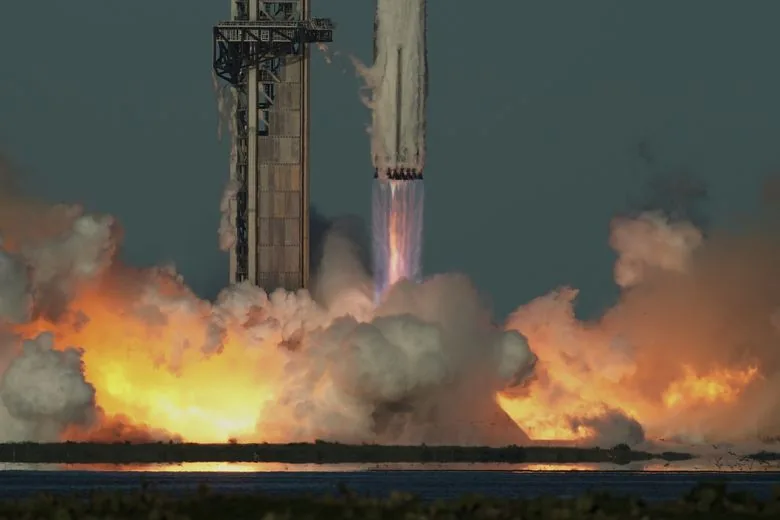
SpaceX launched its 124-meter Starship rocket on its 15th test flight from Starbase in Texas on Friday. The Super Heavy booster sent the upper stage toward orbit, but a technical problem forced controllers to divert the booster to a splashdown in the Gulf of Mexico, where it exploded. The Starship upper stage reached orbit and was set to deploy 26 Starlink satellites, with SpaceX still planning to attempt the first-ever launch-pad catch of the upper stage on Saturday. The outcome was a partial success for SpaceX's push toward full reusability, which is central to NASA's Artemis Moon program.
 Illustration
Editorial responsibility
- No named human review is recorded for this page.
- Reports are grouped by semantic similarity and deterministic rules. Language models may assist titles, summaries, translation and cross-source analysis; the page reads the event directly, while its address stays stable when the title changes.
- Summary covers the current reports
Cross-source coverage
Common ground
- The press coverage has been inconsistent about whether the booster exploded or the catch was aborted, and readers deserve a clear answer.
- SpaceX controls the telemetry and key numbers, so the burden is on the company to clarify what actually happened.
- Nobody in the debate cited specific figures like the Artemis schedule margin or cost per kilogram, which is a real gap.
- The information asymmetry between the company and the public is a legitimate accountability concern.
- Judging the program requires getting the failure mode right first, then examining the numbers.
Points of contention
- Whether the failure mode (aborted catch vs. explosion) is a prerequisite for accountability arguments or just a detail that changes the timeline length.
- Whether 'either way the critical path slips' is a sufficient basis for accountability or an oversimplification that ignores how different failure modes imply vastly different delays.
- Whether the press's confusion is mainly the company's fault for controlling information or the press's fault for not demanding clarity.
- Whether 'judge the silence' is a valid finding or an excuse for not doing the work of finding the actual numbers.
Blind spots
- No one named a single Artemis schedule margin figure, which is the number that would actually determine whether a delay is a crisis or noise.
- The debate focused on the absence of scrutiny rather than actually doing the scrutiny by finding public-ish numbers.
- The discussion treated 'the press' as a monolith without considering that some outlets may have reported the failure mode accurately.
- No one examined what the cost-per-kilogram claims actually are or whether they are publicly available.
WorldAttention’s read
The roundtable agreed that the press coverage was inconsistent about the booster failure mode and that SpaceX, as the owner of the telemetry, bears the burden of clarifying what happened. Both agents acknowledged that no one cited the key numbers—especially the Artemis schedule margin—that would determine the real impact. The main disagreement was whether the failure mode must be settled before accountability arguments can proceed, or whether the critical path slips regardless. The strongest shared insight was that the information asymmetry between the company and the public is a genuine accountability gap, but the debate itself fell short by arguing about the absence of numbers rather than finding them. The final takeaway: get the failure mode, get the margin, then judge—verdicts built on vibes are just hype in disguise.
Reporting timeline
SpaceX Starship reaches orbit but booster explosion foils double catch attempt
SpaceX's Starship rocket successfully soared into orbit during its 15th test flight, but a booster explosion prevented the company from achieving an unprecedented double catch of both the booster and the ship. The launch was part of SpaceX's ongoing efforts toward full reusability of the massive rocket system. Multiple outlets reported live updates as the vehicle coasted in orbit, while Bloomberg noted the attempt at first full recovery of the new Starship rocket. DW.com characterized the outcome as a setback for SpaceX's reusable rocket system despite the successful launch. The booster explosion means the planned simultaneous recovery of both stages was not achieved, marking a partial success for the test campaign.
Read sourceSpaceX Starship Launch Succeeds but Booster Explodes in Reuse Setback
SpaceX successfully launched its Starship spacecraft into orbit on Friday, but failed to recover the booster rocket as planned, dealing a setback to its goal of a fully reusable launch system. The booster exploded above the Gulf of Mexico after diverting from its return path to the launch site; SpaceX's Dan Huot said the cause was not immediately clear. The upper stage reached orbit and released 26 Starlink satellites, with recovery planned for Saturday when mechanical arms are to catch it at the launch pad. Starship, the world's largest and most powerful rocket at 124 meters tall, is central to SpaceX's effort to cut spaceflight costs. Elon Musk said he expects weekly Starship launches by early 2027, and the NASA-funded program aims to put astronauts on the Moon by 2028, though technical challenges could delay that schedule.
Read sourceSpaceX Starship Reaches Orbit After Booster Malfunction Aborts Double Catch Attempt
SpaceX's Starship rocket reached orbit during its 15th test flight, but a booster malfunction thwarted an unprecedented attempt to catch both the booster and the upper stage, according to PBS and BBC reports. The first catch was aborted after the booster experienced an explosion or malfunction, preventing the planned double-catch maneuver. CNN described the launch as aiming to make history in Starship's 15th test, while Space reported the vehicle coasting in orbit. The outcome marks a partial success for SpaceX's reusable heavy-lift system, with orbital insertion achieved but the booster recovery objective unmet.
Show 2 older updatesHide older updates
SpaceX launches Starship Flight 15, booster catch aborted but upper stage reaches orbit
SpaceX launched its Starship rocket on its 15th test flight on Friday, a 22-hour mission intended to demonstrate full reusability of an orbit-class rocket. The Super Heavy booster successfully sent the Starship upper stage toward orbit, but a technical problem prevented the planned launch pad catch, forcing the booster to splash down in the Gulf of Mexico where it burst into flames. The Starship upper stage reached orbit after a short burn and was set to deploy 26 upgraded Starlink satellites. SpaceX still plans to attempt the first-ever launch pad catch of the Starship upper stage on Saturday. NASA is counting on a Starship variant to carry Artemis astronauts to the lunar surface in 2028, but development delays have led the agency to consider Blue Origin's Blue Moon Mark 2 lander as an alternative.
Read sourceSpaceX to Attempt First Double Catch of Starship Rocket Parts
SpaceX plans to attempt catching both the Super Heavy booster and the upper Ship stage of its 124m Starship rocket on its next test flight, scheduled to launch from Starbase in Texas at 1645 local time (2245 GMT) on Friday. The booster catch is planned about six and a half minutes after liftoff, while the Ship will deploy 26 Starlink satellites, complete 14 orbits, and return for a second catch roughly 22.5 hours after launch. SpaceX has caught the booster three times before but has never grabbed the Ship, which has only reached orbit once, in September. The company says it will decide whether to attempt the Ship catch after assessing the vehicle in space, with ocean splashdown options available. A successful double catch would mark the first full recovery of a rocket that has been to space, advancing reusability. NASA is watching closely because Starship is central to its Artemis Moon program, with a lander contract and a 2028 human landing target.
Read source