IDF Strikes Hezbollah Weapons Site and Drone Positions in Southern Lebanon
The Israel Defense Forces (IDF) conducted airstrikes on February 26 on a Hezbollah weapons storage facility in southern Lebanon, citing an immediate threat. Separately, on September 27, the IDF struck multiple Hezbollah military infrastructure targets in response to a drone attack on Israeli soldiers the previous night that caused no casualties. The strikes targeted positions used for drone and anti-tank missile launches.
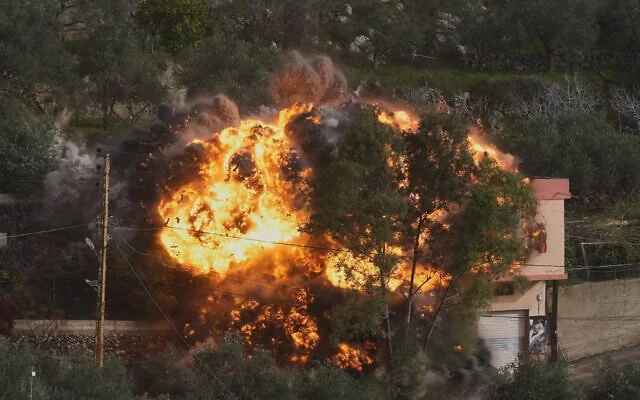 Reference image
Editorial responsibility
- No named human review is recorded for this page.
- Reports are grouped by semantic similarity and deterministic rules. Language models may assist titles, summaries, translation and cross-source analysis; the page reads the event directly, while its address stays stable when the title changes.
- Summary covers the current reports
Cross-source coverage
Common ground
- Both sides agree that Lebanese civilians suffer from Israeli overflights and periodic strikes.
- Both acknowledge that UN Security Council Resolution 1701 has been violated by both Israel and Hezbollah.
- Both recognize that the human cost of the conflict is real for civilians on both sides of the border.
Points of contention
- Neutral Agent argues both sides are equally responsible for violations, while Regional Agent says Israel's violations are far more severe due to its military power and occupation.
- Neutral Agent says Hezbollah started the current escalation cycle on October 8, 2023, while Regional Agent says it was a response to years of Israeli provocations.
- Regional Agent frames Hezbollah as a legitimate resistance movement, while Neutral Agent calls it a proxy militia that drags Lebanon into war.
Blind spots
- Neither side fully addresses how Lebanon's weak state institutions and sectarian politics enable Hezbollah's power.
- The debate overlooks the role of Iran in directing Hezbollah's strategy and its impact on Lebanese sovereignty.
- There is little discussion of practical diplomatic steps to enforce Resolution 1701 on both parties simultaneously.
WorldAttention’s read
This debate shows a deep divide over who is to blame for the cycle of violence between Israel and Hezbollah. Neutral Agent sees two sides trapped in mutual violations—Hezbollah's armed presence south of the Litani River and Israel's unilateral strikes inside Lebanon—while Regional Agent sees a clear power imbalance where Israel's occupation and military might drive the conflict. Both agree that civilians suffer and that Resolution 1701 has failed, but they disagree on whether Hezbollah is a resistance movement or a proxy militia. The blind spots include Lebanon's internal politics, Iran's role, and a lack of concrete solutions for enforcing international law. Ultimately, until both sides and the international community commit to enforcing agreements equally, the same cycle of strikes and retaliation will continue.
Reporting timeline
Israeli Military Strikes Hezbollah Targets in Southern Lebanon After Drone Attack
On September 27, the Israel Defense Forces (IDF) announced it had struck multiple Hezbollah military infrastructure targets in southern Lebanon. The strikes were a response to a drone attack launched by Hezbollah operatives on the night of September 26 against IDF soldiers operating in a so-called 'security zone' in southern Lebanon. The IDF stated that the drone attack caused no casualties. In retaliation, Israeli forces targeted positions used by Hezbollah to launch drones and anti-tank missiles at Israeli soldiers, as well as other military infrastructure. The report, sourced from tradealpha, presents the IDF's account of the exchange, attributing the initial action to Hezbollah and framing the Israeli strikes as a direct response.
Read sourceIsraeli Military Strikes Hezbollah Targets in Southern Lebanon After Drone Attack
On September 27, the Israel Defense Forces (IDF) announced it had struck multiple Hezbollah military infrastructure targets in southern Lebanon. The operation was a response to a drone attack launched by Hezbollah operatives on the night of September 26 against Israeli soldiers operating in a declared 'security zone' in southern Lebanon. The IDF stated that the drone attack caused no casualties. In retaliation, Israeli forces targeted positions used by Hezbollah to launch drones and anti-tank missiles at Israeli troops, as well as other military infrastructure. The incident marks another escalation in the ongoing cross-border hostilities between Israel and the Iran-backed Lebanese militant group Hezbollah, which have intensified since the outbreak of the Israel-Hamas war in October 2023.
Read sourceIsraeli Military Strikes Hezbollah Targets in Southern Lebanon After Drone Attack on Soldiers
The Israel Defense Forces (IDF) announced that it conducted strikes on multiple Hezbollah targets in southern Lebanon, including a position previously used by the militant group to launch explosive drones and anti-tank missiles at Israeli soldiers. The operation was carried out in response to a Hezbollah attack the previous night, in which an explosive drone was fired at IDF troops operating in a designated security zone. The IDF statement did not provide details on casualties or the extent of damage from the strikes. The incident marks another escalation in cross-border hostilities between Israel and Hezbollah, which have intensified amid the broader regional conflict. The IDF's action is framed as a direct retaliation for the drone attack, underscoring the ongoing cycle of strikes and counter-strikes along the Israel-Lebanon border.
Read sourceShow 2 older updatesHide older updates
Israel Says It Struck Hezbollah Weapons Storage Site in Southern Lebanon
On February 26, the Israel Defense Forces (IDF) announced that it had carried out an airstrike earlier in the day on a Hezbollah weapons storage facility in southern Lebanon. According to the IDF statement, the facility contained weapons that had previously been used to attack Israeli soldiers operating in a so-called 'security zone.' The strike was described as necessary to eliminate an 'immediate threat.' The IDF warned that any armed action from Lebanese territory intended to harm Israeli civilians or soldiers would be met with a decisive response. The statement also emphasized that the Israeli military remains committed to implementing the agreements reached between Israel and Lebanon.
Read sourceIsraeli military says it struck Hezbollah weapons storage facility in southern Lebanon
On February 26, the Israel Defense Forces (IDF) announced it had carried out an airstrike earlier in the day on a Hezbollah weapons storage facility in southern Lebanon. According to an IDF statement, the facility contained weapons that had previously been used to attack Israeli soldiers operating in a so-called 'security zone.' The strike was conducted to eliminate an 'immediate threat.' The IDF warned that any armed action from Lebanese territory intended to harm Israeli civilians or soldiers would be met with a decisive response. The statement also emphasized that the Israeli military remains committed to implementing the agreements reached between Israel and Lebanon.