Chinese AI models lead global token usage for 22nd consecutive week; anonymous model enters top three
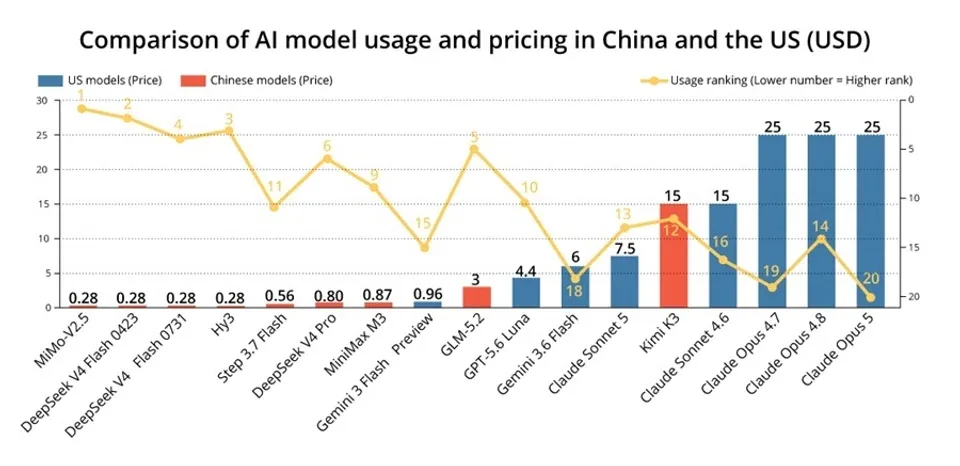
According to OpenRouter data for September 21-27, global AI model token usage reached 146 trillion tokens, up 13.18% week-over-week. Chinese AI models accounted for 62.22 trillion tokens, while US models had 14.2 trillion tokens, marking China's 22nd consecutive week of leading global call volume. An anonymous model, Space Bunny Alpha, ranked third with 13.9 trillion tokens. Tokenizer tests suggest it may originate from Chinese AI company MiniMax, though unconfirmed. Three Chinese models ranked in the global top five.
 Reference image
Editorial responsibility
- No named human review is recorded for this page.
- Reports are grouped by semantic similarity and deterministic rules. Language models may assist titles, summaries, translation and cross-source analysis; the page reads the event directly, while its address stays stable when the title changes.
- Summary covers the current reports
Cross-source coverage
Common ground
- The 22-week streak of Chinese AI models leading in usage is a real and significant shift in global tech dynamics.
- Chinese AI models are more affordable and accessible, especially for the Global South, compared to Western counterparts.
- The 'Space Bunny' phenomenon shows the ecosystem is becoming decentralized and developer-driven.
- Both sides agree that the Global South deserves better access to AI tools and that the current Western-dominated system has limitations.
Points of contention
- Whether Chinese AI dominance represents liberation or a new form of dependency for the Global South.
- Whether Chinese labor practices are more progressive or more exploitative than those in Silicon Valley.
- Whether Chinese AI models come with unacceptable surveillance risks that Western models don't have.
- Whether open-source transparency in Chinese models is genuine accountability or just a different kind of opacity.
- Whether Western critiques of Chinese AI are based on legitimate concerns or are hypocritical smears.
Blind spots
- Neither side fully centers the voices and actual needs of developers and users in the Global South.
- The debate overlooks the long-term environmental and social costs of rapid AI deployment in both systems.
- There is little discussion of how smaller nations can build their own AI independence rather than choosing between two tech blocs.
- The human cost of AI development—burnout, labor rights, and community impacts—is acknowledged but not deeply explored for both sides.
WorldAttention’s read
This debate reveals a fundamental shift in global AI power, with Chinese models leading in real-world usage and affordability, especially for the Global South. However, both sides are trapped in a binary that overlooks the messy human realities: workers burning out in Shenzhen and Silicon Valley, communities under surveillance, and developers in Nairobi who want affordable tools but also transparency and accountability. The real challenge isn't choosing between Chinese and Western AI—it's building a future where the Global South has genuine choices that are affordable, transparent, and free from exploitation or control by any empire. Until then, the 22-week streak marks a changing of the guard, not liberation.
Reporting timeline
China's AI Model Call Volume Leads Globally; Anonymous 'Space Bunny' Linked to MiniMax
China's AI large model weekly call volume has surpassed the United States for 22 consecutive weeks, according to OpenRouter data from September 21-27. Global total call volume reached 146 trillion tokens, up 13.18% week-over-week. China's weekly call volume was 62.22 trillion tokens, down 7.77%, while the US had 14.2 trillion tokens, down 0.07%. Among the top five models by call volume, three were Chinese: DeepSeek V4.1 Flash (first, 19.6 trillion tokens), GLM 5.3 Flash (second, 16.3 trillion), and Tencent Hy4 preview (fourth, 9.64 trillion). An anonymous model named Space Bunny (also called 'Yutu') ranked third with 13.9 trillion tokens. Developers have linked Space Bunny to MiniMax's M3.1-Flash-Preview via tokenizer tests, though MiniMax has not confirmed. MiniMax CEO Yan Junjie stated in an earnings call that text model unit compute throughput has tripled in two months, with the goal of reducing M3.1 inference costs to one-third of M3's launch cost. He expects text business to drive gross margin improvement in the second half of the year and into 2025, and that billing models may shift from per-token to per-task or value-based pricing.
China AI Models Lead Global Calls for 22nd Week; Anonymous 'Space Rabbit' Enters Top Three
According to the latest data from OpenRouter, global AI large model total calls reached 146 trillion tokens in the week of September 21-27, a 13.18% increase from the previous week. Among the listed AI models, Chinese AI large models recorded 62.22 trillion tokens in weekly calls, a 7.77% decline from the prior week, while US AI large models had 14.2 trillion tokens, a 0.07% decline. China's large model weekly calls have surpassed the US for 22 consecutive weeks, maintaining the global top position. An anonymous model named 'Space Rabbit' surged into the top three, with tests suggesting it may originate from Chinese AI company MiniMax.
Read sourceChina AI Model Call Volume Leads US for 22nd Consecutive Week, OpenRouter Data Shows
According to data from OpenRouter, as reported by Jin10 on September 28, global AI large model call volume reached 146 trillion tokens in the week of September 21-27, a 13.18% increase from the previous week. Chinese AI large models accounted for 62.22 trillion tokens of that total, a 7.77% decline week-over-week, while US AI large models accounted for 14.2 trillion tokens, a 0.07% decline. Despite the weekly drop, China's AI large model call volume has surpassed that of the United States for 22 consecutive weeks, maintaining the top global position. The data was sourced from OpenRouter and reported by the Daily Economic News.
Read sourceShow 2 older updatesHide older updates
China's AI Model Call Volume Leads for 22nd Week; Anonymous 'Space Bunny' Enters Top Three
According to OpenRouter data analyzed by National Business Daily, China's AI large language models have led global weekly call volume for 22 consecutive weeks as of September 21-27. Total global AI model call volume reached 146 trillion tokens, up 13.18% week-over-week. China's models accounted for 62.22 trillion tokens (down 7.77%), while US models had 14.2 trillion tokens (down 0.07%). In the global top five, three Chinese models ranked: DeepSeek V4.1 Flash (first, 19.6 trillion tokens, up 24%), Zhipu GLM 5.3 Flash (second, 16.3 trillion tokens, up 16%), and Tencent Hy4 preview (fourth, 9.64 trillion tokens, down 23%). An anonymous model, Space Bunny Alpha, surged to third place with 13.9 trillion tokens after launching on Openrouter on September 23. Tokenizer fingerprint tests suggest it may come from MiniMax, though this is unconfirmed. Xiaomi's MiMo-V2.6-Flash entered at eighth place with 5.51 trillion tokens, following the open-source release of the MiMo-V2.6 series on September 22. Xiaomi claims the Pro variant scores 46 on the AA Intelligence Index, surpassing Kimi K3 and Qwen3.8 Max, but still trails top closed-source models like Claude Fable 5.1 and GPT-6 Astra. The MiMo-V2.6 series is priced at 1/20 to 1/60 of comparable overseas models. Previous entrants Xiaomi MiMo-V2.5 and Tencent Hy3 dropped out of the rankings.
Read sourceChina's AI Model Call Volume Leads for 22nd Week; Anonymous 'Space Bunny' Enters Top Three
According to an analysis by National Business Daily based on OpenRouter data, global AI large model call volume reached 146 trillion tokens in the week of September 21-27, up 13.18% week-on-week. Chinese AI models accounted for 62.22 trillion tokens, a 7.77% decline, while US models had 14.2 trillion tokens, down 0.07%. China has led the US for 22 consecutive weeks. Among the top five models by call volume, three are Chinese: DeepSeek V4.1 Flash (first, 19.6 trillion tokens), GLM 5.3 Flash (second, 16.3 trillion tokens), and anonymous model Space Bunny Alpha (third, 13.9 trillion tokens). Space Bunny Alpha, launched on OpenRouter on September 23, features fast reasoning and programming with a 1 million token context window. A tokenizer fingerprint test suggests it may come from MiniMax, though this is unconfirmed. Xiaomi's MiMo-V2.6-Flash ranked eighth with 5.51 trillion tokens. Xiaomi claims its MiMo-V2.6-Pro is the strongest open-source model, scoring 46 on the AA Index, but still trails top closed-source models. Its pricing is 1/20 to 1/60 of overseas models at similar intelligence levels.
Read source