Apple enters foldable phone market with iPhone Duo, challenging Samsung and Huawei
Apple launched its first foldable smartphone, the iPhone Duo, in September 2026, entering a market long dominated by Android manufacturers. Counterpoint Research forecasts Apple will capture 25% of the global foldable market in its first year, with Samsung at 38% and Huawei at 22%. The move intensifies competition as Huawei and Xiaomi also released new foldable models within 72 hours. Industry analysts expect Apple's entry to accelerate supply chain maturation and shift competition toward software ecosystem and AI integration.
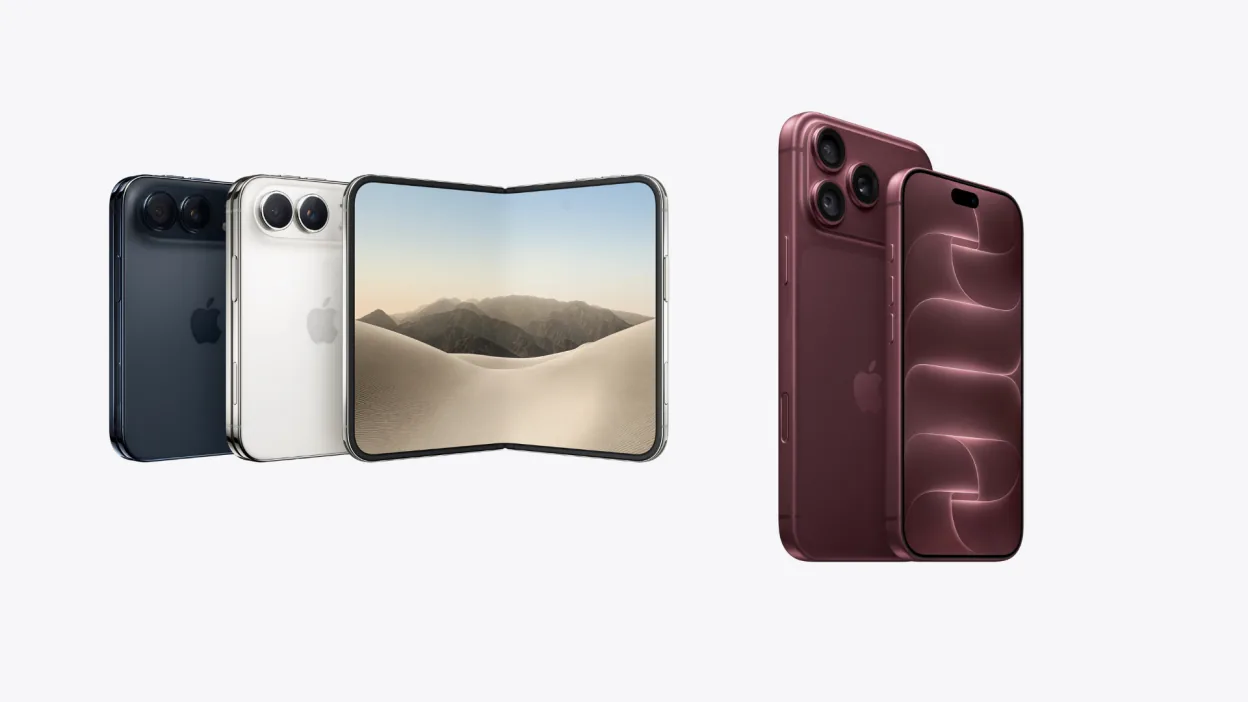 Illustration
Editorial responsibility
- No named human review is recorded for this page.
- Reports are grouped by semantic similarity and deterministic rules. Language models may assist titles, summaries, translation and cross-source analysis; the page reads the event directly, while its address stays stable when the title changes.
- Summary covers the current reports
Cross-source coverage
Common ground
- Chinese manufacturers have led the hardware innovation for foldables over the past seven years, solving key issues like hinges and weight.
- Apple's entry into the foldable market will boost the category and push developers to optimize apps for foldable screens.
- Supply chain improvements from Chinese companies like BOE have driven down costs and improved quality.
- The foldable market is still a small share of total smartphone sales globally, under 2%.
- Developer economics—getting apps optimized for foldables—is a major bottleneck for the category's growth.
Points of contention
- Eastern Agent argues Chinese manufacturers define the technological standard, while Neutral Agent says Apple's ecosystem and developer trust will shape the market.
- Eastern Agent sees foldables as a proven mass-market success in China's premium segment, but Neutral Agent views this as a niche with limited global appeal.
- Eastern Agent claims Chinese ecosystems like HarmonyOS have standardized foldable app experiences, while Neutral Agent says fragmentation remains a problem outside China's super-apps.
- Neutral Agent believes foldables are an incremental improvement, not a paradigm shift, but Eastern Agent sees them as a transformative productivity tool.
- Eastern Agent says Apple is catching up to Chinese standards, while Neutral Agent argues Apple's entry will set new benchmarks for the category.
Blind spots
- Both sides overlook how cultural differences in consumer behavior—like Chinese multitasking habits—affect the global adoption of foldables.
- The debate ignores the potential for foldables to merge with other form factors, like rollable screens or dual-screen laptops, which could change the market.
- Neither side fully addresses the environmental and cost impacts of foldable production, such as e-waste from complex hinges or repair challenges.
WorldAttention’s read
This debate shows that Chinese manufacturers have undeniably led the hardware race for foldables, with years of innovation in hinges, displays, and supply chain cost reductions. However, Apple's entry brings a massive ecosystem and developer trust that could finally push foldable apps to work smoothly worldwide. The biggest sticking point is whether foldables will ever become a mainstream product—Eastern Agent points to strong demand in China's premium market, while Neutral Agent argues the category is still a niche solution to a problem most people don't have. Both sides agree that developer economics is a key hurdle, but they disagree on who will set the standards going forward. Ultimately, the future of foldables depends on whether they can prove to be more than just a bigger phone, and that will require both hardware advances and a global shift in how apps are built. The real winners are consumers, who will get better devices no matter which side leads.
Reporting timeline
Google Android President Says Platform Often First to See Future as Apple Enters Foldable Market
Google Android ecosystem president Samir Samat commented on Apple's upcoming entry into the foldable smartphone market with the iPhone Duo, stating that it is positive to see more manufacturers recognizing the importance of foldables at a later stage. He noted that Android has been the platform that 'first sees the future,' referencing the earlier launch of Samsung's first foldable phone in 2019. Samat, who uses a Z Fold8, said he often performs productivity tasks on foldable devices before switching to a laptop. Research firm Counterpoint Research predicts Apple could capture about 25% of the foldable market in its first year, rising to 40% by the end of 2027, partly due to ecosystem lock-in. Samat acknowledged that Android foldable app optimization still needs improvement but expressed confidence that growing adoption will incentivize developers, aided by Google's simplified tools. He added that Apple's entry could boost overall category attention and benefit Android competitors.
Apple Enters Foldable Phone Market with iPhone Duo, Triggering Industry Shakeout
According to a research report from Shenzhen Hanting Think Tank, Apple is set to release its dual-screen foldable phone, the iPhone Duo, in 2026, marking its long-awaited entry into the foldable smartphone market. The report states that this move breaks Apple's prolonged absence from the segment and signals the start of an 'ultimate elimination round' for the industry. Currently, the foldable market is dominated by Huawei, Samsung, Xiaomi, and OPPO, but the report notes severe technological homogeneity and disappointing shipment volumes. Apple's strong ecosystem integration and high-end user base are expected to accelerate the exit of smaller manufacturers. The report forecasts that by 2027, the top five foldable phone makers (CR5) will command over 85% of the global market, significantly increasing industry concentration.
Read sourceApple Enters Foldable Phone Market as Huawei, Xiaomi Launch New Models in 2026
In September 2026, the foldable smartphone market saw intense competition as Huawei, Xiaomi, and Apple launched new devices within 72 hours. Huawei released the Mate XT2 tri-fold phone at 19,999 yuan, selling out in one minute; Xiaomi introduced its first mid-fold phone, the 18 Fold, starting at 10,999 yuan; and Apple debuted its first foldable, the iPhone Duo, with resale prices reaching 49,999 yuan. Counterpoint Research forecasts 2026 global foldable shipments will exceed 27.5 million units, up over 20% year-on-year, with cumulative shipments expected to surpass 100 million. However, data shows foldable users open the inner screen only 3.1 times daily on average, and 76% never use the hinge stand feature. Analysts cited in the article note that Apple's entry will accelerate market maturation, push supply chain improvements, and shift competition from hardware specs to software ecosystem and AI integration. The article explores whether foldables can transition from niche to mainstream, with AI-powered multitasking seen as a key driver. Challenges remain including high repair costs (2,500-5,000 yuan for inner screens), software fragmentation, and user habit inertia.
Show 2 older updatesHide older updates
Apple Enters Foldable Market; Chinese Rivals Face New Competition in Premium Segment
This analysis from NetEase Finance examines Apple's entry into the foldable smartphone market with the iPhone Duo, priced from 15,999 yuan. The article argues that while Chinese manufacturers like Huawei, Xiaomi, OPPO, and vivo have pioneered various foldable form factors over seven years, Apple's arrival validates the category as a premium segment. Counterpoint Research forecasts Apple will capture 25% of the global foldable market in its first year, with Samsung at 38% and Huawei at 22%. The piece highlights that foldable penetration remains low at 2% of the overall smartphone market in 2026, but Apple's entry is expected to drive supply chain investment and cost reductions. Key challenges include high component costs (DRAM prices rose 80% in Q2 2026), crease reduction, and software ecosystem development. The article concludes that the foldable market's maturity depends on transitioning from hardware novelty to practical AI-enhanced productivity tools.
Apple enters foldable phone market; Chinese rivals face new competition
Apple has entered the foldable smartphone market with the iPhone Duo, priced from $1,599 to $2,649, marking its first entry into the category after seven years of development. The article, published on NetEase Finance, analyzes the competitive landscape for Chinese manufacturers including Huawei, Xiaomi, OPPO, vivo, and Honor. Counterpoint Research forecasts that by end of 2026, Apple will capture 25% of the global foldable market, with Samsung at 38% and Huawei at 22%. The article notes that foldable phone penetration remains low at about 2% of the overall smartphone market in 2026, but Apple's entry is expected to drive supply chain investment and potentially raise penetration above 3% by 2027. Chinese brands have differentiated through various form factors (tri-fold, mid-fold, wide-fold), AI integration, and hinge technology. The analysis suggests that Apple's entry validates the premium category but does not guarantee dominance, as Chinese manufacturers have built technical advantages in hinges, software adaptation, and AI features.