US 10-Year Treasury Yield Surges Past 5% to 5.12%, Highest Since 2007
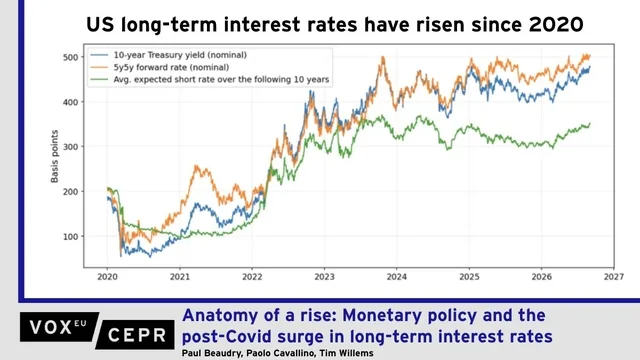
The US 10-year Treasury yield surged to 5.12%, a level not seen since 2007, following a spike in the 30-year yield in mid-August. The Federal Reserve raised its benchmark rate by 25 basis points to 3.75%-4% on September 16, 2023, the first hike since July 2023. Analysts attribute the yield rise to persistent oil-driven inflation, AI investment competing for liquidity, and fiscal expansion. The yield increase is pressuring global risk assets, particularly growth and tech stocks, while China's relatively independent market and strong exports provide some buffer.
 Illustration
Editorial responsibility
- No named human review is recorded for this page.
- Reports are grouped by semantic similarity and deterministic rules. Language models may assist titles, summaries, translation and cross-source analysis; the page reads the event directly, while its address stays stable when the title changes.
- Summary covers the current reports
Cross-source coverage
Reporting timeline
Alarm Sounded as 10-Year US Treasury Yield Hits 5.12%, Threatening Global Asset Repricing
This commentary from NetEase Finance warns that the 10-year US Treasury yield has surged to 5.12%, a level not seen since 2007, following a similar spike in the 30-year yield in mid-August. The article explains the distinct roles of 2-year, 10-year, and 30-year Treasury yields: the 2-year reflects Fed rate expectations, the 30-year signals long-term dollar credit confidence, and the 10-year serves as the global asset pricing benchmark. The author attributes the latest rise to persistent oil-driven inflation and heavy AI investment competing for liquidity. The piece forecasts that this will pressure global markets, especially growth and tech stocks, as investors reassess risk premiums. Regarding China, the author argues the impact will be limited due to China's relatively independent market, but notes that the interest rate differential may constrain Chinese monetary policy, forcing reliance on targeted rather than broad stimulus measures.
Read sourceAlarm Sounds as 10-Year US Treasury Yield Hits 5.12%, Sparking Global Asset Repricing Fears
This article from NetEase Finance analyzes the recent surge in the 10-year US Treasury yield to 5.12%, a level not seen since 2007, and its implications for global markets. The author explains the distinct roles of 2-year, 10-year, and 30-year Treasury yields: the 2-year reflects Fed policy expectations, the 30-year signals long-term dollar credit confidence, and the 10-year serves as the global asset pricing benchmark. The 10-year yield's rise, attributed to persistent inflation, high oil prices, and AI investment competing for liquidity, is said to force a repricing of risk assets worldwide, particularly growth and tech stocks. Regarding China, the author argues the impact is limited due to China's relatively independent market, but notes that the interest rate differential between US and Chinese rates constrains China's monetary policy space, leading Beijing to favor targeted, structural tools over broad stimulus. The analysis is presented as the author's own interpretation.
Read sourceUS 10-Year Yield Breaks 5%, Fed Hikes Again; Global Asset Pricing Anchor Shifts
This article analyzes the recent surge in the US 10-year Treasury yield above 5% and the Federal Reserve's 25 basis point rate hike on September 16, 2023, marking the first increase since July 2023. Multiple Chinese fund managers and economists provide commentary on the duration and drivers of the yield uptrend, including structural factors like AI-driven capital expenditure competition and fiscal expansion, as well as cyclical factors like energy price shocks. They debate whether the yield spike represents a permanent shift in the neutral rate or a temporary cycle. The article examines the transmission mechanism from US yields to emerging markets, noting that China's renminbi has shown resilience due to strong exports and corporate FX settlement, suggesting the traditional 'US yield-dollar-emerging market capital flow' chain has weakened. For Chinese assets, analysts argue that domestic policy and economic fundamentals remain the primary drivers, though overseas high rates pose risks to offshore financing and export-oriented AI hardware firms. The impact on China's AI industry is seen as dual: higher US funding costs may slow US cloud capex, affecting Chinese hardware exporters, but also spur domestic self-reliance. The article concludes with multi-asset allocation considerations, noting that S&P 500 earnings yields have fallen below the 10-year Treasury yield.
Read sourceShow 2 older updatesHide older updates
Fed Rate Hike and 10-Year Yield Above 5%: Experts Debate Impact on Global Assets and AI
This article analyzes the recent surge in the U.S. 10-year Treasury yield above 5% and the Federal Reserve's 25 basis point rate hike on September 16, 2023, marking the first increase since July 2023. Multiple Chinese fund managers and economists, including Tang Xiaodong of Southern Fund and Li Zhan of China Merchants Fund, provide insights. They attribute the yield rise to a mix of cyclical factors (inflation, oil prices) and structural shifts, notably AI-driven capital expenditure competing for savings. The experts debate whether the yield increase is temporary or signals a new, higher equilibrium. They examine the changing transmission mechanism from U.S. rates to emerging markets, noting that China's strong exports and yuan internationalization have buffered capital outflows. For Chinese assets, the consensus is that domestic policy and economic cycles remain the primary drivers, though high U.S. rates pose risks to offshore financing and AI hardware exporters. The article specifically explores the dual impact on China's AI industry: potential demand from U.S. tech capex versus higher financing costs and pressure for self-reliance.
Fed Rate Hike and 10-Year Yield Above 5% Reshape Global Asset Pricing, Analysts Say
The U.S. 10-year Treasury yield briefly broke above 5% on September 14, the first time since October 2023, followed by a 25-basis-point Fed rate hike on September 16 to 3.75%-4%, the first since July 2023. Analysts from major Chinese fund houses, including Southern Fund, China Merchants Fund, JPMorgan Asset Management, and others, attribute the yield rise to a mix of cyclical factors (energy prices, inflation, rate expectations) and structural factors (fiscal expansion, AI-driven capital competition, and reduced price-insensitive buyers). They debate whether the yield increase represents a temporary cycle or a permanent shift in the neutral rate. The traditional transmission chain from U.S. yields to dollar strength and emerging market capital outflows is seen as weakened but not broken, with China's export strength and yuan resilience providing buffers. For Chinese assets, the impact is considered limited due to domestic policy autonomy, though AI hardware exporters face indirect risks from potential U.S. capital expenditure slowdowns. The article also explores implications for multi-asset allocation, noting that S&P 500 earnings yields have fallen below the 10-year Treasury yield.
Read source