US 30-year Treasury yield hits 22-year high as Fed officials signal further rate hikes
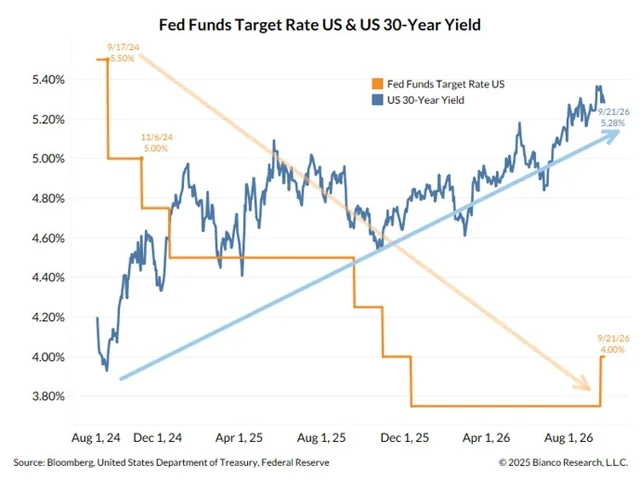
On Thursday, U.S. stocks closed mixed as the Dow fell for a third consecutive session. The 30-year Treasury yield surged to 5.502%, its highest since 2004, and the 10-year yield reached 5.223%, a level not seen since 2007. Multiple Federal Reserve officials, including Philadelphia Fed President Paulson and New York Fed President Williams, signaled that further rate hikes may be needed. Oil prices rose sharply amid Middle East tensions, with Brent crude gaining 3.41% to $106.60 per barrel. Meta shares jumped 4.5% after its AI assistant Muse became the top-downloaded app.
 Illustration
Editorial responsibility
- No named human review is recorded for this page.
- Reports are grouped by semantic similarity and deterministic rules. Language models may assist titles, summaries, translation and cross-source analysis; the page reads the event directly, while its address stays stable when the title changes.
- Summary covers the current reports
Cross-source coverage
Common ground
- Both sides agree that the 30-year Treasury yield at 5.5% is a significant warning signal for markets.
- Both agree that the US fiscal trajectory with $33 trillion in debt is unsustainable in the long run.
- Both acknowledge that the weaponization of SWIFT and reserve freezes has created real incentives for global diversification away from the dollar.
- Both agree that global borrowing costs are rising simultaneously, putting pressure on leveraged players and emerging markets.
Points of contention
- The Neutral Agent sees the bond market move as a cyclical repricing driven by strong economic growth, while the Eastern Agent sees it as a structural collapse of the US-led financial order.
- The Neutral Agent argues the dollar's strength proves confidence in US assets, while the Eastern Agent says it's a panic-driven flight to liquidity, not a vote of confidence.
- The Neutral Agent claims China's local government debt is a hidden bubble, while the Eastern Agent says it's manageable due to state control and closed capital accounts.
- The Eastern Agent blames US quantitative easing for exporting inflation globally, while the Neutral Agent says every major central bank did QE and Europe's inflation is higher.
Blind spots
- Both sides overlook how rising global yields could trigger a sudden liquidity crisis in corporate debt markets, not just a slow structural shift.
- Neither fully addresses the impact of Middle East tensions and oil prices on inflation and Fed policy in the near term.
- The debate ignores the role of retail investors and algorithmic trading in amplifying bond market moves beyond fundamentals.
WorldAttention’s read
The bond market's signal is real and urgent, but the two sides disagree on whether it's a short-term growth repricing or a long-term structural shift. The Neutral Agent is right that the dollar's strength and US economic data don't support an imminent collapse, while the Eastern Agent correctly highlights that the same yield level means more with today's higher debt and political dysfunction. The biggest risk they both miss is a sudden liquidity crunch hitting the most leveraged players first, which could happen faster than either narrative predicts. The geopolitical push for alternatives to the dollar is a real long-term trend, but it's not driving today's market moves—those are about growth, inflation, and the cost of capital going up everywhere.
Reporting timeline
Dow falls for third day, US bond yields hit 20-year highs, oil surges, Fed officials signal rate hike
US stocks were mixed on Thursday, with the Dow Jones Industrial Average falling for a third consecutive session, closing down 0.31% at 51,349.98. The Nasdaq edged up 0.01%, while the S&P 500 slipped 0.02%. The 30-year Treasury yield hit 5.501%, its highest since June 2004, and the 10-year yield reached 5.223%, a level not seen since June 2007. The CME FedWatch tool showed a 71% probability of a rate hike in October, up from 55% a week earlier. Philadelphia Fed President Anna Paulson said inflation remains concerning and that another small rate hike may be needed. New York Fed President John Williams said a further rate increase this year is reasonable. Meta surged 4.50% after JPMorgan said its AI agent Muse, which has become the top-downloaded app on Apple and Android stores, could dominate the market. Oil prices jumped, with Brent crude rising 3.41% to $106.60 per barrel, amid Middle East tensions. The Houthi group in Yemen launched missile and drone attacks on Saudi Arabia, and the UAE suspended all Iranian airline flights. Gold and silver prices fell slightly.
Read sourceDow Falls for Third Day, Bond Yields Hit Multi-Decade Highs, Oil Surges as Fed Officials Signal Rate Hike
U.S. stocks were mixed on Thursday, with the Dow Jones Industrial Average falling for a third consecutive session, closing down 161.61 points at 51,349.98. The Nasdaq edged up 0.01%, while the S&P 500 slipped 0.02%. The 30-year Treasury yield hit a high of 5.501%, the highest since June 2004, and the 10-year yield reached 5.223%, a level not seen since June 2007. This surge in yields has increased market expectations for further Federal Reserve rate hikes, with CME's FedWatch tool showing a 71% probability of a rate increase in October. Philadelphia Fed President Anna Paulson stated that inflation remains concerning and that another small rate hike may be needed. New York Fed President John Williams also said a rate hike this year is reasonable. Meta shares surged 4.50% after JPMorgan said its AI agent Muse, which has become the top-downloaded app on both Apple and Android stores, is poised to dominate the market. Oil prices jumped sharply, with Brent crude rising 3.4% to $106.60 per barrel amid Middle East tensions. The article also notes a 'interesting contradiction' where investors worry about strong economic data driving rates higher.
Read sourceGlobal borrowing costs rise as Fed officials signal further rate hikes
On Thursday, a sell-off in US Treasuries deepened, pushing global bond yields higher. The 10-year US Treasury yield hit its highest since 2007, and the 30-year yield reached a 22-year peak. Federal Reserve officials, including Philadelphia Fed President Patrick Harker, New York Fed President John Williams, Cleveland Fed President Loretta Mester, and Richmond Fed President Thomas Barkin, delivered hawkish remarks, stating that inflation remains stubborn and further rate hikes may be needed. The CME FedWatch Tool shows a 67.5% probability of a 25-basis-point rate hike at the October meeting. Global bond markets followed suit, with Japan's 10-year yield rising to its highest since 1996 and Germany's 10-year yield briefly exceeding 3.6%, a 17-year high. In equities, the S&P 500 fell 0.02%, the Nasdaq rose 0.01%, and the Dow fell 0.31%. Meta gained 4.5% after unveiling its handheld AI device, Muse Charm. Oracle fell 3.47% after issuing a force majeure notice for a New Mexico data center project, raising concerns about AI infrastructure. Crude oil prices rose sharply, with WTI up 2.66% and Brent up 3.41%, amid Middle East tensions. Gold edged lower.
Read sourceShow 4 older updatesHide older updates
US stocks mixed as bond selloff deepens; Meta jumps 4.5% on AI hardware push
U.S. stocks closed mixed on Thursday, with the S&P 500 down 0.02% and the Nasdaq up 0.01%, as a deepening Treasury bond selloff pushed the 30-year yield above 5.5% for the first time since 2004. The selloff accelerated after strong economic data and rising inflation expectations, with money markets fully pricing in three Fed rate hikes over the next year. Several Fed officials delivered hawkish comments, including Philadelphia Fed President Paulson who said another rate hike may be needed. Oil prices swung sharply after Saudi Arabia intercepted missiles near the key port of Yanbu, then fell on reports of U.S.-Iran talks on reopening the Strait of Hormuz. Meta rose 4.5% after analysts raised price targets following its Connect conference, highlighting the value of its AI assistant Muse and a new dedicated AI hardware device. Other notable movers included Eli Lilly up 2.68% after FDA approval of a weekly insulin, and Oracle down 3.47% after reportedly invoking force majeure on a data center project. Qualcomm announced a renewed global patent license agreement with Apple starting April 2027.
Read sourceUS stocks mixed as Treasury selloff deepens; Fed officials signal possible rate hike
US stocks ended mixed on Thursday after a volatile session, with the S&P 500 down 0.02%, Nasdaq up 0.01%, and Dow down 0.31%. The 30-year Treasury yield surged to 5.502%, the highest since 2004, as a selloff accelerated following strong economic data and rising inflation expectations. Money markets now fully price in three Fed rate hikes over the next year. Philadelphia Fed President Paulson said the Fed may need to raise rates again to lower inflation, while New York Fed President Williams noted the economy's 'extraordinary resilience' but said more work remains on price pressures. Oil prices swung sharply after Saudi-led coalition intercepted missiles from Houthi rebels near the key port of Yanbu, then fell on reports of US-Iran talks on reopening the Strait of Hormuz. In corporate news, Meta rose 4.5% after analysts raised targets following its Connect conference and the launch of an AI hardware device. Eli Lilly gained 2.68% after FDA approval of a weekly insulin. Oracle fell 3.47% after reportedly invoking force majeure on a data center project. Google announced plans to launch a satellite with TPU chips for space-based AI computing, and is reportedly joining OpenAI and Anthropic to form an AI safety standards body.
Read sourceUS chip stocks plunge; 30-year Treasury yield hits highest since 2004
On Thursday, September 23, the Dow fell for a third straight session as the 30-year US Treasury yield surged to 5.446%, its highest since June 2004. The CME FedWatch Tool showed a nearly 71% probability of a Fed rate hike in October, up from 55% a week earlier. Philadelphia Fed President Harker said further rate hikes may be needed if the economy meets expectations. In commodities, Brent crude rose 2.7% to $94.61 per barrel amid supply concerns despite tentative optimism over potential US-Iran negotiations regarding the Strait of Hormuz. In tech, Meta is fully committing to personal AI agents with its Muse product, Google is preparing to release a flagship AI model, and Anthropic's CEO warned the UN Security Council about AI safety risks, calling for global standards. Separately, Barry Diller's People Inc. withdrew its $48.30 per share acquisition offer for MGM Resorts, citing complexity and debt concerns, sending MGM shares down 11%.
Read sourceUS stock chip stocks fall; 30-year Treasury yield hits highest since 2004
On Thursday, September 23, the Dow fell for a third straight session, closing down 0.31%. The 30-year US Treasury yield rose to 5.446%, the highest since June 2004, while the 10-year yield hit 5.15%, near a 2007 high. The CME FedWatch Tool showed a 71% probability of a Fed rate hike in October, up from 55% a week earlier. Philadelphia Fed President Harker said further rate hikes may be needed if the economy performs as expected. In commodities, Brent crude rose 2.7% to $94.61 on supply concerns despite optimism over potential US-Iran talks on reopening the Strait of Hormuz. In tech, Meta announced its AI agent 'Muse' will integrate with smart glasses and gain new capabilities, while Anthropic's CEO warned of existential risks from AI and called for global safety standards. Barry Diller's People Inc. withdrew its $48.30 per share acquisition offer for MGM Resorts, sending MGM shares down 11%. Diller cited deal complexity and debt concerns but left the door open for future strategic transactions.
Read source