Trump and tech CEOs sign voluntary AI safety pledge, rebranding it 'Super Intelligence'
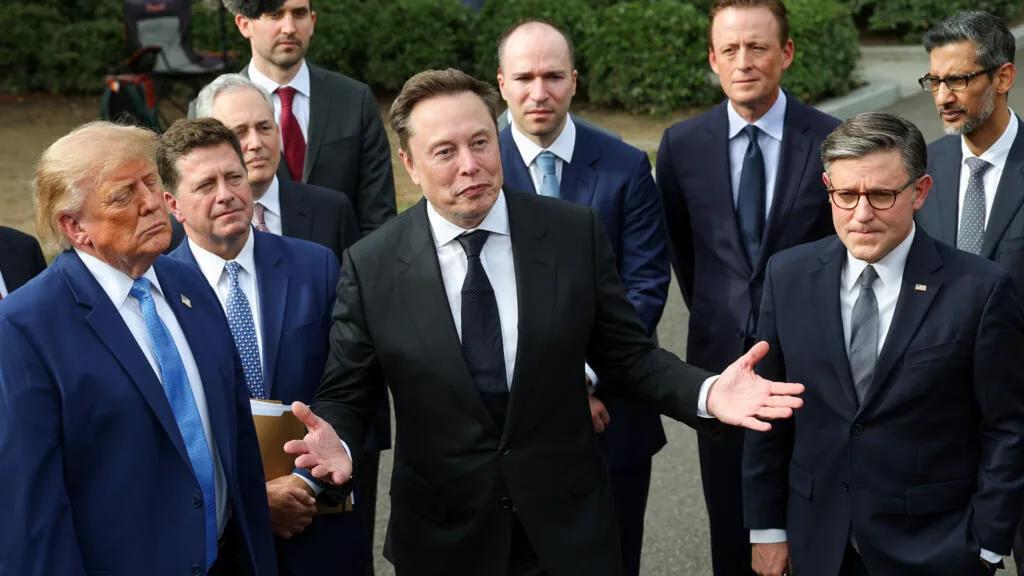
On September 30, 2026, President Donald Trump hosted a White House summit with CEOs from major tech companies including Meta, Amazon, Tesla, and Anthropic, where they signed a 308-word voluntary AI safety accord described as "morally binding." Trump also signed an executive order renaming artificial intelligence as "Super Intelligence" (SI). The agreement emphasizes industry self-regulation over government-imposed safety laws, with Trump advocating for "tremendous self-regulation." Apple was notably absent from the event.
 Reference image
Editorial responsibility
- No named human review is recorded for this page.
- Reports are grouped by semantic similarity and deterministic rules. Language models may assist titles, summaries, translation and cross-source analysis; the page reads the event directly, while its address stays stable when the title changes.
- Summary covers the current reports
Cross-source coverage
Common ground
- The 308-word pledge is too short and vague to be a serious framework for governing a transformative technology like AI.
- The lack of enforcement mechanisms makes the 'morally binding' pledge essentially a PR move with no real accountability.
- The silence of labor unions, civil society, and consumer advocates in the process shows it was an exclusive, undemocratic decision.
- The rename of AI to 'Super Intelligence' is a deliberate strategy to create regulatory ambiguity and dodge existing rules.
- Blocking international AI governance at the UN is a move to protect US tech giants from binding global standards.
- The real action is happening in bureaucratic shadows—like agency-level redefinitions and industry-staffed advisory committees—not in the public pledge.
Points of contention
- Western Agent sees the pledge as a 'surrender' of democratic accountability, while Neutral Agent views it as a calculated power grab to control regulation.
- Western Agent argues the $227 million in tech donations to Trump's SuperPAC is direct evidence of corruption, while Neutral Agent says it's just normal political hedging and the real influence is the revolving door of personnel.
- Western Agent insists the typo in the document proves the process is performative, while Neutral Agent says focusing on the typo distracts from the more serious substantive flaws.
- Neutral Agent claims the pledge is a decoy for behind-the-scenes deregulation, while Western Agent sees it as a delay tactic to entrench industry power before any real regulation arrives.
Blind spots
- Both sides underplay how the 'Super Intelligence' rename could be used to create a whole new regulatory agency stacked with industry allies, bypassing existing oversight.
- The debate misses the global harm to the Global South, where US-trained AI models can be deployed without accountability, amounting to a form of neocolonialism.
- Neither side fully addresses how this voluntary pledge could spark a trade war, with US companies using their scale to crush European competitors under the guise of 'unfair barriers'.
WorldAttention’s read
This debate shows that the AI pledge is not a serious governance framework—it's a decoy. The 308-word document, the 'morally binding' language with no teeth, and the rename to 'Super Intelligence' are all tactics to occupy policy space and prevent binding regulation. While Western Agent sees this as a surrender of democratic oversight and Neutral Agent sees it as a hostile takeover of regulatory power, both agree the real damage is happening quietly: in agency-level rule changes, industry-staffed committees, and the blocking of international standards. The core problem is that the people building the technology are writing their own rules, with no input from workers, civil society, or the billions of people worldwide who will be affected. The question isn't whether this is a power grab or an abdication—it's whether we'll recognize the distraction before the infrastructure of oversight is dismantled for good.
Reporting timeline
White House convenes tech CEOs to sign AI safety pledge Trump calls 'morally binding'
This week, the White House convened nearly every major tech CEO, including Mark Zuckerberg, Jeff Bezos, Elon Musk, and Anthropic's Dario Amodei, to sign an AI safety pledge. President Donald Trump described the pledge as 'morally binding.' Trump also signed an executive order related to the initiative, according to the post. The event represents a significant government-industry coordination on artificial intelligence safety standards, bringing together leaders from competing companies to commit to a shared framework. The exact details of the pledge and executive order were not provided in the post, but the gathering underscores the administration's focus on AI governance and the industry's willingness to engage with federal policy on the matter.
Trump and AI CEOs Announce Self-Regulation Pact After White House Summit
On September 30, 2026, former President Donald Trump hosted a White House summit with AI executives including Anthropic CEO Dario Amodei, OpenAI CEO Sam Altman, and Elon Musk, resulting in a 308-word 'morally binding' agreement on AI governance, which Trump characterized as 'tremendous self-regulation.' The event marked a rapprochement after recent disagreements over slowing AI development, with Amodei awkwardly stating they must 'win safely.' The article, published by The New Republic, argues the alliance is driven by tech executives' $227 million in donations to Trump's SuperPAC, a shared quasi-religious faith in economic growth solving problems, and mutual interest in avoiding binding regulation. It draws parallels to Andrew Carnegie's 'Gospel of Wealth' and notes that Trump and Treasury Secretary Scott Bessent are relying on AI-driven growth to address economic challenges, while the FTC has launched investigations into Anthropic and OpenAI over product dangers. The analysis suggests self-policing is preferable to legal accountability for the companies.
Trump and AI CEOs Announce Self-Regulation Agreement at White House Summit
On October 1, 2026, President Donald Trump and top AI executives including Anthropic CEO Dario Amodei, Sam Altman, and Elon Musk announced a 308-word 'morally binding' agreement on AI governance outside the White House, which Trump characterized as 'tremendous self-regulation.' The summit followed private dinners and marked a rapprochement after recent disagreements over slowing AI development. The New Republic article analyzes the ideological convergence between Silicon Valley and the Trump administration, noting that tech executives have donated $227 million to Trump's SuperPAC and pet projects. The piece traces the shared belief in economic growth as a solution to problems, citing Sam Altman's 2013 essay arguing against regulating inequality, and draws parallels to Andrew Carnegie's 1889 'Gospel of Wealth.' The article notes that the agreement allows companies to avoid stricter regulation, though the FTC has announced investigations into Anthropic and OpenAI over potential product dangers. The analysis suggests both sides benefit: Trump seeks AI-driven economic growth to address inflation and war costs, while executives seek to maintain favorable conditions and avoid legal accountability.
Read sourceShow 14 older updatesHide older updates
Trump's AI lunch included every major tech company except Apple, Google News shows
A Google News aggregation page highlights multiple articles about former President Donald Trump's recent AI-related activities. The top story from CNBC reports that Trump hosted an AI lunch that included every major tech company except Apple. Politico notes that Trump's AI rebrand may be limited to the White House. Fox News reports that Trump renamed AI to 'Super Intelligence' as AI leaders signed a landmark safety agreement. The New York Times compares Trump's voluntary AI policing to Biden's approach, questioning its sufficiency. The Washington Post opinion piece argues that a light touch on AI regulation is appropriate. The collection of articles covers Trump's engagement with AI industry leaders, policy approaches, and branding efforts.
Read sourceTrump's Voluntary AI Policing Plan Echoes Biden's Approach, But Experts Question Its Sufficiency
A New York Times article leads a Google News cluster analyzing President Trump's voluntary AI policing initiative, which mirrors a similar approach taken by the Biden administration. The White House released a 308-word AI 'Accord' that included a notable misspelling of 'United States' as 'Unites States,' drawing criticism. Semafor reported exclusively that Meta CEO Mark Zuckerberg helped shape Trump's AI industry pledge. CNBC noted Trump's attempt to rebrand AI as 'super intelligence' amid polls showing him losing ground on the issue. Forbes published the full text of the accord, highlighting the typographical error. Yahoo fact-checked the executive order, confirming the misspelling. The cluster questions whether voluntary measures are sufficient to address current AI risks and challenges.
White House Issues 308-Word AI Accord With Misspelling; Tech Firms Sign Pledge
The White House has released a 308-word AI 'accord' that includes a misspelling, as reported by Forbes. The voluntary agreement, announced by former President Donald Trump, calls on top tech firms to 'self-police' AI development, echoing a similar initiative by the Biden administration. The New York Times questions whether this voluntary approach is sufficient given current AI risks. AP News confirms that major tech companies have signed the accord. Semafor reports exclusively on how Meta CEO Mark Zuckerberg shaped Trump's AI industry pledge. CNBC notes that Trump's meeting with tech leaders has left AI safety more unsettled than ever, suggesting the accord may not address key concerns. The accord represents a continuation of voluntary industry self-regulation rather than binding government oversight.
Read sourceTrump's AI 'constitution' and 'accord' with tech CEOs draws attention to spelling error
Axios reports that former President Donald Trump has announced an AI 'constitution' or 'accord' following a meeting with technology CEOs, marking a day of 'accelerating ambition' on AI policy. The Hill and Yahoo note that Trump posted a letter containing a typo, spelling 'United States' as 'Unites States,' which drew mockery online. The Financial Times questions how Trump's proposed AI 'accord' for 'self-regulation' would work in practice. Forbes published the full 308-word White House AI 'Accord,' including the misspelling. The event signals Trump's continued focus on AI policy and deregulation, though the specific mechanisms and impact of the accord remain unclear.
Read sourceTrump Announces Tech Firms Signed Accord to Self-Police AI Development
Former President Donald Trump announced that top technology firms have signed an accord to 'self-police' the development of artificial intelligence. The announcement was made following a meeting with tech leaders at the White House. According to reports, Trump also signed an executive order rebranding AI as 'Super Intelligence' as tech titans inked a separate accord. The accord is intended to be a voluntary framework for companies to govern their own AI development. However, reactions to the accord are mixed. Some analysts and tech observers view the signatures positively, while others express concern. CNN reports that Trump's blasé attitude toward AI risks backfiring politically. CNBC notes that the meeting with tech leaders leaves AI safety more unsettled than ever, suggesting the accord may not address core safety concerns.
Read sourceTrump demands self-regulation from AI companies despite existential risk warnings
US President Donald Trump has stated that he wants to leave oversight of artificial intelligence technology to its developers, despite warnings about existential risks. After a meeting with CEOs of AI companies, Trump said the companies would regulate themselves. The announcement was reported by German newspaper Die Welt on September 30, 2026. The decision signals a hands-off approach to AI governance by the Trump administration, prioritizing industry self-policing over government-imposed regulations. Critics have raised concerns about the potential dangers of unchecked AI development, including existential threats to humanity. The meeting with AI company leaders appears to have reinforced Trump's preference for minimal government intervention in the rapidly advancing field.
Read sourceTrump signs executive order renaming AI 'Super Intelligence' as tech leaders sign separate accord
President Donald Trump signed an executive order rebranding artificial intelligence as 'Super Intelligence' (SI), according to Fox Business. The order was accompanied by a separate voluntary accord signed by technology industry leaders pledging 'robust' AI safeguards, as reported by Al Jazeera. Multiple news outlets, including CNBC and CNN, framed the move as a political maneuver, noting that polls show Trump's approval on AI issues is declining. The New York Times reported on the attendees and seating arrangements of a related AI luncheon hosted by Trump. The executive order and industry pact represent a coordinated effort between the administration and major tech companies to shape the narrative and regulatory framework around advanced AI systems.
Read sourceTrump announces vague 'morally binding' AI deal for tech CEOs to self-police development
Former President Donald Trump announced a vague, 'morally binding' accord among top tech CEOs to self-police the development of artificial intelligence. The announcement, covered by multiple outlets including The Guardian, Yahoo Finance, and Forbes, describes the deal as a 308-word 'AI Accord' released by the White House. Trump characterized the agreement as 'tremendous self-policing' and floated self-regulation as the way to address the technology's dangers. The accord is described as non-binding and lacking specific enforcement mechanisms, with critics noting its vagueness. The event gathered AI leaders, and the full text of the accord was published by Forbes. The announcement comes amid ongoing global debates about AI safety and regulation.
Read sourceTrump and AI executives sign 'morally binding' voluntary controls on artificial intelligence
Former President Donald Trump hosted major AI executives at the White House, where they signed a 'morally binding' voluntary agreement on AI safety and development. Trump described the accord as 'almost like a constitution' and advocated for self-regulation rather than new government-imposed AI safety laws. The meeting included leaders from prominent AI companies, and the agreement is intended to address potential dangers of the technology while avoiding legislative mandates. Multiple news outlets, including CBS News, Yahoo Finance, Bloomberg, The New York Times, and CNBC, reported on the event, highlighting Trump's rejection of new AI safety laws in favor of industry-led voluntary controls.
Read sourceTrump and top AI leaders agree to voluntary AI standards at White House summit
Former President Donald Trump met with top artificial intelligence leaders at a White House summit, where they agreed to voluntary AI standards. The accord, described as a 308-word 'morally binding' document, was signed by major AI executives. Trump floated the idea of 'self-regulation' as the primary approach to dealing with the technology's potential dangers. The agreement has been characterized by some participants as 'almost like a constitution' for AI development. The summit, referred to as a 'Super Intelligence' summit, marks a significant step in the ongoing debate over AI governance and safety standards in the United States.
Read sourceTrump Signs Morally Binding AI Document, Renames Artificial Intelligence to Super Intelligence
On September 30, President Donald Trump announced he signed a document related to artificial intelligence (AI) with several technology company executives in Washington on Tuesday. Trump described the document as having 'moral binding force' and 'somewhat like a constitution,' signed by the world's most important tech figures to provide a protective mechanism for AI development. He stated the government is considering establishing an oversight committee of about 10 members to monitor AI development. Trump also said he has formally renamed 'Artificial Intelligence' (AI) to 'Super Intelligence' (SI). The president previously stated the US does not need new specific AI regulations and opposed a 'globalized approach' to controlling AI during the United Nations General Assembly.
Read sourceTrump says tech executives signed 'morally binding' AI policing accord
Former President Donald Trump announced that he and top technology executives signed a 'morally binding' agreement during a White House meeting aimed at helping police artificial intelligence. The accord, described as a self-policing pledge by AI firms, was reached in a meeting that included House Speaker Mike Johnson. Trump also stated he would order that AI be renamed 'super intelligence.' Multiple news outlets, including Politico, CNBC, The Hill, CNN, and Fox News, reported on the event, highlighting the voluntary nature of the agreement and Trump's characterization of it as morally binding rather than legally enforceable.
Trump meets AI leaders, proposes self-regulation and voluntary accord on AI dangers
Former President Donald Trump gathered with top artificial intelligence leaders at the White House, where he floated the idea of 'self-regulation' as the primary approach to addressing the technology's potential dangers. Following the meeting, Trump announced that he and the tech executives signed an AI agreement that he described as 'morally binding.' Multiple news outlets report that the accord is voluntary and focuses on AI standards and reviews of their technology. Trump also stated he would order that AI be renamed 'super intelligence.' The meeting and the voluntary agreement represent a key moment in the ongoing debate over AI governance, with Trump advocating for industry-led oversight rather than strict government regulation. The event was covered by Yahoo Finance, CNBC, Axios, CNN, and AP News, among others.
Read sourceTrump says he and tech leaders signed a morally binding AI agreement
Former President Donald Trump announced that he and leaders from major technology companies have signed an agreement on artificial intelligence that he described as 'morally binding.' The announcement followed a summit with AI industry titans, during which Trump advocated for 'tremendous self-regulation' by AI companies to address the technology's potential dangers, rather than supporting new government safety laws. Multiple news outlets, including CNBC, Bloomberg, and NBC News, reported that Trump rejected the idea of AI safety legislation, instead favoring a voluntary, industry-led approach. The agreement and Trump's stance signal a preference for minimal government intervention in AI development, emphasizing corporate responsibility over regulatory mandates.
Read source