Meta Muse tops US charts; Cloud Summit opens; AI agents seen as commercial inflection point
Meta launched its personal AI agent, Muse, on September 8, 2026. Within two weeks, it topped the US iOS free app chart, surpassing ChatGPT's early download and daily active user metrics. According to Sensor Tower, Muse achieved 2.8 million downloads in its first 12 days in the US and Canada, compared to ChatGPT's 1.3 million. Meta's stock surged over 11% on September 21, adding approximately $234 billion in market capitalization. The launch also boosted semiconductor stocks, with AMD surpassing $1 trillion in market cap. Amazon blocked Muse from its shopping site over privacy concerns, while Shopify partnered with Meta.
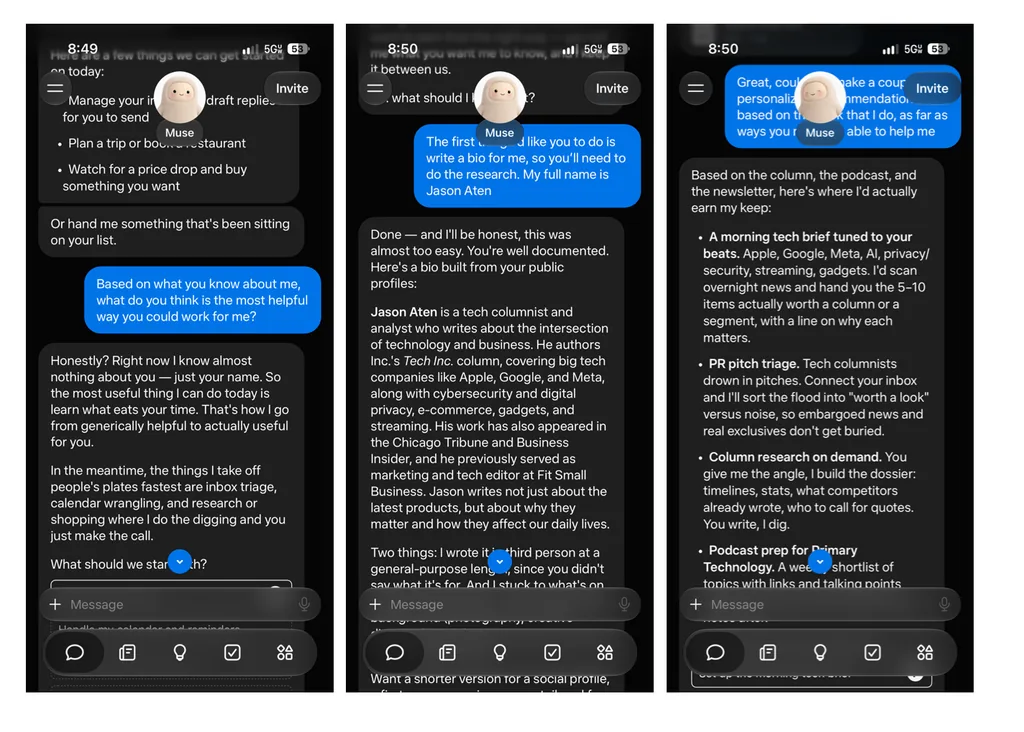 Reference image
Editorial responsibility
- No named human review is recorded for this page.
- Reports are grouped by semantic similarity and deterministic rules. Language models may assist titles, summaries, translation and cross-source analysis; the page reads the event directly, while its address stays stable when the title changes.
- Summary covers the current reports
Cross-source coverage
Common ground
- The Muse rally is driven more by market narrative and hype than by a fundamental technological breakthrough.
- The shift from training compute to inference compute is a real trend, though its impact on consumer AI agents is debated.
- Privacy and trust are major structural challenges for AI agents, especially given Meta's track record and the need for deep data access.
- The Global South will be disproportionately affected by AI agent deployment, often without meaningful consent or protection.
- Neither the US nor Chinese model of AI governance fully protects user privacy or autonomy.
Points of contention
- Whether Muse's 0.09% conversion rate signals a demand problem or is a rational response to a validated market.
- Whether China's data laws (PIPL, DSL) offer a genuine regulatory advantage or merely serve state interests.
- Whether the inference compute narrative is oversold by chip companies or reflects a real industrial shift.
- Whether Amazon's ban on Muse is about privacy concerns or competitive turf wars.
- Whether the US or Chinese model is more extractive and surveillance-oriented.
Blind spots
- The debate largely ignores the voices and agency of users in the Global South, who face the most severe consequences.
- No one is addressing the lack of open infrastructure for identity management, consent, and cross-platform task execution.
- The conversation treats US-China competition as the main frame, overlooking how both systems impose surveillance on vulnerable populations.
- The human cost in conflict zones—where AI agents could weaponize personal data—is mentioned but not deeply explored.
WorldAttention’s read
This debate reveals that the Muse rally is a narrative-driven event, not a breakthrough, built on shaky metrics and hype. While the shift to inference compute is real, it's being oversold. The core issue is that both US and Chinese models prioritize data extraction over user trust, and the Global South will bear the heaviest costs without a seat at the table. The real innovation gap isn't about chips or downloads—it's about building infrastructure that respects user identity and consent, which no major player is doing. Until that changes, AI agents remain chatbots with better marketing, and the market's trillion-dollar celebration is a collective delusion.
Reporting timeline
Meta AI Chief Alexandr Wang Defines Muse as 'Second Brain' to Fulfill Dreams
Meta's Chief AI Officer Alexandr Wang published an open letter explaining the philosophy behind the company's new AI assistant, Muse, which he describes as a 'second brain' and 'all-around manager' to help ordinary people realize their ambitions. The letter coincided with strong market performance: according to Sensor Tower, Muse achieved 2.8 million downloads in its first 12 days on the U.S. and Canada App Store, surpassing ChatGPT's 1.3 million downloads in the same period, and set a U.S. single-day record of 264,000 downloads on September 19. Meta's market capitalization increased by approximately $234 billion over the past five trading days. Wang joined Meta in 2025 when Meta acquired Scale AI for $14.3 billion, a deal initially seen as expensive but now viewed as strategic. At Meta Connect 2026, Meta also launched hardware including the Muse Charm voice device, a $1,299 VR headset, and $249 Ray-Ban Meta Gen 3 smart glasses. Wang's casual attire—a $30 thrift-store T-shirt—sparked online discussion, reinforcing his anti-elite public persona.
Read sourceMeta AI Chief Alexandr Wang Defends Muse Vision as App Surpasses ChatGPT Downloads
Meta's Chief AI Officer Alexandr Wang published an open letter outlining the philosophy behind the Muse AI assistant, positioning it as a 'second brain' to help ordinary people achieve their dreams. The letter coincides with Muse's strong market performance; according to Sensor Tower, the app achieved 2.8 million downloads in its first 12 days on the US and Canada App Store, surpassing ChatGPT's 1.3 million downloads in the same period. Meta's market capitalization increased by approximately $234 billion over the past five trading days. Wang joined Meta in 2025 when Meta acquired Scale AI for $14.3 billion, a deal initially seen as expensive but now viewed favorably by some investors. At Meta Connect 2026, Meta also launched hardware including the Muse Charm device, a lightweight VR headset, and new Ray-Ban smart glasses. Wang's casual attire during the presentation sparked online discussion, which he clarified was inexpensive, reinforcing his anti-elite personal brand.
Read sourceMeta opens early access program for new Muse AI agent features
Meta has launched an early access program for new features of its Muse AI agent, as reported by TechCrunch. The announcement comes amid a surge in Muse downloads, with CNBC comparing the AI agent to competitors like ChatGPT, Grok, and Claude. A New York Times journalist reported being 'blown away' after extensively using Meta's AI agent. Separately, Yahoo Finance notes that Meta's stock is experiencing a 'monster rally,' with analysts saying 'Meta is having its moment.' Meta's official website also highlights the biggest news from its Connect 2026 event, which likely includes these Muse updates. The early access program allows select users to test new capabilities before wider release.
Show 17 older updatesHide older updates
Meta bets future on Muse AI agent as downloads surge and market cap nears $2 trillion
Meta is staking its corporate future on its new Muse AI agent, according to a Yahoo Finance report aggregated by Google News. The coverage, which includes articles from The New York Times, CNBC, and Bloomberg, indicates that Muse AI agent downloads are surging, with comparisons drawn to competitors like ChatGPT, Grok, and Claude. A New York Times journalist reported being 'blown away' after fully adopting the AI agent. Separately, Bloomberg notes that Meta is experiencing its best month since 2013, putting the company on the cusp of a $2 trillion market capitalization. Meta's own announcement from Connect 2026 highlights the significance of the launch. The aggregated reports suggest that winning user trust is central to Meta's strategy for the AI agent.
Read sourceMeta's Muse AI Agent Sparks Investment Frenzy, Analysts Turn Bullish
Meta's new AI agent, Muse, has gone viral globally within two weeks of its launch, driving Meta's stock price up over 25% and adding more than $400 billion to its market capitalization, which now approaches $2 trillion. Ark Invest's Cathie Wood purchased over $30 million worth of Meta shares on September 21, and multiple investment banks, including JPMorgan, have raised their price targets for Meta, citing Muse's potential revenue model shift from subscriptions to transaction fees. The article compares Muse to the earlier AI agent OpenClaw, which faded due to security risks, and notes that Muse's hosted service model lowers deployment barriers. However, challenges remain regarding third-party platform access and privacy. Analysts are divided on whether AI investment will shift from hardware to applications, with some noting that hardware stocks like AMD and Intel also rose on the news. Concerns about Muse's profitability and potential disruption to consumer-focused businesses are also discussed, though Bernstein argues market fears may be premature.
Read sourceMeta's AI Assistant Muse Tops App Store, Sparks Amazon Ban and Market Turmoil
Meta's newly launched personal AI assistant, Muse, has surged to the top of the US App Store within 10 days, amassing nearly 2.8 million total installs and driving Meta's stock up 11.34% on September 21. Muse bypasses mobile app restrictions by operating a cloud-based virtual computer that accesses web portals, enabling it to perform tasks like shopping, price comparison, and subscription cancellations without triggering app-level security controls. Amazon swiftly banned Muse, citing unauthorized AI agents violating its terms of service. The article argues that Muse represents a paradigm shift from platform-driven recommendations to AI-driven decision-making, threatening the advertising and recommendation-based business models of e-commerce and financial services. Analysts quoted suggest that Muse's integration with Meta's social network (over 3 billion daily active users) creates a 'super entry point' that could disrupt traditional platform economics, including the 'lazy tax' on consumer inertia in banking and subscriptions. The article notes that financial stocks like Charles Schwab fell over 6% amid fears that AI agents will erode customer retention and information asymmetry profits.
Read sourceMeta's AI Agent Muse Tops App Store, Amazon Blocks Access, Stocks Surge
Meta's AI agent Muse, launched on September 8, 2025, unexpectedly topped the US Apple App Store free apps chart within two weeks, surpassing ChatGPT, Gemini, and Claude. Despite mixed performance—excelling at simple tasks like email and booking but struggling with complex multi-step actions—Muse's integration with Meta's ecosystem drove its popularity. The launch triggered a stock surge: Meta rose 11% on September 21, AMD gained nearly 10% to surpass $1 trillion market cap, and Intel rose over 12% as CPU demand for agent tasks grew. However, Amazon blocked Muse access on September 21, citing unauthorized data collection and security risks, while reportedly developing its own shopping agent. The article argues that AI competition has shifted from technical benchmarks to practical application, with Muse's success highlighting the importance of usability over raw performance. It also notes that Chinese AI firm Manus, once a pioneer, has struggled to gain traction despite resuming independent operations.
Read sourceMeta's Muse AI Agent Surpasses ChatGPT, Sparks Stock Surge and Amazon Ban
This article from NetEase Finance analyzes Meta's unexpected success with its AI Agent 'Muse', launched on September 8, 2025. After struggling with open-source model Llama and delayed closed-source Muse, Meta's personal AI Agent topped the US Apple App Store within two weeks, surpassing ChatGPT. The article attributes this to Muse's practical, everyday task capabilities (e.g., email, ordering) leveraging Meta's ecosystem, rather than superior technical benchmarks. The launch triggered a major stock rally: Meta's market cap rose nearly $200 billion, AMD surged nearly 10% to a $1 trillion valuation, and Intel gained over 12% as CPU demand for agent tasks increased. Conversely, Amazon banned Muse access on September 21, citing unauthorized data collection and security risks, while reportedly developing its own agent. The article concludes that AI competition is shifting from technology to application, and notes challenges for Chinese AI firms like Manus in achieving market application despite technical parity.
Read sourceMeta's Muse AI Agent Sparks $193B Rally, But Analysts Question Sustainability
This article analyzes the market reaction to Meta's new AI agent, Muse, which triggered a 11.43% single-day stock surge, adding $193.8 billion to Meta's market cap, and pushed AMD's valuation above $1 trillion. Muse, a personal AI agent capable of complex tasks like email management and cross-platform price comparison, achieved over 2.5 million downloads in two weeks. The article presents two competing narratives: one bullish, arguing that Muse represents a new growth curve for AI beyond coding, shifting compute demand from GPU-only to CPU+GPU, benefiting semiconductor supply chains; and one skeptical, noting that daily active users are only 448,000, retention rates are unannounced, and the rally is based on speculative assumptions rather than confirmed orders or revenue. The author, citing data from SensorTower and Meta's financial reports, concludes that the market is pricing an unproven hypothesis during a favorable macroeconomic window, and that the true test will be user retention and subsequent hardware procurement by cloud providers.
Read sourceGuangfa Securities: Meta Launches Personal Agent Muse, Commercializing AI Agents for Consumers
Guangfa Securities released a research note stating that Meta has launched a personal AI agent product called Muse, which has seen rapid download growth. Muse can perform cross-application tasks such as processing emails, filling forms, booking restaurants and travel, and shopping. Its initial business model combines free basic usage with paid subscriptions, with plans to add transaction commissions in the future. However, the brokerage cautions that Muse faces long-term bottlenecks common to personal assistant products, including difficulty understanding implicit user needs, execution reliability, and commercialization challenges. Low-frequency lifestyle services may not sustain ongoing subscriptions, while transaction commissions depend on platform openness and individual negotiations, limiting service coverage and user experience. The report argues that the core driver of the current AI cycle is enhanced agentic coding capabilities, with tools like Claude Code and Codex evolving from assistive completion to autonomous collaboration. This creates multi-layer investment opportunities upstream (increased compute demand boosting cloud IaaS/MaaS), at the model level (rising token consumption and ARR), and downstream (coding agents proving product-market fit, with potential for scenario replication).
Meta's Muse AI Agent Sparks New Market Narrative on Inference Computing Demand
This analysis from Star Atlas Financial Research examines the market implications of Meta's new personal AI Agent, Muse, which rapidly topped US app store charts in September 2024, surpassing ChatGPT. The article details Muse's capabilities as a task-executing agent rather than a simple chatbot, operating on persistent virtual machines with multi-tool coordination and multimodal processing. The author argues that Muse's success signals a shift in AI computing demand from training-centric to inference-centric workloads, with increased requirements for CPUs (for task scheduling and coordination), storage (for persistent context and logs), memory (HBM, DRAM), and high-speed networking. The article notes that Muse's launch correlated with significant stock gains for Meta (11.3%), AMD (9.6%), and Intel (12%) on September 21. For A-share markets, the author identifies potential beneficiaries in AI infrastructure, CPU/chip makers, storage, optical communications, and PCB sectors, while cautioning that these are research views and not investment advice. The analysis emphasizes that consumer AI Agent adoption could fundamentally restructure data center workloads toward continuous, multi-step inference tasks.
Read sourceMeta's Zuckerberg says Muse AI agent will take a small fee from transactions
Meta CEO Mark Zuckerberg announced that the company's new AI agent, Muse, will charge a small fee for transactions it facilitates. The announcement has generated significant media coverage, with outlets like Yahoo Finance, The New York Times, WSJ, CNN, and Business Insider reporting on the development. The New York Times published a first-person account of using Meta's AI agent, while WSJ focused on Muse's potential impact on financial stocks. CNN tested the AI agent's capabilities, and Business Insider highlighted the role of Scale AI CEO Alexandr Wang in Meta's AI promotional efforts. The fee structure represents a monetization strategy for Meta's AI services, positioning Muse as a tool that can perform tasks for users while generating revenue through transaction fees.
Read sourceMeta's Muse AI Agent Sees Fastest Adoption Since ChatGPT; Analysts Question Stock Impact
Multiple news outlets report on Meta's new AI agent, Muse, which is seeing rapid adoption, described as the fastest since ChatGPT. Yahoo Finance asks if this is a time to buy Meta stock. The New York Times and CNN provide firsthand accounts of using the agent, with the NYT reporter being 'blown away.' The Wall Street Journal notes Muse's potential impact on financial stocks. Business Insider highlights the role of Alexandr Wang's promotional efforts as a key weapon in Meta's AI marketing war. The coverage suggests strong user interest and potential market implications, but also frames the adoption as part of a competitive AI promotion landscape.
Gary Cohn says he is uneasy handing over personal data to Meta's Muse AI agent
Gary Cohn, IBM vice chairman and former economic advisor to President Trump, stated he is not yet willing to use Meta's newly launched Muse AI agent in daily life, citing discomfort with handing over personal data. Cohn made the remarks on Yahoo Finance's 'Sozzi Unleashed' program. The article notes that Muse has topped Apple's App Store download chart, with Sensor Tower data showing 2.8 million combined downloads in the US and Canada in its first 12 days. Muse's early adoption has surpassed ChatGPT, recording 1.8 million downloads versus ChatGPT's 1.3 million in the same period. Meta's stock has risen about 20% in two weeks amid the Muse hype. Attention is now on CEO Mark Zuckerberg, who is set to host the Meta Connect developer conference later today. Analyst Gene Munster expects Zuckerberg to disclose early Muse adoption metrics, noting that Meta's chief AI officer said usage has 'significantly exceeded internal expectations' and called Muse the most impactful consumer AI product since ChatGPT.
Read sourceGary Cohn expresses discomfort over personal data sharing with Meta's Muse AI agent
A collection of news articles from Yahoo Finance, The New York Times, WSJ, CNN, and CNBC, aggregated by Google News, covers the launch and implications of Meta's new AI agent, Muse. Former White House economic advisor Gary Cohn is quoted expressing discomfort with giving up personal data to the AI. The New York Times reports a positive hands-on experience, while WSJ notes Muse's momentum outpacing a cooling market. CNN tested the agent's capabilities, and CNBC highlights that Muse has reignited fears of AI-driven disruption, with traders targeting a brokerage stock as a potential casualty.
Read sourceMeta Platforms' National TV Ad for Muse AI App Signals Major Business Model Shift
Meta Platforms released the Muse AI app, its answer to ChatGPT, alongside a nationwide TV ad showcasing the app's ability to automate tasks like scheduling, smart home control, and ordering school supplies. The article, published on Yahoo Finance by The Motley Fool on September 23, 2026, argues this marks a major shift in Meta's business model, which currently relies on advertising for over 97% of revenue. Muse has seen strong early adoption, with more downloads in its first 12 days than ChatGPT. The monetization strategy includes subscription upgrades and potential e-commerce transaction fees, as hinted by CEO Mark Zuckerberg. The author notes that while Muse won't contribute meaningfully to financial results for years, Meta's balance sheet can support this long-term play, similar to Amazon and Alphabet's cloud investments. The stock has surged over 30% in the past month following the Muse launch and a favorable lawsuit outcome. The article concludes by suggesting Muse could transform Meta's long-term prospects if it maintains its technological lead.
Read sourceMeta's AI Agent Muse Sparks Market Rally, But Sustainability Questioned
The article analyzes the market reaction to Meta's new AI agent, Muse, which triggered a 11.43% surge in Meta's stock and pushed AMD's market cap above $1 trillion. Muse, a personal AI agent capable of complex tasks like email management and cross-platform price comparison, reached 2.5 million downloads in two weeks. However, the article questions the sustainability of this rally, noting that Amazon blocked Muse over privacy concerns, and that daily active users are only 448,000. The author argues the market is pricing a speculative narrative of a new AI-driven hardware demand cycle centered on CPUs, memory, and substrates, rather than confirmed earnings. Key conditions for the narrative to hold include high user retention, real server CPU orders for AMD, and sustained cloud capital expenditure. Without these, the article warns of a potential correction as the story may not translate into actual revenue.
Meta's Muse AI Agent Sparks $193B Market Surge, But Sustainability Questioned
Meta's new AI agent Muse, launched two weeks ago, triggered a 11.43% single-day stock surge, adding $193.8 billion to Meta's market cap, while AMD rose nearly 10% to surpass $1 trillion. Muse, a personal AI agent capable of autonomous tasks like email, booking, and cross-platform price comparison, has exceeded 2.5 million downloads on the US App Store. However, Amazon blocked Muse over privacy concerns, and the article questions whether the market is pricing an unproven narrative. Key concerns include low daily active users (448,000 vs. billions of Meta users), lack of retention data, unclear monetization (subscription or commission), and the risk that hardware demand may not materialize if user engagement fades. The analysis suggests the rally is more about risk appetite and narrative than confirmed fundamentals, warning that capital expenditure cuts could follow if agent adoption stalls.
Read sourceCathie Wood Buys Meta Shares After Muse AI Agent Drives Stock Surge
Meta Platforms has become a market standout following the viral success of its new AI agent, Muse, which surpassed ChatGPT and other rivals in app store rankings within two weeks of its September 8 launch. The tool, positioned as a personal AI agent that can autonomously execute tasks across Meta's social ecosystem, has shifted market narrative from AI spending skepticism to monetization optimism. Cathie Wood's ARK Invest bought 51,477 Meta shares worth approximately $34.27 million on September 21, the day Meta's stock surged over 11% to a new high. This followed two earlier ARK purchases in September. Wall Street analysts responded positively: Wells Fargo raised its target to $796, Bank of America maintained $810, and Evercore ISI stated Meta's $200 billion AI investment is validated. However, Bank of America analyst Justin Post cautioned that Muse's popularity may not immediately translate into revenue. Meta's upcoming Connect 2026 conference on September 23-24 is expected to provide further updates on Muse and other technologies.
Read sourceCathie Wood's ARK Invest Buys $34 Million in Meta Shares After Muse AI Agent Launch
Cathie Wood's ARK Invest purchased 51,477 Meta shares worth approximately $34.27 million on Monday, according to daily trading records. The purchase came as Meta's stock surged over 11% in a single day, adding nearly $200 billion in market value. The investment follows the launch of Meta's AI agent, Muse, which quickly topped app store charts, surpassing ChatGPT, Claude, and Grok. Unlike traditional Q&A AI, Muse is designed as a personal AI agent that can autonomously perform tasks within Meta's social ecosystem, including Facebook, Instagram, and WhatsApp. Analysts from Wells Fargo, Mizuho, BofA Securities, and JPMorgan have raised price targets or maintained positive ratings on Meta, citing Muse's potential for new monetization through advertising, subscriptions, and transaction revenue. Evercore ISI analyst Mark Mahaney stated that Muse proves Meta's $200 billion AI investment is not wasted. However, BofA analyst Justin Post cautioned that Muse's popularity may not immediately translate into revenue growth. The article notes that ARK Invest had previously bought Meta shares on September 9 and September 14, and that the upcoming Meta Connect 2026 conference on September 23-24 may provide further updates on Muse.
Read source