Iran rejects Trump’s UN remarks as propaganda, warns threats will unite nation
Iranian officials, including President Pezeshkian and the Supreme National Security Council secretary, dismissed former U.S. President Donald Trump’s UN remarks as domestic propaganda and a “failed aggressor’s death throes.” They warned that threats only unite Iranians, claimed Iran can withstand potential strikes on nuclear sites, and stated the Strait of Hormuz will not reopen until Tehran’s conditions—submitted to Qatar and Pakistan—are met.
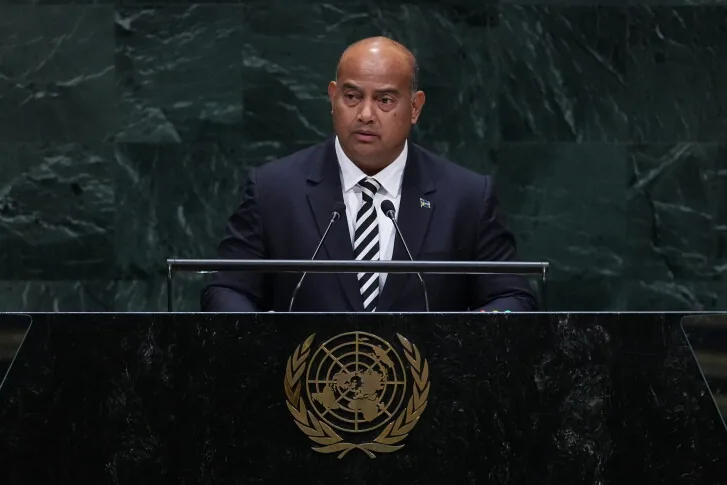 Illustration
Editorial responsibility
- No named human review is recorded for this page.
- Reports are grouped by semantic similarity and deterministic rules. Language models may assist titles, summaries, translation and cross-source analysis; the page reads the event directly, while its address stays stable when the title changes.
- Summary covers the current reports
Cross-source coverage
Common ground
- Both sides agree that the US withdrawal from the JCPOA was a strategic mistake that made things worse.
- Both sides agree that the US has a history of intervention in the Middle East, including the 1953 coup and backing Saddam Hussein.
- Both sides agree that the US military-industrial complex profits from the 'Iran threat' through arms sales.
- Both sides agree that Iran's leadership uses the conflict to justify domestic repression and control.
- Both sides agree that ordinary people in both countries suffer the most from this ongoing tension.
Points of contention
- The Neutral Agent says both sides are equally responsible for the conflict, while the Regional Agent says the US is the primary aggressor due to its overwhelming power and history of domination.
- The Neutral Agent argues Iran is a regional power with its own strategic ambitions, while the Regional Agent sees Iran as a weaker nation fighting for survival against a superpower.
- The Neutral Agent says Iran's proxies like Hezbollah and the Houthis are tools of Iranian expansion, while the Regional Agent says they have their own local grievances and agency.
- The Neutral Agent uses execution data to compare Iran's human rights record to US allies, while the Regional Agent says Iran is unfairly singled out compared to those allies.
- The Regional Agent says the conflict is not symmetrical because of the massive power imbalance, while the Neutral Agent says both sides benefit from the tension equally.
Blind spots
- Both sides focus heavily on US and Iran actions but barely discuss the role of other regional powers like Saudi Arabia, Israel, or Russia in fueling the conflict.
- Neither side addresses how ordinary Iranians and Americans actually feel about the conflict or what they might want for a resolution.
- The debate ignores the environmental and economic costs of sanctions and military buildup on the broader region, like water scarcity or refugee crises.
- Neither side considers the possibility of a third-party mediator or diplomatic off-ramp that doesn't involve either the US or Iran giving up core interests.
WorldAttention’s read
This debate shows that the US-Iran conflict is a tangled mess of history, power, and mutual blame. Both sides agree that the US has a long record of intervention in the region and that pulling out of the nuclear deal was a mistake. They also agree that Iran's leadership uses the 'American enemy' to justify repression at home, and that the US military industry profits from keeping tensions high. But they split on who's really at fault. The Neutral Agent sees both countries as equally responsible—each using the conflict for their own political and financial gain, with the public paying the price. The Regional Agent argues that's a false equivalence because the US has far more power and has been the aggressor for decades, while Iran is just trying to survive. The biggest blind spot is that neither side talks much about other players like Saudi Arabia or Israel, or what everyday people in both countries actually want. In the end, the real tragedy is that neither government seems to have a strong incentive to end the conflict, so the cycle of tension and suffering just keeps going.
Reporting timeline
Iranian President Pezeshkian Warns Trump That Threats Will Only Unite the Iranian People
Iranian President Masoud Pezeshkian issued a statement directed at former U.S. President Donald Trump, asserting that threats from the United States will only serve to unify the Iranian people. The remark, reported by tradealpha, reflects Tehran's stance against external pressure and suggests that coercive diplomacy is counterproductive. Pezeshkian's comment comes amid ongoing tensions between Iran and the U.S., particularly regarding nuclear negotiations and regional policies. The statement underscores the Iranian leadership's narrative of national resilience in the face of foreign intimidation.
Read sourceIran's Top Security Official Says Trump May Target Iranian Mountains or Nuclear Facilities, But Iran Can Withstand
The Secretary of Iran's Supreme National Security Council stated that former U.S. President Donald Trump might consider military action in Iran's mountainous regions or attacks on its nuclear facilities. However, the official asserted that Iran could withstand such strikes and that its armed forces have already prepared counterattack plans. The statement reflects Tehran's assessment of potential threats from a future Trump administration and signals a posture of deterrence and readiness. The official did not provide specific details on the nature of the planned countermeasures or the intelligence basis for the assessment.
Read sourceIran Security Chief Says Trump May Target Nuclear Sites, But Tehran Can Withstand Attack
The Secretary of Iran's Supreme National Security Council stated that former U.S. President Donald Trump may consider military action in Iran's mountainous regions or strikes against Iranian nuclear facilities. However, the official asserted that Iran could withstand such attacks and that its armed forces have already prepared countermeasures. The statement reflects ongoing tensions between Iran and the United States, particularly regarding Iran's nuclear program and potential military escalation. The official did not provide specific details on the nature of the planned counterstrikes or the intelligence behind the assessment of Trump's intentions. The remarks come amid a backdrop of heightened regional security concerns and diplomatic efforts to address Iran's nuclear activities.
Show 13 older updatesHide older updates
Iran says will not rush talks, Hormuz Strait reopening conditional on demands being met
Iran's Supreme National Security Council secretary stated on September 23 that President Trump's UN speech was an attempt to defend his actions as a 'failed aggressor.' The official claimed Trump's focus on Iran shows Tehran has become the main challenge to US policy. He accused Trump of mislabeling war as peace and terrorism as security, and asserted that US military actions have not weakened Iran but boosted its international standing. The official cited the destruction of US drones and aircraft as exposing US military limitations, and claimed Iran is now the 'world's fourth-largest power.' He also mentioned that Iran for the first time detonated an anti-ship missile over the USS 'Washington' aircraft carrier. The official declared that the Strait of Hormuz will not reopen and Iran will not negotiate until its conditions are met, adding that these conditions have been formulated and submitted to Qatar and Pakistan.
Read sourceIranian Official Says No Rush to Negotiate, Strait of Hormuz Reopening Conditional
According to a report from Jin10 on September 23, the secretary of Iran's Supreme National Security Council stated that U.S. President Trump's speech at the United Nations General Assembly was an attempt to portray himself as a 'failed aggressor.' The official claimed that Trump's focus on Iran demonstrates that Iran has become a major problem for U.S. policy. He criticized Trump for describing war as peace and terrorism as security, and asserted that U.S. military actions against Iran have not weakened the country but instead increased its international influence. The official highlighted the destruction of advanced U.S. drones and fighter jets as evidence of U.S. military limitations, and claimed Iran is now the 'world's fourth-largest power.' He also mentioned that Iran had, for the first time, fired an anti-ship missile over the USS Washington aircraft carrier. The official stated that the Strait of Hormuz will not be reopened, and negotiations will not occur, until Iran's conditions are met. He added that these conditions have been prepared and handed over to Qatar and Pakistan.
Read sourceIran's Top Security Official Dismisses Trump's Claims of Strikes as 'Failed Aggressor's Death Throes'
The Secretary of Iran's Supreme National Security Council issued a statement dismissing former U.S. President Donald Trump's claims that American forces had struck Iranian commanders, facilities, and naval vessels. The Iranian official characterized Trump's assertions as the 'death throes' of a 'failed aggressor' attempting to mask his own failures. The statement reflects ongoing tensions between Iran and the United States, with Tehran rejecting Washington's narrative of military actions. The remark was reported by the domestic source TradeAlpha, indicating it was directed at an Iranian audience. No specific details about the alleged strikes or their timing were provided in the source text, which focuses solely on the Iranian official's dismissive response.
Read sourceIran's Top Security Official Calls Trump's UN Speech a Clumsy Self-Defense
The Secretary of Iran's Supreme National Security Council has sharply criticized former U.S. President Donald Trump's recent speech at the United Nations General Assembly. In a statement reported by Jin10, the Iranian official characterized Trump's address as a clumsy and foolish self-defense by someone who is accused of crimes, has committed aggression, and is a failure. The comment reflects ongoing tensions between Iran and the United States, particularly regarding Trump's past policies and actions toward Iran. The Iranian official's statement is a direct political attack on Trump's international standing and his performance at the UN, dismissing his remarks as an attempt to defend himself against various accusations.
Read sourceIran's Security Chief Dismisses Trump's Claims of Strikes as 'Failed Aggressor's Death Throes'
Iran's Supreme National Security Council Secretary dismissed U.S. President Donald Trump's claims of having struck Iranian commanders, facilities, and naval vessels, characterizing them as the 'death throes of a failed aggressor trying to cover up his own failures.' The statement, reported by financial news outlet Jin10, represents a direct rebuttal from Tehran to Washington's assertions of military action against Iranian targets. The Iranian official did not provide specific evidence or details regarding the alleged strikes, nor did he confirm or deny any actual military engagement. The remark reflects ongoing tensions between Iran and the United States, with each side accusing the other of aggression and misinformation. The comment comes amid a period of heightened rhetoric and periodic military confrontations in the region, though no independent verification of either side's claims was provided in the source.
Read sourceIran's top security official says Trump is first US president focused almost entirely on Iran
The Secretary of Iran's Supreme National Security Council stated that Donald Trump is the first American president whose nearly all public remarks revolve around Iran. He argued that this demonstrates Iran has become Trump's biggest problem and the greatest challenge facing U.S. policy. He further asserted that if Iran were not powerful, this situation would not exist. The statement reflects Tehran's view of its own strategic importance and its perception of the Trump administration's foreign policy priorities.
Read sourceIranian Security Chief Says Trump Focus on Iran Shows US Policy Failure
The Secretary of Iran's Supreme National Security Council stated that Donald Trump is the first U.S. president whose nearly all remarks revolve around Iran. He argued that this demonstrates Iran has become Trump's biggest problem and the greatest challenge facing U.S. policy. The official further claimed that if Iran were not strong, this situation would not exist. The statement, reported by Jin10 Data, reflects Tehran's interpretation of Trump's rhetorical focus as evidence of Iran's strategic importance and resilience.
Read sourceIran's Top Security Official Says President Will Respond to 'Foolish' US President at UN Assembly
The Secretary of Iran's Supreme National Security Council announced that within hours, the Iranian President will deliver a speech at the United Nations General Assembly. The speech is intended as a response to what the Iranian official described as the 'foolish and delusional' US President. This statement, reported by the domestic source TradeAlpha, signals a direct diplomatic confrontation between Iran and the United States on the international stage. The Iranian official's harsh characterization of the US leader sets an adversarial tone for the upcoming address, which is expected to outline Iran's position on key bilateral and global issues. The timing and venue of the response underscore the high-stakes nature of the diplomatic exchange, occurring at the annual gathering of world leaders.
Read sourceIranian Security Chief Calls Trump's UN Speech a Historic Mistake by a Failed Criminal
The Secretary of Iran's Supreme National Security Council stated that former U.S. President Donald Trump's speech at the United Nations General Assembly was one of his historic mistakes. The official characterized Trump as a 'failed criminal' who was defending himself during the address. This statement reflects the Iranian government's ongoing adversarial stance toward Trump, particularly in light of his administration's policies, including the withdrawal from the JCPOA nuclear deal and the assassination of General Qasem Soleimani. The remark was reported by the Iranian news outlet Jin10, highlighting the deep tensions between Tehran and Washington. The official's comment is a direct critique of Trump's international standing and his approach to diplomacy, framing the speech as a defensive act rather than a constructive engagement with the global community.
Read sourceIranian Military Says Trump Threats Reflect US Strategic Dilemma, Not Strength
On September 23, the Iranian Armed Forces General Staff and Khatam al-Anbia Central Headquarters issued a statement criticizing US President Donald Trump's hostile rhetoric and repeated threats against Iran. The statement asserts that Trump's remarks, delivered from the UN podium, serve as a tool for US domestic political propaganda rather than reflecting battlefield realities. It argues that the threats, made amid a depletion of US military power, do not demonstrate strength but instead reveal a US strategic dilemma. The Iranian military further claims that Trump's words cannot alter the balance of power, compensate for America's declining position in the new world order, or reverse its failures in conflicts involving Iran and the 'Axis of Resistance.' The statement frames the US approach as an attempt to justify aggression, global insecurity, and 'piracy' through international platforms.
Read sourceIranian Military Says Trump Threats Reflect US Strategic Dilemma, Not Strength
On September 23, the Iranian Armed Forces General Staff and Khatam al-Anbiya Central Headquarters issued a statement criticizing US President Donald Trump's hostile rhetoric and repeated threats against Iran, made from the UN podium. The statement argues that these threats are not based on battlefield realities but serve as domestic political propaganda tools. It asserts that, amid the depletion of US military power, such baseless accusations and threats indicate a strategic dilemma rather than strength. The Iranian military declares that Trump's words will not alter the balance of power, nor compensate for the US's declining position in the new world order or its failures in conflicts involving Iran and the 'Axis of Resistance.' The statement frames the US approach as an attempt to justify aggression, global insecurity, and 'piracy.'
Iranian Armed Forces Dismiss Trump's UN Remarks as Domestic Propaganda Tool
The Iranian Armed Forces issued a statement rejecting U.S. President Donald Trump's remarks about Iran delivered at the United Nations General Assembly, characterizing them as a 'domestic propaganda tool.' The statement, reported by tradealpha, asserts that Trump's comments are intended for internal political consumption rather than substantive international discourse. This response reflects ongoing tensions between Iran and the United States, particularly regarding Trump's confrontational rhetoric toward Tehran on the global stage. The Iranian military's direct condemnation underscores the deep mistrust between the two nations and highlights how Trump's UN address is being framed by Iranian state actors as a political maneuver aimed at domestic audiences rather than a genuine diplomatic engagement.
Read sourceIran Armed Forces Dismiss Trump's UN Remarks as Domestic Propaganda Tool
In a statement reported by financial news outlet Jin10, the Iranian armed forces have characterized remarks made by U.S. President Donald Trump at the United Nations General Assembly as a 'domestic propaganda tool.' The statement directly rejects Trump's comments regarding Iran, framing them as intended for internal political consumption within the United States rather than substantive diplomatic engagement. This response underscores the ongoing tension between Iran and the United States, particularly in international forums. The Iranian military's characterization suggests a dismissal of the U.S. president's accusations or criticisms as lacking credibility and being aimed at rallying domestic support. The report does not specify which particular remarks by Trump prompted this reaction, nor does it provide additional context from the UN session. The statement reflects the Iranian establishment's consistent narrative that U.S. pressure and rhetoric are politically motivated.
Read source