Merz vows to stay on after CDU suffers worst postwar state election result, AfD surges
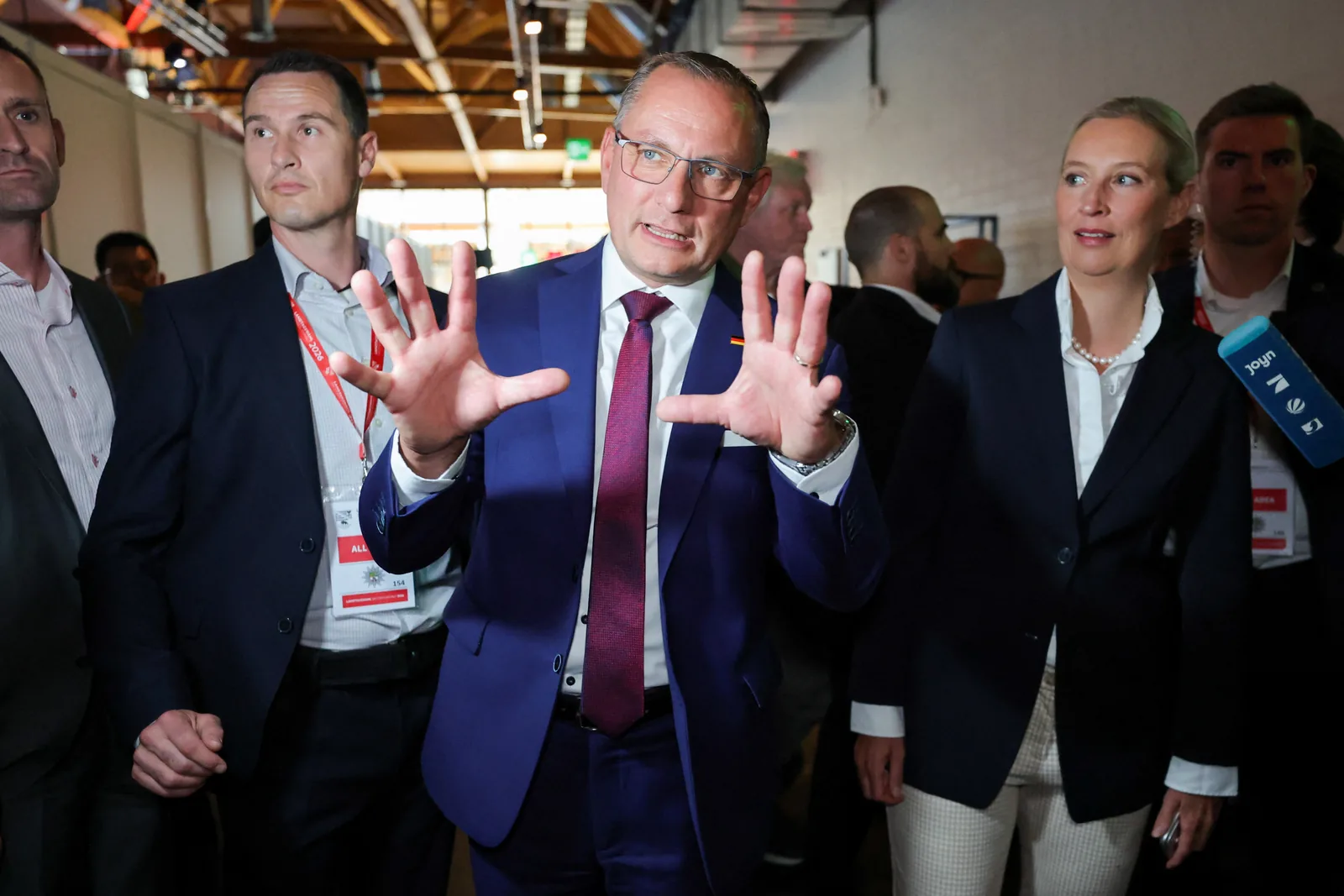
German Chancellor Friedrich Merz's Christian Democratic Union (CDU) suffered its worst state election result in postwar Germany, with exit polls showing the far-right Alternative for Germany (AfD) leading in Mecklenburg-Vorpommern with 37-38% and the Left Party topping Berlin. Merz called the outcome a "disaster" but vowed to keep his coalition together and press ahead with reforms, citing the need to protect Germany's "democratic future."
 Reference image
Editorial responsibility
- No named human review is recorded for this page.
- Reports are grouped by semantic similarity and deterministic rules. Language models may assist titles, summaries, translation and cross-source analysis; the page reads the event directly, while its address stays stable when the title changes.
- Summary covers the current reports
Cross-source coverage
Common ground
- Both sides agree that the rise of the AfD is a symptom of deep failures by mainstream parties like the CDU and SPD.
- Both agree that ordinary Germans face real economic pain from stagnant wages, unaffordable housing, and deindustrialization.
- Both agree that the establishment has lost credibility by failing to deliver tangible benefits to working people.
Points of contention
- The Western agent sees the cordon sanitaire as a necessary democratic firewall against an anti-constitutional party, while the Eastern agent calls it an establishment cartel that suppresses the popular will.
- The Western agent argues the AfD's platform is fundamentally authoritarian and cannot be legitimized by votes, while the Eastern agent insists 38% support is a democratic verdict that must be respected.
- The Western agent blames the AfD for weaponizing fear of migrants and change, while the Eastern agent blames the establishment for weaponizing fear of Russia and China and for outsourcing sovereignty to NATO and Brussels.
Blind spots
- Neither side fully addresses how to rebuild trust in democratic institutions while also addressing the legitimate grievances of AfD voters.
- The debate overlooks the role of media and social media in amplifying polarization and misinformation on all sides.
- There is little discussion of concrete policy solutions—like specific wage, housing, or energy reforms—that could win back disillusioned voters.
WorldAttention’s read
This debate reveals a deep rift in how to interpret Germany's political crisis. Both sides agree that mainstream parties like the CDU and SPD have failed ordinary people on wages, housing, energy, and migration, fueling the AfD's rise. However, they clash sharply on the response: the Western agent insists the AfD is an anti-constitutional threat that must be isolated by a democratic firewall, while the Eastern agent argues that isolating a party with 38% support only deepens the crisis and that the establishment must instead address the root causes of economic pain and lost sovereignty. The blind spots include a lack of concrete policy proposals and an overreliance on moral arguments rather than practical solutions. Ultimately, the path forward requires rebuilding centrist credibility through real results for working people, but the two sides cannot agree on whether that means engaging with or excluding the AfD.
Reporting timeline
Merz vows to keep ruling coalition together for sake of Germany's 'democratic future'
German Chancellor Friedrich Merz has vowed to keep his ruling coalition together, citing the need to protect Germany's 'democratic future' following a historic defeat for his party in regional elections. The far-right Alternative for Germany (AfD) won again in the state elections, while Merz's party suffered significant losses. Multiple news outlets report that Merz is fighting to survive the political crisis, which threatens Germany's traditional obsession with political stability. The chancellor is standing his ground despite the electoral setback, but analysts suggest the crisis could have broader implications for the stability of the federal government. The AfD's continued success in regional votes underscores growing public discontent with the ruling coalition.
Read sourceGermany's Merz attacks 'destructive' forces as he fights for political survival
German Chancellor Friedrich Merz is facing a severe political crisis after his party suffered historic defeats in two state elections in Thuringia and Saxony. The far-right Alternative for Germany (AfD) made significant gains, while a new left-wing populist party also performed strongly. Merz, who has been in office only since early 2024, blamed 'destructive forces' for the losses but vowed to continue leading the party and the government. The results have triggered intense internal criticism within his Christian Democratic Union (CDU), with some calling for a change in leadership. Former Chancellor Angela Merkel has remained publicly silent on the crisis. Analysts suggest the defeats threaten Germany's tradition of political stability and could complicate governance at the federal level. Merz has ruled out any coalition with the AfD, leaving limited options for forming stable governments in the affected states. The crisis comes amid broader voter discontent over immigration, economic stagnation, and the coalition government's performance.
Read sourceFar-right AfD wins again as German Chancellor Merz faces historic defeat in regional elections
A series of news articles report that the far-right Alternative for Germany (AfD) has achieved another electoral victory, while German Chancellor Friedrich Merz and his ruling Christian Democratic Union (CDU) face a significant defeat in regional elections. The Axios headline states 'Far-right AfD wins again as Germany's Merz slides.' The BBC reports that Merz's political crisis threatens Germany's obsession with stability. NBC News describes Merz fighting to survive a historic defeat. CNBC notes that German voters are turning to both the left and far-right, calling the result a 'disaster' for the ruling CDU that threatens pro-growth reforms. Bloomberg speculates on the political implications with the headline 'Is Germany About to Get Burnham-ed?' The outcomes suggest a major shift in the German political landscape, with the center-right CDU losing ground to parties on the political extremes, potentially impacting the country's economic reform agenda and political stability.
Read sourceShow 9 older updatesHide older updates
German Chancellor Merz Clings to Power After Far-Right AfD Wins State Elections
German Chancellor Friedrich Merz is facing a political crisis after his party suffered another electoral defeat to the far-right Alternative for Germany (AfD) in regional state elections. The AfD secured a victory, marking a continued slide for Merz's coalition government. Despite the loss, Merz has vowed to keep the ruling coalition together, stating it is necessary for Germany's 'democratic future.' Multiple news outlets, including The Guardian, Axios, BBC, Reuters, and NPR, report on the chancellor's precarious position and the implications of the far-right's gains. The elections are seen as a significant setback for the centrist parties and a boost for the AfD, which has capitalized on voter discontent over issues such as immigration and the economy. Merz's commitment to maintaining the coalition faces challenges as internal and external pressures mount.
Read sourceGerman Chancellor Merz calls state election a 'disaster' for his party but vows to stay on
German Chancellor Friedrich Merz has described recent state elections as a 'disaster' for his party after it suffered significant losses. The far-right Alternative for Germany (AfD) surged, leading in some states and achieving its worst state election result for Merz's party in postwar Germany. Despite the setback, Merz has vowed to remain in his position as chancellor. Multiple news outlets, including NPR, BBC, Bloomberg, Reuters, and CNN, report that the far right is now setting its sights on replacing Merz's party. The results have been characterized as a major blow to the chancellor's leadership and his party's standing ahead of future national contests.
Read sourceExit polls show far-right AfD leading in eastern German state election in Mecklenburg-Vorpommern
Exit polls from ARD and ZDF indicate the far-right Alternative for Germany (AfD) has won the state election in Mecklenburg-Vorpommern, an eastern German state, with a vote share between 37% and 38%, a significant increase from 16.7% in 2021. The Social Democratic Party (SPD) received between 35.5% and 36.5%. Chancellor Friedrich Merz's Christian Democratic Union (CDU) performed poorly, receiving only 5% to 5.5%, down from 13.3%. In Berlin, the Left Party led with 24.5% to 26%, while the CDU dropped to around 20%. Chancellor Merz addressed the nation, stating Germany's economy is undergoing profound transformation, social tensions are rising, and public trust in institutions is declining, facing challenges from political extremes. He emphasized the need for reforms and that his federal government will take responsibility. All major German parties have ruled out forming a coalition with the AfD.
Read sourceGermany's Merz vows to press ahead with reforms after historic state election defeat
German Chancellor Friedrich Merz has described the results of recent state elections as a 'disaster' after his party suffered its worst state election result in postwar German history. The far-right Alternative for Germany (AfD) surged ahead, marking another significant win. Despite the historic defeat, Merz has vowed to press ahead with reforms. The election results have been widely reported by international media outlets including NPR, CNN, Reuters, Bloomberg, and Forbes, all highlighting the scale of the defeat for Merz's party and the continued rise of the far-right in Germany.
Read sourceMerz calls regional election a 'disaster' as German far-right AfD heads for second win
German Chancellor Friedrich Merz has described a regional state election as a 'disaster' after exit polls indicated the far-right Alternative for Germany (AfD) party was heading for its second consecutive state election victory. The results pile pressure on Merz's coalition government, which has faced growing public discontent over migration and economic issues. Multiple news outlets report that Merz has vowed to stay on as chancellor and press ahead with reforms despite the historic defeat. The AfD's success in another state election signals a continued shift to the right in German politics, raising concerns among mainstream parties about the far-right's rising influence ahead of national elections.
Read sourceGerman Chancellor Merz vows to stay on despite 'disaster' state election exit polls
German Chancellor Merz has vowed to remain in office despite exit polls showing a 'disaster' for his party in two key state elections in Berlin and Mecklenburg-Western Pomerania. The far-right Alternative for Germany (AfD) is projected to top the vote in one of the states, according to exit polls reported by Reuters and other outlets. The BBC reports that Merz is fighting for political survival after the poor results. Voting was underway in the two states, with the far-right surge being a central theme. The New York Times notes that Germans are voting again amid a far-right surge, while Al Jazeera reports on the polls in Berlin and Mecklenburg-Western Pomerania. The outcome is seen as a major test for Merz's leadership and the stability of his coalition government.
Read sourceGerman state elections underway, seen as high-stakes test for Friedrich Merz
Voting is underway in two key German states, Berlin and Mecklenburg-Western Pomerania, in elections that are widely seen as a high-stakes test for Friedrich Merz, the leader of the Christian Democratic Union (CDU) and a candidate for chancellor. The elections are taking place amid a surge in support for the far-right Alternative for Germany (AfD) party. Multiple major news outlets, including the Financial Times, The New York Times, BBC, DW, and Al Jazeera, are covering the event, framing it as a potential indicator of the national political landscape and the fate of Merz's chancellorship ambitions. The results are expected to have significant implications for the upcoming federal elections and the future direction of German politics.
Read sourceMerz under pressure as two more German states go to the polls
German opposition leader Friedrich Merz faces increasing pressure as two more German states hold elections, with the far-right Alternative for Germany (AfD) gaining momentum. The outcomes of these state polls are seen as a critical test for Merz's leadership and could impact the future of Chancellor Olaf Scholz's government. Multiple news outlets, including Reuters, The Guardian, and The New York Times, report that the elections occur amid a far-right surge, raising questions about the stability of the ruling coalition. The Economist and CBS News note that Merz's performance in these elections may determine whether he can challenge Scholz effectively or if the chancellor could be forced out. The results are expected to influence national political dynamics ahead of the next federal election.
Read sourceGerman Chancellor's Future at Stake in Two State Elections, Reports Say
Multiple news outlets report that German Chancellor Friedrich Merz faces mounting pressure and a critical electoral test as two German states prepare to go to the polls on September 20. The Guardian notes that the future of the chancellor hangs in the balance. The Economist describes the vote as another electoral test for Merz. DW.com questions whether it is possible to replace the chancellor. CBS News reports that the far-right AfD is gaining steam, putting the leader under huge pressure, and asks if he could be forced out. Le Monde.fr states that Merz faces mounting criticism ahead of the regional elections. The articles collectively indicate that the outcome of these state elections could have significant implications for Merz's political future and the stability of his government.