Copper tariff fears drive record $500M shipment to New Orleans, narrowing arbitrage
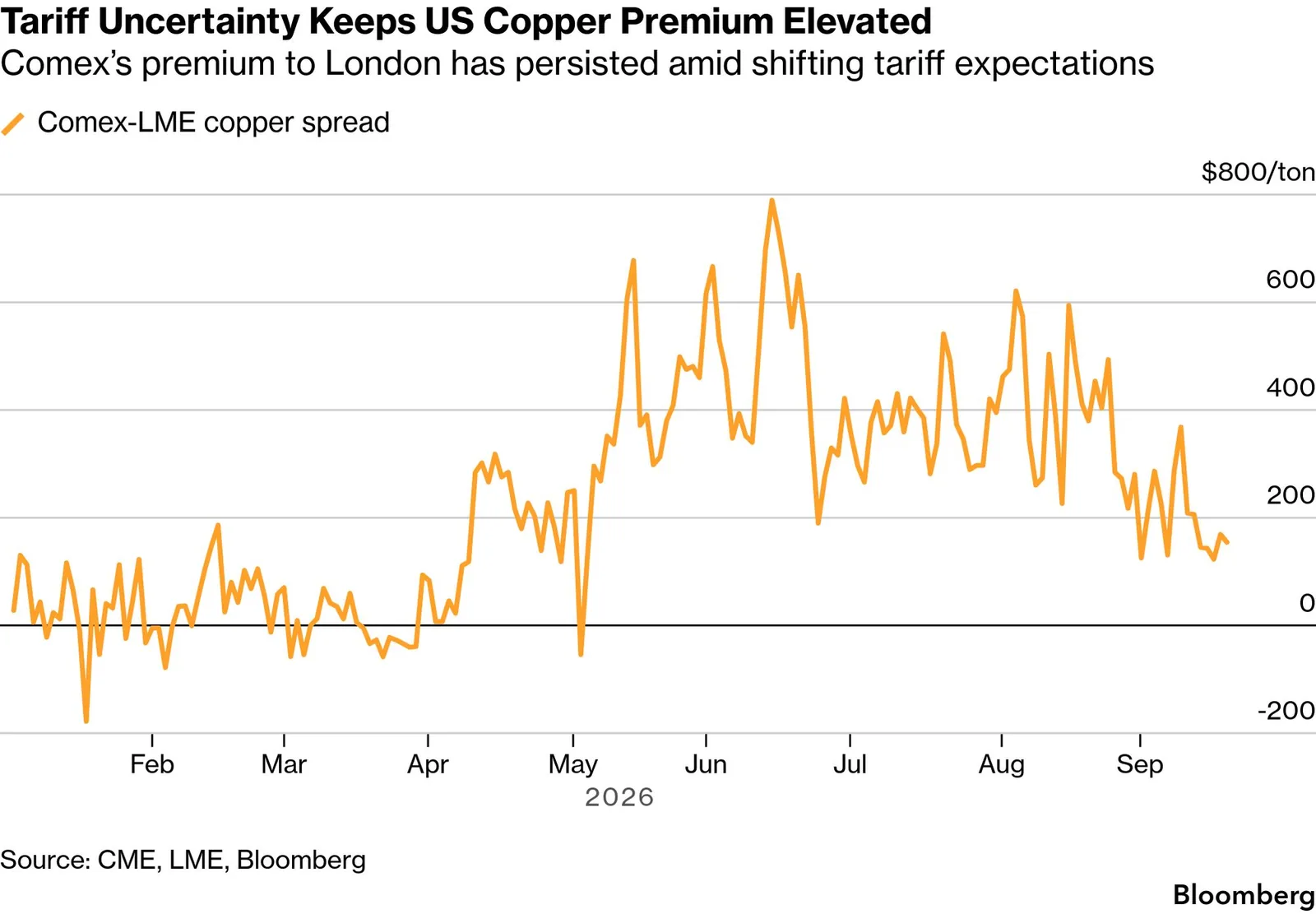
A record $500 million African copper shipment aboard the Nord Norfolk is heading to New Orleans as traders rush to beat potential US tariffs on refined copper. The Port of New Orleans is nearly saturated, with 100,000 more tonnes expected. The LME-Comex arbitrage spread has narrowed to $169/ton from a $789 peak, reducing shipment incentives. US warehouse capacity has expanded by 20 new facilities since early 2025.
 Illustration
Editorial responsibility
- No named human review is recorded for this page.
- Reports are grouped by semantic similarity and deterministic rules. Language models may assist titles, summaries, translation and cross-source analysis; the page reads the event directly, while its address stays stable when the title changes.
- Summary covers the current reports
Cross-source coverage
Common ground
- The $500 million copper shipment and port congestion are symptoms of policy uncertainty, not genuine market demand.
- The 78% collapse in the arbitrage spread shows traders doubt the tariff will actually be imposed.
- Asian manufacturers are facing real harm from higher input costs due to copper being diverted to the US.
- The environmental cost of shipping 100,000 tonnes of copper across oceans for speculative storage is significant and often overlooked.
- The psychological impact on global supply chains—signaling that the US can disrupt trade at will—is a genuine concern.
Points of contention
- Eastern Agent argues the tariff threat is a deliberate US strategy of economic coercion, while Neutral Agent sees it as policy paralysis or incompetence.
- Eastern Agent believes the multipolar world order (e.g., BRICS) would create predictable, rules-based trade, while Neutral Agent argues it would just multiply disruptions and veto points.
- Neutral Agent insists the market overreacted to an unresolved threat, while Eastern Agent blames Washington's weaponized trade policy for triggering the chaos.
- Eastern Agent views the lack of a clear tariff timeline as strategic ambiguity, while Neutral Agent sees it as evidence of indecision and dysfunction.
Blind spots
- Both sides initially overlooked the environmental cost of speculative copper shipments, including carbon emissions from trans-Pacific shipping and barge transfers.
- The domestic political constraints—like the construction industry's opposition to tariffs—were underappreciated by Eastern Agent and only fully raised by Neutral Agent late in the debate.
- Neither side deeply explored how other nations (e.g., China or India) might retaliate or adapt to similar tariff threats in a multipolar system.
WorldAttention’s read
This debate reveals a deep divide over whether the copper tariff saga is a calculated US power play or a case of policy paralysis. Both sides agree that the uncertainty is causing real harm—wasting resources, hurting Asian manufacturers, and burning carbon—but they disagree on intent. Eastern Agent sees a deliberate strategy to coerce global supply chains, while Neutral Agent sees a government stuck between domestic pressures and unable to act. The blind spots include the environmental toll and the role of domestic politics, which both sides eventually acknowledged. Ultimately, the core issue is that one country's indecision can distort global markets, and the path forward requires either more functional governance in the current system or a new, more balanced global order—though there's no consensus on which is more realistic.
Reporting timeline
Copper Prices Surge Despite Fed Pressure as Tariff Fears Drive Stockpiling
Copper prices remain strong near record highs despite high interest rates and a hawkish Federal Reserve, which typically pressures industrial metals. A key driver is the expectation of US tariffs on refined copper, prompting traders and producers to rush shipments to American ports. This has drawn significant copper inventories to the US, with a single vessel carrying $500 million worth of African copper to New Orleans. US warehouse capacity is expanding rapidly, with 20 new Comex copper warehouses added since early 2025. However, this stockpiling has not eased global price pressure, as it is policy-driven rather than demand-driven. The arbitrage window between US and international prices has narrowed from $789 per ton to around $169, reducing the incentive for further shipments. Uncertainty over whether the US will finalize the tariff is causing some market participants to reassess their logistics. Analysts from TD Securities and RBC Capital Markets note that while tariff speculation may fade, underlying physical market tightness from data centers, renewable energy demand, and mine supply disruptions continues to support copper prices.
Read sourceCopper Prices Surge Despite Fed Pressure as Tariff Fears Trigger Rush to US Market
Copper prices remain near record highs despite a hawkish Federal Reserve and a strong dollar, driven by a massive rush to ship copper to the US ahead of potential tariffs on refined copper. A single vessel carrying $500 million worth of African copper arrived in New Orleans, the largest such shipment on record. US warehouse capacity is being rapidly expanded, with 20 new Comex copper warehouses added since early 2025. However, the arbitrage window between US and international prices is narrowing, falling from $789 per ton to around $169, as doubts grow over whether the tariffs will be implemented. Analysts from TD Securities and RBC Capital Markets note that the tariff threat itself has already drawn supply to the US and raised domestic premiums, while underlying physical tightness from data centers, renewable energy demand, and mine supply disruptions continues to support prices. Some shipments may be redirected to Asia if tariffs do not materialize.
Copper Prices Surge Despite Fed Pressure as Tariff Fears Trigger Rush to US
Copper prices remain strong near record highs despite hawkish Federal Reserve signals and a strong dollar, driven by a rush to ship metal to the US ahead of potential tariffs on refined copper. A single vessel carrying approximately $500 million worth of African copper arrived in New Orleans, the largest single-shipment cargo on record according to Kpler. US warehouse capacity is expanding rapidly, with the CME adding 20 new copper warehouses since early 2025. However, the arbitrage window between US and international prices has narrowed from $789 per ton to around $169, reducing the incentive for further shipments. Analysts at TD Securities note that the mere threat of tariffs has already created tariff-like effects, drawing supply to the US and raising domestic premiums. RBC Capital Markets analysts caution that while speculative tariff buying may fade, physical market tightness from data centers, renewable energy demand, and mine supply disruptions continues to support prices.
Read sourceShow 4 older updatesHide older updates
Record $500 Million Copper Shipment Nears US as Tariff Fears Swamp New Orleans Port
The Liberian-flagged bulk carrier Nord Norfolk is crossing the Atlantic carrying approximately $500 million worth of African copper, potentially setting a record for the most expensive single-vessel bulk shipment in history. This shipment is part of a broader 'copper rush' into the United States driven by the possibility of import tariffs on refined copper, a policy first proposed by former President Trump in February 2024. The Port of New Orleans, a key hub for Comex copper warehouses, is reportedly nearly saturated, with an additional 100,000 metric tons of copper from Africa and South America expected in September and October. The strong US import demand has pushed benchmark LME copper prices up about 50% since the tariff proposal. However, the LME-Comex arbitrage spread has narrowed to $169 per ton from a peak of $789, as skepticism grows over whether the tariffs will be implemented. TD Securities strategist Ryan McKay noted that the mere possibility of tariffs has already achieved their intended effect of attracting supply and raising domestic premiums. Traders are watching whether the narrowing arbitrage window will slow the pace of US imports and potentially reroute cargoes to Asia.
Read sourceCopper Shipment Worth $500 Million Heads to US as Port of New Orleans Faces Congestion
A Liberian-flagged bulk carrier, the 'Nord Norfolk,' is crossing the Atlantic toward New Orleans carrying approximately $500 million worth of African-origin copper, potentially the highest single-batch market value for a commodity cargo ship on record. This shipment is part of a massive influx of copper into the United States driven by traders anticipating potential copper import tariffs. The Port of New Orleans, a key metal import gateway, is reportedly saturated, with an estimated 100,000 metric tons of copper from Africa and South America scheduled to arrive in September and October. A logistics CEO confirmed severe congestion and delays in transferring metals to trucks and rail, forcing some companies to use barges. The surge in US imports has been a core driver of record copper prices, with the global benchmark rising about 50% since tariff proposals began. However, the arbitrage spread between London and New York copper prices has narrowed to $169 per ton from a peak of $789, raising questions about whether the import pace will slow. TD Securities strategist Ryan McKay noted that the mere possibility of tariffs has already attracted large supplies to the US, and the White House may delay its decision to maintain this status quo.
Record $500M Copper Cargo Heads to New Orleans as US Tariff Fears Drive Market
The Liberian-flagged bulk carrier Nord Norfolk is crossing the Atlantic toward New Orleans carrying approximately $500 million worth of African-produced copper, the highest single-batch market value for a commodity cargo ever recorded by data analytics firm Kpler. The Port of New Orleans is a key metals transshipment hub and central node for COMEX copper warehouses under CME Group, with storage capacity now nearly saturated. An additional 100,000 tonnes of copper from Africa and South America are scheduled to arrive in September and October. Robust U.S. demand for copper imports has driven record-high prices. Since former President Trump first formally proposed tariffs on copper in February last year, the global benchmark copper price on the London Metal Exchange has risen by about 50%. However, growing market skepticism over whether Trump will ultimately implement the tariffs has narrowed the price spread between U.S. and international markets; the arbitrage spread currently stands at $169 per tonne, down from an annual peak of $789 per tonne. In response to surging demand for U.S. warehousing, storage companies are applying to COMEX for additional capacity. The exchange stated that since the start of 2025, it has added 20 new warehouses, increasing copper storage capacity by nearly 725,000 short tons, equivalent to about 39% of annual U.S. refined copper consumption.
Copper Shipment Worth $500 Million Highlights Tariff-Driven Rush to US Ports
The bulk carrier Nord Norfolk is crossing the Atlantic carrying approximately $500 million worth of African copper, potentially setting a record for the most expensive single-vessel bulk shipment in history. This vessel is part of a larger 'copper rush' to U.S. shores driven by anticipation of potential import tariffs on refined copper by President Trump. The Port of New Orleans, a key hub for Comex copper warehouses, is nearly saturated, with an additional 100,000 tonnes of copper from Africa and South America scheduled to arrive in September and October. Since Trump first proposed copper tariffs in February, benchmark LME copper has surged about 50%. However, skepticism over whether the tariffs will be implemented has narrowed the LME-Comex arbitrage spread to $169 per tonne from a peak of $789, potentially reducing the incentive for further shipments to the U.S. TD Securities strategist Ryan McKay noted that the mere possibility of tariffs has already achieved their intended effect by attracting supply and raising domestic premiums. The White House may continue delaying a decision to maintain this status quo.
Read source