Changxin Technology begins mass production of fifth-generation DRAM; shares surge 6%
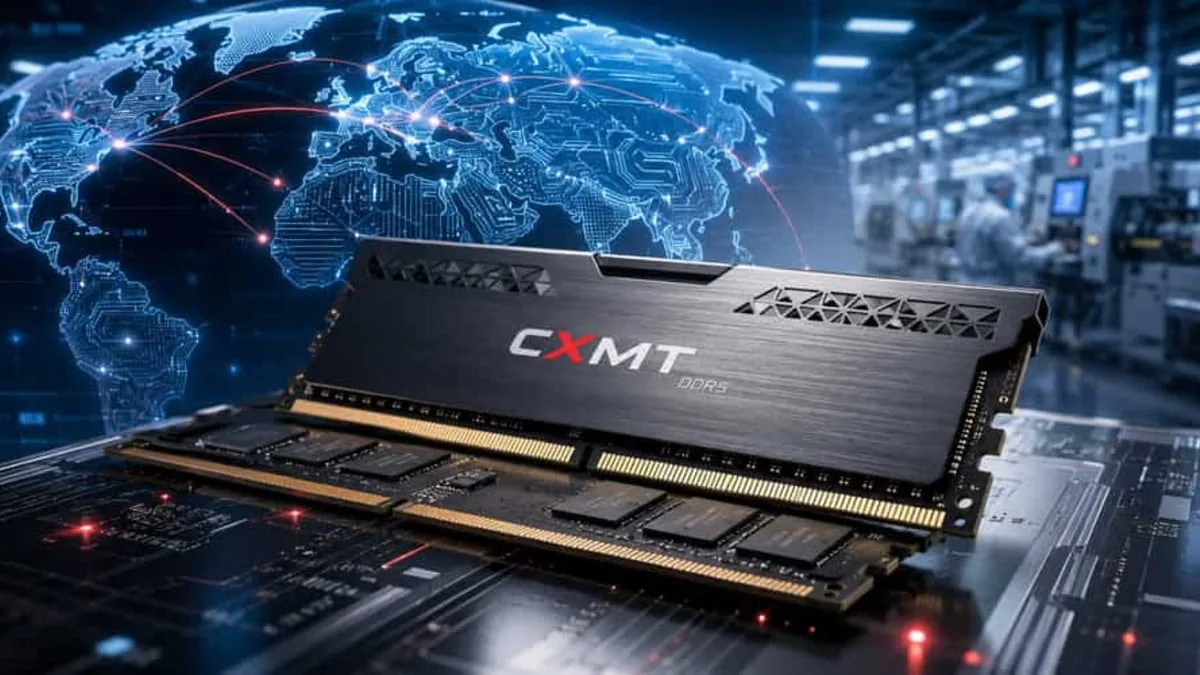
Chinese DRAM leader Changxin Technology (CXMT) announced on September 20, 2026, that its fifth-generation process technology platform has entered mass production, showcasing 24GB LPDDR5X products at the World Manufacturing Conference. The company cautioned that yield ramp-up will take time and products have not yet generated significant sales. The news drove CXMT shares up nearly 6% intraday on September 21. Separately, UBS raised its global AI capex forecast to $998 billion in 2026, citing rapid memory price increases, while South Korea reported a 259% year-on-year surge in chip exports for the first 20 days of September.
 Illustration
Editorial responsibility
- No named human review is recorded for this page.
- Reports are grouped by semantic similarity and deterministic rules. Language models may assist titles, summaries, translation and cross-source analysis; the page reads the event directly, while its address stays stable when the title changes.
- Summary covers the current reports
Cross-source coverage
Common ground
- Changxin's G5 DRAM mass production is a real engineering achievement and a significant milestone for China's semiconductor industry.
- US export controls have backfired by accelerating China's push for domestic chip production.
- The global memory market is currently experiencing a price boom driven by AI demand, which has boosted revenues for Asian producers including Changxin.
- The yield gap between Changxin and established players like Samsung and SK Hynix is a genuine challenge that won't be solved quickly.
- The human cost of this effort—engineers working long hours under pressure—is real and often overlooked.
Points of contention
- Whether Changxin's success proves it can become a cost-competitive global leader or just survive in a protected domestic market.
- Whether the current price boom is sustainable 'oxygen' for R&D or a temporary high that will crash when supply increases.
- Whether the yield gap is a temporary hurdle that will close through necessity or a structural disadvantage that compounds over time.
- Whether the market's high valuation of Changxin is justified or a bubble ignoring basic economics.
- Whether the focus should be on geopolitical sovereignty and justice or on financial and technological fundamentals.
Blind spots
- The debate largely ignores the impact on the Global South and the ethical costs of the AI boom, such as energy use and resource extraction.
- There is little discussion of how Chinese capacity additions could flood the market and crash prices, hurting all producers.
- The long-term sustainability of engineer burnout and the human toll of this national push is acknowledged but not deeply explored.
- The possibility that Changxin might redefine competition by focusing on self-sufficiency and the domestic market rather than node leadership is underappreciated.
WorldAttention’s read
Changxin's G5 DRAM production is a real breakthrough that proves China can build advanced memory chips despite export controls, but it's not yet a victory. The company faces steep challenges: a yield gap that won't close quickly, a price boom that could reverse, and intense competition from better-equipped incumbents. The market is betting on a best-case scenario, but the human cost and economic risks are real. The bigger question is whether this shift leads to a more multipolar and fair global tech order or just a new hierarchy. For now, Changxin has survived and positioned itself for the AI era, but dominance is far from guaranteed.
Reporting timeline
China Memory Breakthrough, UBS Sees Global AI Capex Nearing $1 Trillion by 2026
On September 21, Chinese tech stocks rebounded, driven by a breakthrough in domestic memory technology. At the 2026 World Manufacturing Expo, a leading Chinese memory maker announced mass production of its fifth-generation platform, including 24GB LPDDR5X products for flagship smartphones. UBS forecasts global AI capital expenditure will reach $998 billion in 2026, nearly doubling from $506 billion in 2025, with memory spending surging from $71 billion to $367 billion due to rapid price increases. TrendForce raised its Q4 DRAM contract price forecast to 18-23% from 8-13%, citing server demand. Apple accepted Samsung's Q1 2027 memory quotes, with DRAM near $2/Gb and NAND near $0.33/Gb, up 30-40% from Q3 2026. Huawei released the Ascend 960 supernode with NPO technology and the OceanStor M900 AI memory storage system, supporting up to million-card clusters. Analysts expect demand growth for AI chips, CPUs, memory, interconnect, and cooling solutions as computing shifts from single cards to clusters.
Read sourceChina's Top DRAM Maker Changxin Technology Begins Mass Production of 5th-Gen Chips
Changxin Technology (stock code 688825), China's leading DRAM manufacturer, announced on September 20 that its fifth-generation process technology platform has entered mass production. The announcement was made at the 2026 World Manufacturing Conference. The company also showcased a high-capacity LPDDR5X product built on the new platform. The stock rose nearly 6% in intraday trading on September 21 before paring gains to 3.5%, giving a market capitalization of 3.9 trillion yuan. Changxin cautioned that the new platform requires a yield ramp-up period and that products have not yet generated significant sales. Separately, South Korea reported a 259% surge in chip exports for the first 20 days of September. UBS sharply raised its global AI capital expenditure forecast, projecting $998 billion in 2026 and $1.447 trillion in 2027, citing rapid memory price increases. The bank noted that rising memory prices shift income and profits to Asian memory producers, benefiting their economies.
Read sourceChangxin Technology's Fifth-Gen DRAM Process Enters Mass Production; Stock Surges on AI Memory Boom
On September 21, 2026, Chinese DRAM leader Changxin Technology (stock code 688825) saw its share price surge nearly 6% intraday before closing up 3.5%, reaching a market cap of 3.9 trillion yuan. The rally followed the company's announcement that its fifth-generation process technology platform had officially entered mass production, with LPDDR5X products showcased at the World Manufacturing Convention. Changxin cautioned that the new platform requires a yield ramp-up period and has not yet generated significant sales. The news coincided with strong gains for Samsung Electronics and SK Hynix, as Korean customs data showed chip exports surged 259% in the first 20 days of September. UBS sharply raised its global AI capital expenditure forecast, projecting $998 billion in 2026 and $1.447 trillion in 2027, driven largely by rising memory prices. Changxin reported first-half 2026 revenue of 150.31 billion yuan, up 874% year-on-year, with net profit of 77.6 billion yuan versus a loss a year earlier. Analysts at TF Securities highlighted the company's exposure to AI demand, the DRAM super-cycle, and domestic substitution trends.
Read sourceShow 7 older updatesHide older updates
Changxin Technology Shares Surge on Fifth-Gen DRAM Mass Production; Korea Chip Exports Jump 259%
On September 21, 2026, shares of Chinese DRAM leader Changxin Technology (688825) rose as much as 6% after the company announced late on September 20 that its fifth-generation process technology platform had entered mass production. The company displayed a large-capacity LPDDR5X product based on the platform at the 2026 World Manufacturing Convention. Changxin cautioned that the new platform requires a yield ramp-up period and has not yet generated significant sales. Separately, Korea Customs Service reported that chip exports surged 259% year-on-year in the first 20 days of September, driving overall export growth of 78%. UBS sharply raised its global AI capital expenditure forecast, projecting $998 billion in 2026 and $1.447 trillion in 2027, citing rapidly rising memory prices. Tianfeng Securities noted Changxin benefits from AI demand, the DRAM super-cycle, and domestic substitution. The article also cites Omdia data showing the global DRAM market could grow from $150.5 billion in 2025 to $763.8 billion in 2030.
Read sourceChangxin Technology Shares Surge on 5th-Gen DRAM Mass Production; Korea Chip Exports Soar 259%
Changxin Technology (stock code 688825), China's leading DRAM manufacturer, saw its shares rise up to 6% on September 21 after announcing late on September 20 that its fifth-generation process technology platform has entered mass production. The company showcased large-capacity LPDDR5X products based on the platform at the 2026 World Manufacturing Convention. Changxin cautioned that the new platform requires a yield ramp-up period and has not yet generated significant sales. The announcement comes amid a global DRAM supply shortage and surging prices driven by AI demand. Separately, Korea Customs data showed Korea's chip exports surged 259% year-on-year in the first 20 days of September, reaching $34.12 billion. UBS sharply raised its global AI capital expenditure forecast, projecting $998 billion in 2026 and $1.447 trillion in 2027, citing rapidly rising memory prices. Changxin reported H1 2026 revenue of 150.31 billion yuan, up 873.64% year-on-year, with net profit of 77.605 billion yuan versus a loss a year earlier. TF Securities highlighted the company's exposure to AI computing growth, the DRAM super-cycle, and domestic substitution trends.
Read sourceChina's CXMT Mass Produces G5 DRAM, Enters Flash Market; AI Memory Demand Drives Price Surge
This daily storage market digest from TradeAlpha (Sept 21, 2026) reports multiple key developments. China's ChangXin Memory Technologies (CXMT) announced mass production of its fifth-generation (G5) DRAM technology, bringing its general DRAM process close to international leading levels. A source indicates CXMT is preparing to enter the NAND flash market, directly competing with Samsung, SK Hynix, and Micron. Acer notes that storage shortages are partially easing, predicting PC prices may reverse in H2 2027. UBS forecasts global AI capital expenditure will reach $1.4 trillion by 2027, with 90% of the incremental spending driven by memory price increases. TrendForce reports DDR5 16Gb (2Gx8) 4800/5600 spot prices rose 0.75% day-on-day. SK Hynix subsidiary Solidigm plans to build a NAND production base in the eastern US. TrendForce expects CoWoS-L to remain the mainstream AI chip packaging solution through 2028. Mature process foundries like UMC and Powerchip are considering price hikes due to surging demand. South Korea's exports in the first 20 days of September hit a record high, with chip exports surging nearly 260% year-on-year.
Read sourceMemory Market Digest: Longxin G5 DRAM Mass Production, AI Capex Forecast, Chip Export Surge
This daily market digest from Jin10, dated September 21, 2026, covers key developments in the global memory and semiconductor industry. Longxin Technology announced the mass production of its fifth-generation (G5) technology platform, bringing its general-purpose DRAM process close to international tier-1 levels. Sources indicate Longxin is preparing to enter the flash memory market, directly competing with Samsung, SK Hynix, and Micron. Acer noted that storage shortages are partially easing, but PC prices may not reverse until the second half of 2027. UBS forecasts global AI capital expenditure will reach $1.4 trillion by 2027, with 90% of the increase driven by memory price hikes. TrendForce reported a 0.75% day-on-day increase in the spot price of DDR5 16Gb (2Gx8) 4800/5600 modules. SK Hynix subsidiary Solidigm plans to build a NAND production base in the eastern United States. TrendForce also predicts CoWoS-L will remain the mainstream AI chip packaging solution through 2028. Mature-node foundries UMC and Powerchip are planning price increases amid demand surges. South Korea's exports for the first 20 days of September hit a record high, with chip exports surging nearly 260% year-on-year.
Changxin Technology Surges on Mass Production of Fifth-Gen DRAM; Korean Chip Exports Soar
Chinese DRAM maker Changxin Technology (stock code 688825) saw its shares surge nearly 6% intraday on September 21, after announcing late on September 20 that its fifth-generation process technology platform has entered mass production. The company, now China's largest and the world's fourth-largest DRAM manufacturer by shipments and sales, also showcased a high-capacity LPDDR5X product built on the platform. Changxin cautioned that the new platform requires a yield ramp-up period and has not yet generated significant sales. Separately, South Korea reported a 259% year-on-year surge in chip exports for the first 20 days of September, reaching $34.12 billion. UBS sharply raised its global AI capital expenditure forecast, projecting $998 billion in 2026 and $1.447 trillion in 2027, driven largely by rising memory prices. The bank noted that this shift in spending benefits Asian memory producers. Changxin's first-half 2026 revenue surged 873.64% to 150.31 billion yuan, with net profit of 77.605 billion yuan versus a loss a year earlier, attributed to tight DRAM supply and price increases.
Read sourceChina's DRAM Leader Changxin Technology Starts Mass Production of Fifth-Gen Chips
Changxin Technology (stock code 688825), China's top DRAM manufacturer and the world's fourth-largest, announced on September 20 that its fifth-generation process technology platform has entered mass production. The news, disclosed at the 2026 World Manufacturing Conference, drove the company's stock up nearly 6% intraday on September 21 before settling at a 3.5% gain, giving it a market capitalization of 3.9 trillion yuan. The company cautioned that yield ramp-up will take time and that products based on the new platform have not yet generated significant sales. Separately, South Korea's September 1-20 chip exports surged 259% year-on-year to $34.12 billion, according to Korean customs data. UBS sharply raised its global AI capital expenditure forecast, projecting $998 billion in 2026 and $1.447 trillion in 2027, citing rapid memory price increases rather than broader infrastructure expansion. The bank noted that rising memory prices shift income and profits to Asian memory producers, benefiting their economies. Changxin reported first-half 2026 revenue of 150.31 billion yuan, up 873.64% year-on-year, swinging to a net profit of 77.61 billion yuan from a loss a year earlier, driven by tight DRAM supply and higher prices.
Read sourceChangxin Technology Shares Surge on Mass Production of Fifth-Gen DRAM Platform
On September 20, 2026, Chinese DRAM maker Changxin Technology (stock code 688825) announced at the World Manufacturing Conference that its fifth-generation process technology platform has entered mass production, and it showcased a high-capacity LPDDR5X product built on the platform. The company stated the milestone will help enrich its product matrix and enhance competitiveness, but cautioned that the new platform requires a yield ramp-up period and that products have not yet generated significant sales, so the near-term financial impact is limited. The announcement drove Changxin's stock up nearly 6% intraday on September 21, before paring gains to 3.5%, giving the company a market capitalization of 3.9 trillion yuan. Separately, UBS sharply raised its global AI capital expenditure forecast, predicting $998 billion in 2026 and $1.447 trillion in 2027, citing rapidly rising memory prices. UBS noted that the spending surge is driven by price increases rather than infrastructure expansion, which will shift income and profits to Asian memory producers. South Korea's chip exports surged 259% year-on-year in the first 20 days of September, reaching $34.12 billion, contributing to a record export total of $71.4 billion for the period.
Read source