CDU shut out of state parliament for first time since 1949; Merz vows to continue reforms
German Chancellor Friedrich Merz's Christian Democratic Union (CDU) suffered historic defeats in state elections on September 20, 2026. In Mecklenburg-Vorpommern, the CDU received 4.9% of the vote, failing to enter the state parliament for the first time since World War II. In Berlin, the CDU placed second with 18.8%, behind the Left Party. The far-right Alternative for Germany (AfD) won in Mecklenburg-Vorpommern. Merz described the result as a "disaster" but vowed to continue his reform agenda, stating reforms are "the antidote to authoritarian poison." Internal party criticism has grown, with some CDU figures calling for his resignation.
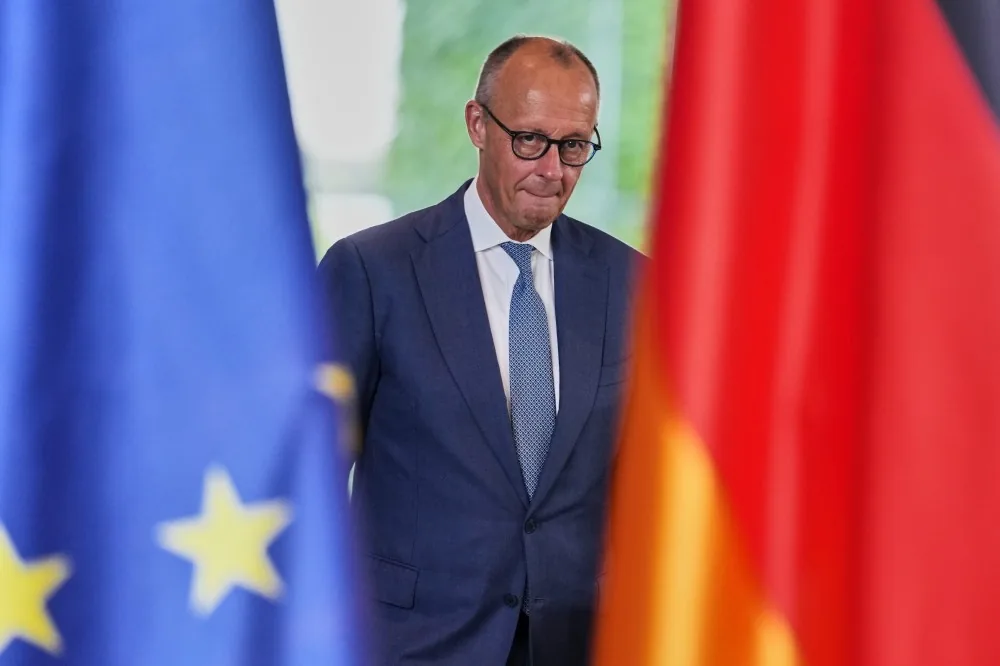 Reference image
Editorial responsibility
- No named human review is recorded for this page.
- Reports are grouped by semantic similarity and deterministic rules. Language models may assist titles, summaries, translation and cross-source analysis; the page reads the event directly, while its address stays stable when the title changes.
- Summary covers the current reports
Cross-source coverage
Reporting timeline
Poll: Merz-led Union Party Support Falls to Lowest Since Parliamentary Election Period
A new poll released on September 27 in Germany shows that the support rate for Chancellor Friedrich Merz's Union party (CDU/CSU) has dropped to 19%, the lowest level since the current federal parliamentary election cycle began. The decline places the Union party 10 percentage points behind the Alternative for Germany (AfD) party. The poll was conducted by an unspecified survey organization and reported by CCTV News via the Cailianshe financial news service. The result marks a significant setback for Merz's leadership and the center-right alliance, which has seen its popularity erode amid ongoing political challenges.
Read sourceGermany's identity crisis deepens as Merz scrambles for support after election losses
A series of regional elections in Germany has destabilized Chancellor Friedrich Merz's coalition government, revealing a deepening national identity crisis. Merz's CDU party lost to the far-right Alternative for Germany (AfD) in several states, including Saxony-Anhalt and Mecklenburg-Western Pomerania, while the Left party topped polls in Berlin. Voters are turning away from centrist parties amid fears over the economy and migration. Merz, who came to power in 2025 promising to boost the economy and curb immigration, faces record-low approval ratings and is described as arrogant and out of touch. Although no open challenge has emerged within his party, rumors of a chancellor swap persist. The AfD, polling at around 28% nationally, has capitalized on nostalgia and anxiety, despite being monitored for extremism. Economic growth forecasts have been raised above 1% for 2026-2027, and illegal entries are down, but public anxieties over energy costs, Chinese competition, and integration remain high. The elections highlight eroding support for Germany's political center and a polarizing debate on the AfD.
Germany's Merz faces difficult days after far-right AfD and Left Party election wins
A collection of news reports indicates that German Chancellor Friedrich Merz is facing a political crisis following significant electoral gains by the far-right Alternative for Germany (AfD) and the Left Party in state elections. The AfD is reported to be leading in a north-east state according to exit polls. Multiple sources, including DW.com, NPR, Reuters, BBC, and Al Jazeera, cover the event, highlighting the challenge to Merz's leadership and Germany's traditional political stability. The reports note that Merz is standing his ground after his party's losses, but the rise of the far-right is seen as a development with implications beyond Germany's borders.
Read sourceShow 17 older updatesHide older updates
Merz vows to keep ruling coalition together for Germany's 'democratic future' after state election defeats
German Chancellor Friedrich Merz has vowed to keep his ruling coalition between the Christian Democratic Unionist (CDU) party and the Social Democratic Party (SPD) together for the sake of Germany's 'democratic future,' following resounding defeats for his party in two state elections. In Mecklenburg-Vorpommern, the far-right Alternative for Germany (AfD) won the most votes, and the CDU failed to reach the threshold to enter the state parliament. In Berlin, the CDU came second to the hard-left Die Linke party, with the AfD also making significant gains. Merz described the result in Mecklenburg-Vorpommern as 'a heavy blow' and a 'profound turning point,' but pushed back against the idea that his low popularity ratings were behind the defeats, insisting the reasons 'go far beyond my own person.' His position has come under mounting pressure, with rumors of a possible mid-term chancellor swap. AfD co-leader Alice Weidel told the BBC that Merz would leave office 'pretty soon.' The elections occurred two weeks after the CDU saw its vote halved in Saxony-Anhalt.
Read sourceGerman Chancellor Merz Says He Has Party Support to Remain in Office After Election Defeats
German Chancellor Friedrich Merz announced on September 21 that he has secured support from his Christian Democratic Union (CDU) party leadership to continue as chancellor, despite the party's historic failure to enter the state parliament in Mecklenburg-Vorpommern. The CDU received less than 5% of the vote in Sunday's election, marking the first time since World War II that the party has been excluded from a state legislature. This defeat follows a series of losses to the far-right Alternative for Germany (AfD) over the past month, prompting growing calls within the conservative party for Merz to resign. After convening CDU leadership in Berlin to assess his position, Merz stated he has internal backing to stay. He also proposed that the CDU continue its 16-month coalition with the Social Democratic Party (SPD) to pursue comprehensive reforms to Germany's pension, healthcare, and tax systems.
Read sourceGerman Chancellor Merz Says He Has Party Support to Remain in Office After Election Defeat
German Chancellor Friedrich Merz has stated he will continue his reform agenda and remain as leader, following a historic defeat for his Christian Democratic Union (CDU) in a state election. On September 21, the CDU failed to secure 5% of the vote in Mecklenburg-Vorpommern, marking the first time the party has been shut out of a state parliament in post-World War II Germany. This loss follows a series of setbacks to the far-right Alternative for Germany (AfD) party. Despite growing calls from within the conservative party for Merz to step down, he convened the CDU leadership in Berlin and claimed to have secured their backing to stay. He also proposed that the CDU continue its 16-month coalition with the Social Democratic Party (SPD) to push forward comprehensive reforms to Germany's pension, healthcare, and tax systems.
Read sourceMerz press conference begins with technical glitch; chancellor scolds standing reporter
German Chancellor Friedrich Merz held a press conference on September 21, 2026, following the CDU's electoral defeats in Berlin and Mecklenburg-Vorpommern state elections. The conference began awkwardly with a sound problem, after which Merz scolded a journalist for standing and blocking others' views. The CDU failed to re-enter the Mecklenburg-Vorpommern parliament for the first time, while in Berlin the Left party came first, the CDU second, and the AfD third. Merz acknowledged the role of federal politics in the results, stating the government faces a 'historic task' and that 'it is about nothing less than the democratic future of the country.' He condemned rising antisemitism and announced a law to ban expropriations. CDU Vice Silvia Breher reported a 'depressed mood' in the party presidium, while Hamburg CDU chief Dennis Thering suggested Merz should face a confidence vote. The Left party distanced itself from a clan chief and a terrorist glorifier who appeared at its election party.
Read sourceGerman citizens criticize Chancellor Friedrich Merz for lack of reforms and poor communication
Following the CDU's failure to secure any seats in the state parliament of Mecklenburg-Vorpommern, WELT reporter Greta Wagener conducted a vox populi at Berlin's main train station to gauge public sentiment toward Chancellor Friedrich Merz. According to the article, citizens expressed criticism of Merz, pointing to a lack of reforms and inadequate communication from the Chancellor. The piece, published by Die Welt on September 21, 2026, presents this as a snapshot of public mood in the capital after a significant electoral setback for Merz's party.
CDU gets zero votes in eleven German towns, misses state parliament by 1,138 votes
In the Mecklenburg-Vorpommern state election held on September 21, 2026, the Christian Democratic Union (CDU) suffered a historic defeat, receiving zero votes in eleven small municipalities. The party narrowly missed the 5% threshold to enter the state parliament, falling short by just 1,138 votes. The far-right Alternative for Germany (AfD) won the election with 38.2% of the vote, followed by the Social Democratic Party (SPD) with 35.5%. According to a ZDF election analysis, 80% of respondents and 70% of CDU supporters blamed Chancellor Friedrich Merz for the party's poor performance, with only 1% viewing him as helpful. Voter migration data shows the AfD gained 30,000 votes from former CDU voters, along with 47,000 from the SPD and 67,000 from previous non-voters. A potential coalition government could be formed by the SPD, the Left Party (6.5%), and the Greens (5.7%).
Read sourceGermany's CDU suffers historic defeat in regional elections, falling below 5% for first time
On September 20, 2026, German Chancellor Friedrich Merz's Christian Democratic Union (CDU) suffered a historic defeat in regional elections in Mecklenburg-Vorpommern and Berlin. For the first time since 1949, the CDU fell below the 5% threshold required for parliamentary representation in a state election, in Mecklenburg-Vorpommern. The party was defeated by the far-right Alternative for Germany (AfD) in Mecklenburg-Vorpommern and by the far-left in Berlin. This defeat follows the CDU's loss of Saxony-Anhalt on September 6, where it had governed since 2002, to the AfD, which is now attempting to form a governing coalition there. The article notes that the AfD's rise is causing concern within EU institutions.
Chrupalla Says 'Blue Wave Cannot Be Stopped,' Calls for Chancellor Merz's Resignation
Following state elections in Mecklenburg-Vorpommern and Berlin, the CDU failed to re-enter the Mecklenburg-Vorpommern state parliament, falling below the 5% threshold. AfD co-leader Tino Chrupalla declared the resignation of Chancellor Friedrich Merz as 'overdue,' citing 'extreme politics' on energy prices and Ukraine support. AfD co-leader Alice Weidel stated the results show the AfD has 'replaced the CDU as a people's party' and called for an end to the 'firewall' policy against her party. The AfD won the election in Mecklenburg-Vorpommern, while the Left party came first in Berlin. The SPD expressed irritation with Merz's insistence on continuing reform policies despite the losses.
Read sourceAfD's Siegmund Mocks Merz as 'AfD Campaigner' After CDU Fails to Enter State Parliament
The CDU failed to clear the 5% threshold in the Mecklenburg-Vorpommern state election, marking the first time the party has been shut out of a German state parliament. AfD politician Ulrich Siegmund mocked the result in a video, sarcastically claiming that CDU leader and Chancellor Friedrich Merz is actually an AfD campaigner they infiltrated into the CDU. The AfD won the state election in Mecklenburg-Vorpommern, while the Left party came first in Berlin. The CDU came second in Berlin but lost its coalition majority with the SPD. The results have triggered internal CDU discussions, with some figures calling for better communication of government policies, while others, like CDU Vice Karl-Josef Laumann, expressed support for Merz. SPD General Secretary Tim Klüssendorf criticized Merz's insistence on continuing current reforms without reflection on voter discontent. AfD leader Tino Chrupalla expressed confidence in further electoral gains.
Read sourceCDU Has a Chancellor Problem, Says Editor After Election Losses in Berlin and Mecklenburg-Vorpommern
Following electoral defeats in Berlin and Mecklenburg-Vorpommern, Michael Bröcker, editor-in-chief of Table Media, argues in an analysis for Die Welt that the Christian Democratic Union (CDU) is in crisis. Bröcker asserts that CDU leader Friedrich Merz embodies an unstable government and that the party must rediscover a clear political direction. The article, published on September 21, 2026, presents Bröcker's view that the recent losses reflect deeper issues within the Union, specifically pointing to Merz's leadership as a central problem. The analysis suggests that without a coherent strategy, the party risks further decline, framing the situation as a 'Kanzlerproblem' (chancellor problem) for the CDU.
Historian Says Merz's Only Chance Is a Decisive Reform Course from the Right-Center
In an analysis published by Die Welt on September 21, 2026, contemporary historian Andreas Rödder examines the results of the state elections in Mecklenburg-Vorpommern and Berlin, which saw the CDU ejected from the state parliament. Rödder argues that Germany is now paying the price for having become too comfortable, stating, 'We are now paying the bill for having let ourselves have it too good.' He asserts that the only chance for CDU leader Friedrich Merz is to pursue a decisive reform course from the right-center. The article frames this as a critical moment for Merz's leadership and the CDU's future direction following significant electoral losses.
Read sourceCDU state premiers meet without Merz after election defeats; criticism of chancellor grows
The CDU suffered major electoral defeats on September 21, 2026, failing to enter the state parliament of Mecklenburg-Vorpommern for the first time with only 4.9% of the vote, and finishing second behind the Left Party in Berlin. On election night, CDU state premiers and some state party leaders held a secret two-hour meeting in Berlin without Chancellor Friedrich Merz, according to reports. Criticism of Merz is mounting within the party. Christian Gräff, head of the Mittelstands- und Wirtschaftsunion in Berlin, publicly called for Merz's resignation, stating 'Merz muss weg' and citing a lack of communication skills. Former CDU leader in Mecklenburg-Vorpommern, Eckhardt Rehberg, attributed the defeat to 'mangelnde Empathie' from Merz and Berlin politics. However, Merz received support from CDU vice-faction leader Günter Krings, who rejected a personnel debate. Merz himself vowed to continue his reform course with 'Rückgrat, Standhaftigkeit und Geduld'. The CDU presidium and federal board are scheduled to meet the following day to assess the situation.
Read sourceColumnist Compares Merz to Captain Tying Himself to Mast to Avoid Being Washed Overboard
In a column for Die Welt published on September 21, 2026, Hans-Ulrich Jörges analyzes the consequences of recent state elections for Germany's Christian Democratic Union (CDU). Following the CDU's failure to re-enter the state parliament of Mecklenburg-Vorpommern and significant losses in Berlin, Jörges raises the question of Chancellor Friedrich Merz's leadership. The columnist compares Merz to a captain who ties himself to the mast to avoid being washed overboard, suggesting a precarious position for the CDU leader. The analysis focuses on the internal party dynamics and the potential challenges to Merz's authority within the CDU after these electoral setbacks.
Read sourceCDU Politicians Call for Merz's Resignation After Election Debacles in Mecklenburg-Vorpommern and Berlin
Following the CDU's failure to enter the state parliament in Mecklenburg-Vorpommern for the first time, where the AfD came first, and a second-place finish in Berlin, internal party criticism of Chancellor Friedrich Merz (CDU) is growing. Christian Gräff, former CDU MP and head of the Mittelstands- und Wirtschaftsunion in Berlin, posted 'Merz muss weg' (Merz must go) on X, stating Merz 'cannot be executive' and lacks communication skills. Gräff did not name a successor but said ministers and state premiers could take over. Former CDU leader in Mecklenburg-Vorpommern, Eckhardt Rehberg, attributed the defeat to 'Berlin politics' and Merz's 'lack of empathy,' while absolving state candidate Daniel Peters. However, CDU deputy parliamentary group leader Günter Krings rejected a personnel debate, arguing no alternative has been shown to improve the situation. CSU parliamentary leader Klaus Holetschek urged Merz to accelerate reforms, echoing Merz's own pledge to maintain his reform course despite the losses.
Read sourceCDU Ousted from State Parliament in MV, Left Wins Berlin, Merz Continues Amid Election Disaster
In the German states of Mecklenburg-Vorpommern (MV) and Berlin, the Left Party (Die Linke), the Alternative for Germany (AfD), and the Social Democratic Party (SPD) emerged as the winners in recent state elections. The Christian Democratic Union (CDU) suffered a major defeat, losing all its seats in the Mecklenburg-Vorpommern state parliament. The article, published by Die Welt on September 21, 2026, reports that CDU leader Friedrich Merz is continuing his leadership despite the electoral disaster. The summary attributes to the source the view that the Chancellor is attempting to turn the CDU's election disaster into a fresh start, though the specific conditions and likelihood of this turnaround are not detailed in the provided text.
CDU loses state parliament seat in Mecklenburg-Vorpommern; Left Party wins in Berlin; Merz continues
According to a report by Die Welt, the winners of the state elections in Mecklenburg-Vorpommern and Berlin are the Left Party (Die Linke), the far-right Alternative for Germany (AfD), and the Social Democratic Party (SPD). The Christian Democratic Union (CDU) suffered a 'disaster,' losing its representation in the state parliament of Mecklenburg-Vorpommern. The article notes that Chancellor Friedrich Merz is attempting to turn the electoral disaster for his CDU into a fresh start, despite the party's poor performance. The summary is based on the source's headline and brief text, which attributes the characterization of the CDU's result as a 'disaster' and describes Merz's actions as an attempt to create an 'Aufbruch' (new beginning).
Read sourceInternational Press Calls CDU's Double Election Defeat Humiliating, Merz Under Pressure
International media outlets reacted strongly to the CDU's poor performance in two German state elections on September 21, 2026. In Mecklenburg-Vorpommern, the CDU received only 4.9% of the vote, failing to enter the state parliament for the first time. In Berlin, the CDU placed second with 18.8%, far behind the Left party at 25.7%. Switzerland's NZZ called it a 'further political caesura' following the AfD's win in Saxony-Anhalt. Britain's The Times said the CDU's exclusion from the state parliament carries 'gloomy symbolic power' for a party that saw itself as a pillar of German governance. The Telegraph described a 'humiliating double defeat' and noted Chancellor Friedrich Merz faces resignation pressure due to his failure to reform the economy and curb the AfD, with a 10% approval rating. The Guardian reported that Merz's declining support has caused instability in Europe's largest economy, warning that an early exit could boost the far right ahead of elections in France, Italy, Spain, and Poland. Poland's Gazeta Wyborcza questioned whether Merz can keep his job, noting he promised to halve AfD support but is accused of fueling its rise. Canada's Le Devoir cited a professor saying the results reflect uncertainty about Germany's direction. French outlets Le Figaro and TV5Monde highlighted the far right's gains and Merz's slow decision-making. Spain's El País said the results deepen Merz's legitimacy crisis.
Read source