Alibaba unveils Zhenwu V900 AI chip, targets 20GW data center capacity by 2032
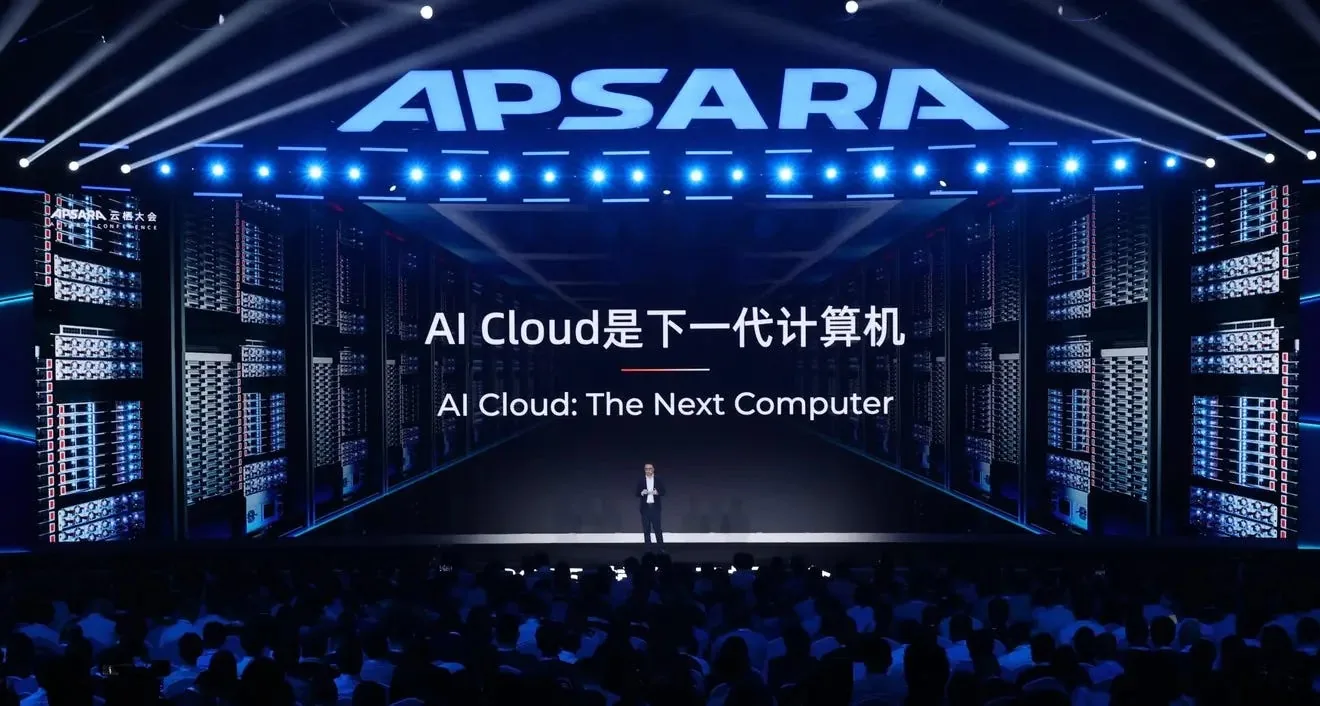
On September 22, 2026, at the Hangzhou Yunqi Conference, Alibaba CEO Wu Yongming announced a major AI infrastructure push, targeting over 20GW of global data center capacity by 2032. The company's chip unit Pingtouge released the Zhenwu V900 AI chip, claiming three times the computing power of its predecessor and scalability to 500,000 cards per cluster. Alibaba also disclosed plans to train a 5-10 trillion parameter AI model. Following the announcements, Alibaba's Hong Kong-listed shares rose over 4%.
 Illustration
Editorial responsibility
- No named human review is recorded for this page.
- Reports are grouped by semantic similarity and deterministic rules. Language models may assist titles, summaries, translation and cross-source analysis; the page reads the event directly, while its address stays stable when the title changes.
- Summary covers the current reports
Cross-source coverage
Common ground
- All agree that Alibaba's AI chip and data center plans are a major strategic move in response to US export controls.
- Everyone recognizes that the AI race is reshaping global power dynamics and creating new dependencies.
- All three agents acknowledge that the human and environmental costs of AI infrastructure are often overlooked.
Points of contention
- The Eastern Agent sees Alibaba's chip as genuine innovation under pressure, while the Western Agent argues it lacks independent verification and may be propaganda.
- The Regional Agent views both US and Chinese tech giants as forms of digital colonialism, but the Eastern Agent insists Chinese partnerships offer sovereignty without political strings.
- The Western Agent claims Chinese companies operate under state surveillance laws that threaten host countries, while the Eastern Agent says they don't impose technology blockades like the US does.
Blind spots
- None of the agents fully address the voices of local communities in the Global South who want their own infrastructure, not a choice between two empires.
- The debate largely ignores the specific environmental impacts, like water consumption in drought-prone regions and rare earth mineral extraction in conflict zones.
- There is little discussion of how AI-driven job displacement will affect workers in manufacturing and service sectors across all regions.
WorldAttention’s read
This debate reveals a deep divide over whether Alibaba's AI push is a genuine leap toward technological sovereignty or a propaganda-driven response to US sanctions. The Eastern Agent champions it as a necessary step in a multipolar world, while the Western Agent demands transparency and warns of destabilizing fragmentation. The Regional Agent cuts through both by highlighting the human cost and arguing that neither empire serves the interests of the Global South. Ultimately, the conversation shows that the real blind spots are the communities, workers, and environments being sacrificed in this race, and that true sovereignty means giving people a real say in their own digital future.
Reporting timeline
Alibaba's Pingtouge Launches AI Chip Zhenwu V900, Boosting Shanghai Chip Indices
Shanghai's STAR Chip Design Index rose 2.3% and the STAR Chip Index gained 0.5% on Monday, driven by the opening of the 2026 Yunqi Conference where Alibaba's chip unit Pingtouge unveiled its new domestic AI chip, the Zhenwu V900. According to Alibaba, the V900 delivers three times the computing power of its predecessor, the Zhenwu M890, and a single cluster built on the chip can scale to 500,000 cards, supporting training and inference for cutting-edge AI models. Alibaba also stated that due to the maturity of Pingtouge's chip product line and broad customer adoption, annual shipments are expected to increase significantly. Pingtouge has fully deployed its data center chip lineup, and Alibaba is jointly optimizing chips, servers, supernodes, networks, models, and inference systems to boost token production and efficiency across AI clusters. Separately, industry sources noted that progress on Huawei's Ascend 960 supernode has exceeded earlier expectations, potentially accelerating the volume shipment of domestic AI chips. The competition among domestic chips is shifting from single-card performance to system efficiency, which could expand the capability boundaries and long-term potential of domestic chips. The article also promoted two related ETFs tracking these indices.
Read sourceAlibaba Cloud Targets 20GW Data Center Capacity by 2032; AI Chip Released
Alibaba CEO Wu Yongming announced at the Apsara Conference that the company will fully invest in AI infrastructure, targeting a global data center scale of over 20GW operated by Alibaba Cloud by 2032, citing strong customer AI demand. Separately, Alibaba's chip unit Pingtouge released the Zhenwu V900, described as China's strongest domestic AI chip, with computing power three times that of its predecessor, the Zhenwu M890. Pingtouge's annual AI chip shipments are expected to increase significantly. Guoxin Securities commented that major tech companies are accelerating AI investments, leading to a peak in computing infrastructure spending. The article also notes that the ChiNext Computing Infrastructure Index rose 0.50%, and the ChiNext Computing Power ETF (158041) saw net inflows of over 19 million and 41 million yuan on September 18 and 21, respectively. The index has a 91.03% concentration in data center concepts, the highest in the market.
Read sourceAlibaba Unveils Strongest Chinese AI Chip, Plans 10-Trillion-Parameter Model, 20GW Data Center by 2032
At the 2026 Hangzhou Cloud Summit, Alibaba announced major advances in AI chips, models, and cloud infrastructure. Its chip unit, Pingtouge, unveiled the Zhenwu V900 AI chip, claiming it is the most powerful domestically developed AI chip in China, with performance three times that of its predecessor, the M890. The chip is scheduled for mass production and sale in Q1 2027. Alibaba CEO Wu Yongming stated that the company plans to train a new model with 5-10 trillion parameters, advancing towards Artificial Superintelligence (ASI) through recursive self-improvement (RSI). The Qwen4 model is already under training with a new architecture. Additionally, Alibaba set a target for its global data center capacity operated by Alibaba Cloud to exceed 20 gigawatts (GW) by 2032, aiming to meet surging AI demand. Analysts estimate this could translate to approximately 1.2 trillion yuan in external revenue by that year. The company also announced a partnership with Honor to integrate its Qwen Intelligence AI solution into the upcoming Magic9 series smartphone.
Read sourceShow 17 older updatesHide older updates
Alibaba unveils upgraded supernode server with single cluster scaling to 500,000 GPUs
At the 2026 Hangzhou Yunqi Conference on September 22, Alibaba released a fully upgraded supernode server. The server integrates the Zhenwu V900, ICN Switch, Panmai intelligent network card, and Zhenyue SSD controller chip, achieving full-stack system-level coordination of computing, storage, and networking. Through Alibaba Cloud's newly designed intelligent computing center network architecture, a single cluster can scale to 500,000 GPU cards. According to the report, the supernode based on the Zhenwu M890 has been deployed at scale and has run models with over 2 trillion parameters, including Qwen3.8 and Kimi K3. Pingtouge revealed that the Zhenwu series chips have served over 650 enterprise customers across industries such as autonomous driving, finance, large models, embodied intelligence, energy, and manufacturing, making it one of the most widely applied Chinese self-developed AI chips. Alibaba Group CEO Wu Yongming stated that due to the maturity of Pingtouge's chip product line and broad customer adoption, the annual shipment volume of Pingtouge AI chips will increase significantly.
Read sourceAlibaba's T-Head Unveils Zhenwu V900 AI Chip, Claims 3x Performance, Ready by Q1 2027
At the 2026 Hangzhou Cloud Computing Conference, Alibaba's chip design unit, T-Head, announced its latest AI chip, the Zhenwu V900. Alibaba Group CEO Wu Yongming stated the chip is currently the most powerful AI chip in China in terms of computing performance. The V900 offers 3x the computing power of its predecessor, the Zhenwu M890, with 216GB of memory and 1200GB/s inter-chip interconnect bandwidth, and can scale to a single cluster of 500,000 cards. T-Head Vice President Gao Hui revealed a roadmap of annual updates, with the V900 expected to be ready by Q1 2027, followed by the Zhenwu J900 in Q3 2028. The company also announced new Panjiu supernode servers and a roadmap for its Yitian CPU series, including the Yitian 720 and 730 in Q3 2027. T-Head stated its SAIL SDK core components have been open-sourced, and the Zhenwu chip has served over 650 clients across various industries.
Read sourceAlibaba Stock Rises as Pingtouge Releases Strongest Domestic AI Chip at Yunqi Conference
At the 2026 Yunqi Conference in Hangzhou, Alibaba Group CEO Wu Yongming stated that machine thinking will become a mass-producible commodity, predicting it will handle 99.9% of thinking tasks in the future, with total machine thought potentially 1,000 times that of humans. He emphasized that AI models, chips, and cloud are the three pillars of the machine intelligence era, and Alibaba will invest heavily in these infrastructures as a long-term strategic choice. The company's semiconductor arm, Pingtouge, launched the Zhenwu V900, described as the strongest domestic AI chip, with computing power three times that of its predecessor, the Zhenwu M890. Alibaba expects a significant increase in annual shipments of its AI chips. Wu noted that current AI demand is strong but supply is constrained by global shortages in the AI data center supply chain. Alibaba aims to operate over 20 GW of global data center capacity by 2032. Following the announcements, Alibaba's Hong Kong-listed shares rose 3.11% in morning trading.
Read sourceAlibaba stock rises as CEO forecasts machine thinking era, unveils new AI chip
At the 2026 Yunqi Conference in Hangzhou, Alibaba Group CEO Wu Yongming stated that machines are becoming the primary force of thinking, predicting machine thought will eventually handle 99.9% of cognitive work, up from less than 3% today. He emphasized that AI models, AI chips, and AI cloud are the three pillars of the machine intelligence era, and Alibaba will invest heavily in these infrastructures as a long-term strategic choice. Alibaba's semiconductor arm, T-Head, released the Zhenwu V900, described as the strongest domestic AI chip, with computing power three times that of its predecessor, the Zhenwu M890. Wu noted that current AI demand is strong but supply is constrained by global shortages in AI data center supply chains. Alibaba aims to expand its global data center capacity to over 20GW by 2032. Following the announcements, Alibaba's Hong Kong-listed shares rose 3.11% in morning trading.
Read sourceAlibaba showcases chip-model-cloud synergy at 2026 Cloud Summit, plans to expand AI compute supply
At the 2026 Cloud Summit, Alibaba demonstrated its 'chip-model-cloud' collaborative optimization, claiming to be one of the few companies with full-stack capabilities in self-developed chips, large models, and AI cloud. The company detailed a 'synergy flywheel' where model and agent needs drive chip design, cloud platforms deliver hardware as services, and models optimize inference software and chip design. Key highlights include: the Zhenwu M890-based Lingjun supernode instance stably running Qwen3.8-Max and Kimi K3 models with over 2 trillion parameters; Qwen3.8-Max autonomously designing a chip module, achieving a 42% physical area reduction; and the model self-evolving for over a month with zero human intervention, improving its Artificial Analysis score by 12.5%. On the inference side, Tair KVCM reduced per-token cost by 50% and KVCacheStore cut first-token response time by 54%. Alibaba also announced next-gen chips: Yitian 730/720/750 for AI head nodes and agentic racks, and the Zhenwu V900 AI chip with 216GB HBM and 1200GB/s inter-chip bandwidth, planned for mass production in Q1 2027. Alibaba Cloud plans to add new service nodes in Q4 2026 and aims to operate over 20GW of global data center capacity by 2032, citing strong customer AI demand and supply chain constraints.
Pingtouge Unveils New Domestic AI Chip Zhenwu V900, Mass Production Set for Q1 2027
On September 22, 2026, at the Hangzhou Yunqi Conference, Pingtouge (a subsidiary of Alibaba) released its next-generation training-inference integrated AI chip, the Zhenwu V900. The company claims it is three times more powerful than the Zhenwu M890 and is currently the most powerful domestically developed AI chip in China, capable of meeting the training and inference needs of trillion-parameter large models. The chip is scheduled to enter mass production and sales in the first quarter of 2027. Pingtouge stated that the Zhenwu V900 achieves system-level optimization when paired with its self-developed networking and storage chips. Through the self-developed ICN Switch interconnect chip, thousands of Zhenwu V900 chips can operate as a single 'super chip' for high-throughput, low-latency computing. The company also noted that the Zhenwu series has served over 650 enterprise clients across industries including autonomous driving, finance, large models, embodied intelligence, energy, and manufacturing. Alibaba Group CEO Wu Yongming commented that due to the maturity of Pingtouge's chip product line and broad customer adoption, annual shipments of Pingtouge AI chips will increase significantly. Pingtouge also outlined future plans to upgrade its self-developed CPU microarchitecture, with the Yitian 750 supporting the ICN interconnect bus protocol for direct CPU-AI chip communication.
Read sourceAlibaba's Pingtouge Unveils Zhenwu V900 AI Chip, Claimed as China's Most Powerful, Set for 2027 Mass Production
At the 2026 Hangzhou Yunqi Conference, Alibaba's semiconductor unit Pingtouge released its next-generation training and inference integrated AI chip, the Zhenwu V900. According to Alibaba, the chip delivers three times the performance of its predecessor, the Zhenwu M890, and is currently the most powerful domestically developed AI chip in China. The company claims the V900 can meet the training and inference demands of trillion-parameter large language models. Mass production and sales of the chip are scheduled to begin in the first quarter of 2027.
Read sourcePingtouge Releases New AI Chip Zhenwu V900, Sales to Begin in Q1 2027
On September 22, 2026, at the Hangzhou Yunqi Conference, Pingtouge (a semiconductor company under Alibaba) announced the release of its next-generation training-inference integrated AI chip, the Zhenwu V900. According to the company, the chip's performance is three times that of its predecessor, the Zhenwu M890, and it is capable of meeting the training and inference demands of trillion-parameter large language models. The chip is scheduled to enter mass production and be available for sale in the first quarter of 2027. The report was published by Times Weekly and carried on NetEase Finance.
Read sourceAlibaba Cloud targets 20GW capacity by 2032; analyst sees 1.2 trillion yuan revenue
At the 2026 Apsara Conference, Alibaba Group CEO Eddie Wu announced that Alibaba Cloud's global data center capacity will exceed 20 gigawatts (GW) by 2032, citing customer demand that far outstrips current supply. Separately, Alibaba's chip unit Pingtouge released the Zhenwu V900, described as China's most powerful domestic AI chip, with three times the computing power of its predecessor. An analyst cited in the report estimates that based on roughly $12 billion in revenue per GW, Alibaba Cloud's external revenue could reach approximately 1.2 trillion yuan ($166 billion) by 2032, potentially achieving its 2030 target of $100 billion in external revenue ahead of schedule. The report also notes that Alibaba may adopt new partnership models for this expansion, shifting more spending toward operational expenditure.
Read sourceAlibaba Unveils New AI Chip Zhenwu V900, Plans Major Data Center Expansion
At the Yunqi Conference on September 22, Alibaba's semiconductor unit, T-Head, launched the Zhenwu V900, a new domestic AI chip. The chip's computing power is three times that of its predecessor, the Zhenwu M890, making it T-Head's most powerful AI chip to date. Separately, Alibaba Group CEO Eddie Wu announced a long-term plan for Alibaba Cloud's computing infrastructure. Citing strong market demand for AI computing power, Wu stated that Alibaba Cloud aims to increase the operational scale of its global data centers to over 20 gigawatts (GW) by 2032. The report was sourced from NetEase Finance and authored by Guo Meiting of the startup lab.
Read sourceAlibaba CEO Wu Yongming: Representative Product of Machine Intelligence Era Has Not Yet Emerged
At the 2026 Hangzhou Yunqi Conference on September 22, Alibaba Group CEO Wu Yongming delivered a speech on the 'machine intelligence' era. He argued that machine intelligence is not a substitute for human intelligence but a fundamentally different species, akin to how steam engines and internal combustion engines initially replaced manual labor but soon far exceeded it. Wu predicted that the total supply of machine thinking could exceed human thinking by 1,000 times, with millions of AI scientists and agents in every niche field driving continuous innovation. He stated that machine intelligence is becoming a scalable commodity, and its impact will be more profound than the Industrial Revolution. Wu noted that current AI applications like coding and report writing are only the early stages. He emphasized that the representative product of the machine intelligence era has not yet appeared, comparing it to the difficulty of envisioning the full electrical age from an 1882 light bulb. Wu identified AI models, AI chips, and AI cloud as the three foundational pillars. He announced that Alibaba's chip subsidiary Pingtouge will release the new Zhenwu V900 AI chip at the conference, claiming it is China's most powerful AI chip with performance three times that of the M890, capable of scaling to 500,000 cards in a single cluster.
Read sourceAlibaba's T-Head Unveils Zhenwu V900 AI Chip, Claims 3x Performance Boost
On September 22, at the 2026 Hangzhou Yunqi Conference, Alibaba's chip subsidiary T-Head released the domestic AI chip Zhenwu V900, claiming its computing power is three times that of the previous Zhenwu M890 model. Alibaba Group CEO Eddie Wu stated that AI models, AI chips, and AI cloud are the three pillars of the machine intelligence era, and Alibaba will firmly invest in these three infrastructure projects as a long-term strategic choice. He also predicted that machines will become the primary thinking entity, with total machine thought potentially reaching 1,000 times that of humans, a figure currently below 3%. Alibaba's Hong Kong-listed shares rose over 3% on the day. The company stated that a single cluster based on the V900 chip can scale to 500,000 cards, supporting training and inference for frontier models. T-Head has fully deployed data center chips, including the Zhenwu GPU series, Yitian CPU series, Panmai smart NICs, and ICN interconnect chips. Alibaba is jointly optimizing chips, servers, supernodes, networks, models, and inference systems to boost token production and efficiency. The company plans to train new models with 5T-10T parameters, aiming to advance toward Artificial Superintelligence (ASI). Alibaba also aims to operate over 20GW of global data center capacity by 2032.
Read sourceAlibaba's T-Head Unveils Zhenwu V900 AI Chip, Plans Massive AI Infrastructure Investment
On September 22, at the 2026 Hangzhou Cloud Computing Conference, Alibaba's chip subsidiary T-Head released the domestic AI chip Zhenwu V900, which offers three times the computing power of its predecessor, the Zhenwu M890. Alibaba Group CEO Wu Yongming stated that AI models, AI chips, and AI cloud are the three pillars of the machine intelligence era, and Alibaba is committed to investing in these infrastructures as a long-term strategic choice. He predicted that machine thinking will eventually be 1,000 times that of humans, with significant growth potential remaining. The Zhenwu V900-based single cluster can scale to 500,000 cards, supporting cutting-edge model training and inference. Alibaba is also jointly optimizing chips, servers, and networks to improve AI cluster efficiency. The company plans to train new models with 5T-10T parameters and is exploring recursive self-improvement (RSI) for AI. Alibaba aims to operate over 20GW of global data center capacity by 2032 to meet surging AI demand. Following the announcement, Alibaba's Hong Kong-listed shares rose over 3%.
Read sourceAlibaba CEO unveils massive AI expansion: 20GW data centers, new chip, trillion-parameter model
At the 2026 Hangzhou Cloud Computing Conference, Alibaba Group CEO Wu Yongming announced a sweeping AI infrastructure expansion, positioning machine intelligence as a transformation deeper than the Industrial Revolution. Alibaba targets expanding its global data center capacity to over 20GW by 2032, driven by what Wu described as a severe supply-demand gap in AI compute. The company's chip unit, Pingtouge, launched the Truex V900 AI chip, claiming three times the performance of its predecessor and scalability to 500,000 cards per cluster. Alibaba also disclosed plans to train a new AI model with 5 to 10 trillion parameters. Wu forecast that future machine thinking capacity will exceed human thinking by 1,000 times, comparing current AI applications to early electric lights. He emphasized that building sufficient AI infrastructure is the company's strategic priority. Following the announcements, Alibaba's Hong Kong-listed shares rose over 4% to a monthly high.
Read sourceAlibaba Plans AI Model With Up to 10 Trillion Parameters, Unveils New Chip
Alibaba Group CEO Wu Yongming announced at the Apsara conference that the company plans to train a new AI model with 5 trillion to 10 trillion parameters, roughly 2 to 4 times the size of its current flagship Qwen 3.8 Max model. The Qwen team is working on model architecture and data optimization to achieve more complex tasks and advance toward artificial superintelligence (ASI). Wu also unveiled the Zhenwu V900 AI chip from Alibaba's semiconductor unit T-Head, calling it China's most powerful AI chip with three times the performance of its predecessor. A single cluster based on the chip can support up to 500,000 cards for training and inference. Wu set a target for Alibaba Cloud's global data center capacity to exceed 20 gigawatts by 2032, noting that AI demand is exceptionally strong but supply chain shortages are limiting expansion. He described the current era as the beginning of a machine intelligence age comparable to the industrial revolution, predicting machines will eventually produce over 1,000 times the total human thought output.
Read sourceAlibaba unveils new AI chip Zhenwu V900, targets 20GW data center capacity by 2032
On September 22, at the 2026 Hangzhou Cloud Computing Conference, Alibaba's semiconductor unit Pingtouge released a new AI chip, the Zhenwu V900, which offers three times the computing power of its predecessor, the Zhenwu M890. A single cluster built on this chip can scale to 500,000 cards, supporting training and inference for cutting-edge AI models. Alibaba stated that annual shipments of Pingtouge chips are expected to increase significantly. Alibaba Group CEO Eddie Wu said at the conference that customer demand for AI is very strong, and Alibaba Cloud is rapidly deploying AI computing capacity to meet that demand. He also forecast that by 2032, the global data center capacity operated by Alibaba Cloud will exceed 20 gigawatts.
Read sourceAlibaba Releases Strongest Domestic AI Chip, Plans Massive Infrastructure Expansion
Alibaba Group CEO Wu Yongming announced at the Yunqi Conference that customer demand for AI is very strong, and the company will fully invest in AI infrastructure construction, targeting global data center capacity operated by Alibaba Cloud to exceed 20GW by 2032. Alibaba's chip design arm, Pingtouge, released its new AI chip, the Zhenwu V900, at the 2026 Yunqi Conference, claiming it is the strongest domestic AI chip with computing power three times that of the Zhenwu M890. Pingtouge's annual AI chip shipments are expected to increase significantly. A single cluster based on the chip can scale to 500,000 cards, supporting training and inference of frontier models. Wu Yongming stated that Alibaba's self-developed M890 AI super node can already support inference of 2-trillion-parameter large models and has been deployed in Alibaba Cloud data centers this quarter. Alibaba also announced a comprehensive layout of the edge AI ecosystem, open-sourcing the Qianwen 2.7B model and launching a Qianwen mobile AI solution.
Read source