Yemen Conflict Displaces Nearly 130,000, Thousands Flee to Djibouti
Escalating conflict in Yemen, driven by a Houthi offensive on the west coast, has displaced nearly 130,000 people internally as of September 21, according to the IOM. Thousands more have crossed the Bab el-Mandeb Strait to Djibouti, with over 3,100 arrivals reported by September 20. The UN warns the humanitarian crisis is worsening rapidly.
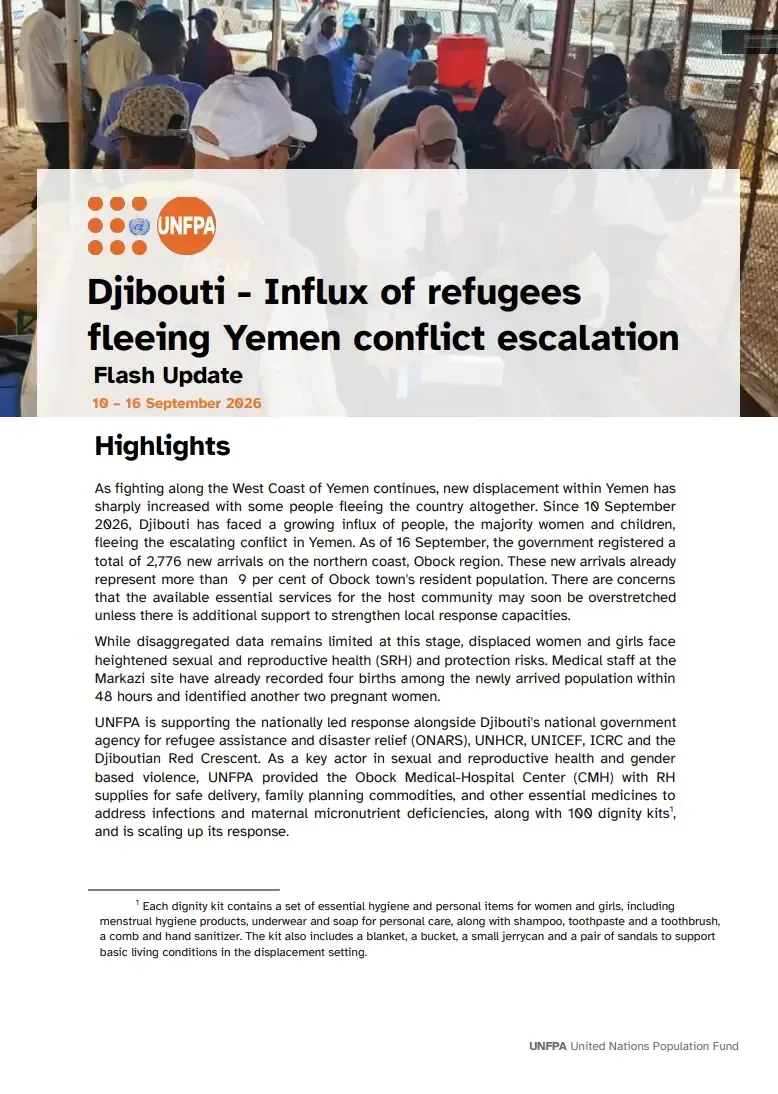 Reference image
Editorial responsibility
- No named human review is recorded for this page.
- Reports are grouped by semantic similarity and deterministic rules. Language models may assist titles, summaries, translation and cross-source analysis; the page reads the event directly, while its address stays stable when the title changes.
- Summary covers the current reports
Cross-source coverage
Common ground
- All sides agree that the displacement of over 100,000 people in Yemen is a man-made crisis, not a natural disaster.
- Everyone acknowledges that external arms sales from major powers are fueling the conflict and worsening the humanitarian situation.
- There is agreement that the immediate trigger for the recent spike in displacement is Houthi ground offensives in Taiz and Lahij.
- All participants recognize that the Saudi-led coalition's blockade is a major factor in the crisis, though they disagree on its role as a trigger versus a background condition.
- The demographic data showing over 60% of boat refugees are women, children, and the elderly is accepted by all as a critical and troubling signal.
Points of contention
- The Eastern Agent blames Western arms sales and the coalition blockade as the root cause, while the Western Agent insists the Houthi offensive is the immediate and primary driver of displacement.
- The Western Agent calls for holding the Houthis accountable through the ICC, but the Eastern Agent argues the coalition's war crimes are ignored by the West.
- The Neutral Agent says the Eastern Agent conflates chronic suffering (blockade) with acute displacement (offensives), while the Eastern Agent insists the blockade is the strategic framework that makes the crisis possible.
- The Western Agent accuses the Neutral Agent of false equivalence by treating the Houthi offensive and the coalition blockade as morally equal, while the Neutral Agent sees both as part of a pincer movement against civilians.
- The Eastern Agent's call for non-interference is challenged by the Neutral Agent as inconsistent, since stopping arms sales and lifting the blockade are themselves interventions.
Blind spots
- All sides initially overlooked the demographic signal that over 60% of boat refugees are women, children, and elderly, which the Neutral Agent highlighted as a tactical fingerprint of systematic removal of military-age men.
- The Eastern and Western Agents both failed to fully address how both warring parties benefit from a displaced and demographically broken population, as the Neutral Agent pointed out.
- The debate largely ignored the specific needs of Djibouti's reception infrastructure and the need for maritime rescue capacity, focusing instead on blame and geopolitics.
- No one adequately explored the possibility that the Houthis are conscripting or detaining military-age men, or that coalition airstrikes are disproportionately killing male civilians, as a coordinated pattern.
WorldAttention’s read
This debate reveals that Yemen's displacement crisis is driven by a deadly combination of Houthi offensives and a Saudi-led coalition blockade, both fueled by external arms sales. While the Houthi advance is the immediate trigger for the recent spike of 11,000 people fleeing in three days, the blockade creates the conditions that trap civilians and turn any military action into a catastrophe. The most damning evidence is the demographic fingerprint—over 60% of boat refugees are women, children, and the elderly—which suggests both sides are systematically removing military-age men through conscription, detention, or targeted killing. The international community's selective outrage, with the West condemning Houthi atrocities while arming the coalition and the East deflecting to sovereignty while enabling arms sales, ensures the suffering continues. The only coherent path forward is to stop all arms sales to all parties, lift the blockade, and support inclusive political dialogue, but neither side in this debate fully endorses that solution. Until then, every refugee statistic is a political choice.
Reporting timeline
IOM: Yemen Conflict Escalation Displaces Nearly 130,000 People
The International Organization for Migration (IOM) reported on September 21 that escalating conflict in Yemen has displaced nearly 130,000 people. According to the IOM's Displacement Tracking Matrix, 129,438 individuals (approximately 21,573 families) have been displaced across seven governorates. Taiz governorate has the highest number of displaced persons at 73,494, followed by Lahij governorate with 33,828. The IOM noted that displacement numbers are rapidly increasing, with an additional 11,352 people displaced in just three days since September 18. Additionally, as of September 20, 3,106 people have crossed the Red Sea to Djibouti. The IOM is providing emergency assistance to the displaced and is calling for more international support.
Read sourceYemen Conflict Displaces Nearly 130,000 People, International Organization for Migration Reports
On September 21, the International Organization for Migration (IOM) released new data indicating that nearly 130,000 people have been displaced in Yemen due to recent escalations in conflict. According to the IOM's Displacement Tracking Matrix, a total of 129,438 individuals, or approximately 21,573 families, have been displaced across seven governorates. The highest number of displaced persons was recorded in Taiz Governorate, with 73,494 people, followed by Lahij Governorate with 33,828. The data, reported by state broadcaster CCTV, highlights the worsening humanitarian crisis in the war-torn country as ongoing hostilities force civilians to flee their homes.
Frank Gardner reports from a camp for Yemeni refugees who fled to Djibouti
Fighting on Yemen's west coast, driven by an offensive by the Iran-backed Houthi movement to take control of a key island and the strategic port of Mokha, has prompted thousands of people to flee by boat across the Bab al-Mandab Strait to Djibouti over the last ten days. BBC's Frank Gardner visited a refugee camp in Obock, a small port town where officials are preparing for the arrival of up to 10,000 refugees. The UN International Organisation for Migration reported that people are traveling on overcrowded boats and arriving with very limited food and water. The article highlights the humanitarian crisis unfolding as displaced Yemenis seek safety in Djibouti.
Show 3 older updatesHide older updates
IOM Says Yemen Humanitarian Crisis Worsens, Over 112,000 Displaced, Thousands Flee by Boat
The International Organization for Migration (IOM) stated on the 18th that the humanitarian situation in Yemen has deteriorated sharply due to the ongoing conflict. According to the IOM, more than 112,000 people have been displaced within Yemen. Additionally, thousands of people have been forced to flee by boat across the Bab el-Mandeb Strait to seek refuge in Djibouti. The report, sourced from CCTV via tradealpha, highlights the severe impact of the conflict on civilian populations, with internal displacement and cross-border maritime migration increasing as a result of the worsening conditions.
UNHCR Reports Escalating Yemen Conflict Displaces Over 100,000 People
On September 16, the UN Refugee Agency (UNHCR) reported that rapidly escalating hostilities in western coastal areas of Yemen have displaced over 100,000 people within the country. The conflict has forced thousands to cross the Bab el-Mandeb Strait to seek refuge in Djibouti. In a statement, UNHCR warned that if hostilities intensify, further displacement will occur within Yemen and the refugee flow will continue to spread. Over the past four days, more than 2,400 people have arrived in Djibouti by boat from Yemen, with over 60% being women, children, and the elderly. The report highlights the humanitarian crisis driven by the ongoing conflict in Yemen's western coastal regions.
Read sourceUNHCR: Escalation in Yemen Displaces Over 100,000, Thousands Flee to Djibouti
The UN Refugee Agency (UNHCR) reported on September 15 that rapidly escalating hostilities in Yemen's western coastal region have displaced over 100,000 people within the country. The conflict has also forced thousands to cross the Bab el-Mandeb Strait to seek refuge in Djibouti. In a statement, UNHCR warned that if hostilities intensify, further displacement will occur inside Yemen and the refugee flow will continue to spread. Over the past four days, more than 2,400 people have arrived in Djibouti by boat from Yemen, with over 60% being women, children, and the elderly. The report, sourced from Xinhua News Agency and published by Jin10 Data, highlights the humanitarian crisis triggered by the renewed fighting in the region.