US 30-Year Treasury Yield Surges to 5.5%, a 22-Year High, Reshaping Global Markets
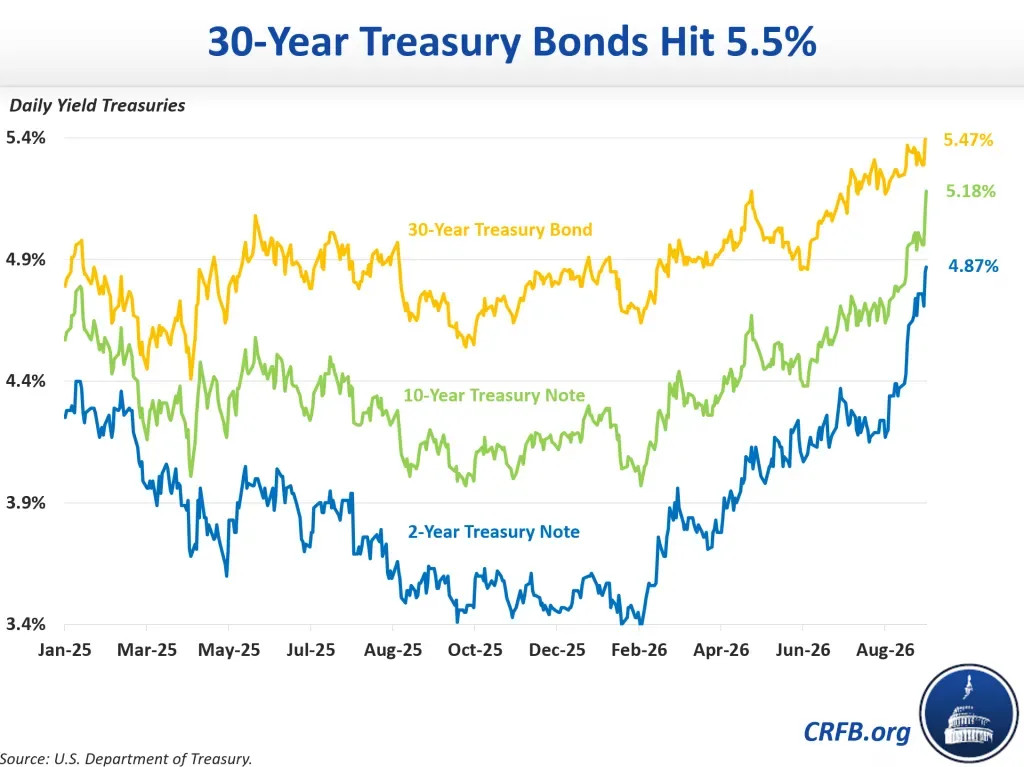
The US 30-year Treasury yield has surpassed 5.5%, a 22-year high, with the 10-year yield exceeding 5.16%. This surge, driven by Fed rate hike expectations, sticky inflation, fiscal deficits, and geopolitical tensions, is reshaping global investment logic. Higher yields reduce the appeal of stocks and real estate, increase corporate financing costs potentially above 7.5%, and suppress housing demand through rising mortgage rates. Analysts warn of sustained pressure on corporate finances and stock valuations, particularly for speculative and cash-intensive AI firms.
 Reference image
Editorial responsibility
- No named human review is recorded for this page.
- Reports are grouped by semantic similarity and deterministic rules. Language models may assist titles, summaries, translation and cross-source analysis; the page reads the event directly, while its address stays stable when the title changes.
- Summary covers the current reports
Cross-source coverage
Common ground
- The US Treasury yield spike to 5.5% is not a neutral market event but a sign of deeper problems in the global financial system.
- The current system is structurally unequal, with the US benefiting from exorbitant privilege while the Global South suffers from capital flight and currency crises.
- The multipolar shift, including BRICS and yuan-denominated trade, has created real leverage for some nations that previously had no alternatives.
- Both the Western and Chinese systems have flaws, including opaque terms, tied procurement, and debt that burdens ordinary people.
Points of contention
- The Eastern Agent sees the yield spike as mainly Washington's fiscal mismanagement, while the Regional Agent sees it as part of a designed system of financial imperialism.
- The Eastern Agent argues China offers unconditional cooperation without political strings, while the Regional Agent says Chinese loans come with hidden strings like tied contracts and resource extraction.
- The Eastern Agent believes the Global South has genuine agency and sovereign choice, while the Regional Agent argues structural power (like IMF control of credit ratings) rigs the game.
- The Regional Agent says both the dollar and yuan systems are exploitative, just with different flags, while the Eastern Agent insists the multipolar order is real progress, not just a change of masters.
Blind spots
- Neither side fully addresses the lack of democratic, accountable financial institutions built by and for the Global South itself.
- The debate overlooks the need for regional payment systems and debt restructuring mechanisms that bypass both the dollar and the yuan.
- The human cost for ordinary people in the Global South is mentioned but not centered in concrete solutions.
- The Eastern Agent downplays the risks of Chinese debt dependency, while the Regional Agent downplays the leverage that multipolar options provide.
WorldAttention’s read
This debate shows that the US Treasury yield spike is a symptom of a global financial system in crisis, but there's no agreement on whether the solution is a multipolar shift led by China or a completely new system built by the Global South. Both sides agree the current system is unequal and hurts ordinary people, but they clash over whether China's alternative is liberation or just a different kind of extraction. The real blind spot is that neither the dollar nor the yuan system centers the needs of people in Cairo, Karachi, or Nairobi—and until the Global South builds its own democratic financial institutions, it will remain a battlefield for great power competition rather than a driver of its own destiny.
Reporting timeline
US 30-Year Yield Hits 5.5%: Why Global Assets Haven't Crashed Yet
This analysis from Tencent Stock/格隆汇 examines the recent surge in the US 30-year Treasury yield (US30Y) to 5.5%, a level not seen in decades. It details the interplay between key figures: Treasury Secretary Bessent's efforts to support long-dated bonds through repo operations, Fed hawk Warsh's rate hikes to maintain credibility, and former President Trump's influence on oil prices via Middle East diplomacy. The article attributes the yield spike to a combination of strong economic data (non-farm payrolls, sticky CPI), the Fed's September 25bp rate hike, and a surprise surge in oil prices due to geopolitical tensions in the Persian Gulf and Red Sea. It explains that while 5.5% yields pressure US mortgages, corporate refinancing, and government debt costs, global assets like US equities and Bitcoin have performed well. The author argues this is because the first rate hike often confirms a strong economy, boosting corporate earnings, and that the yield rise is more about growth than runaway inflation. However, it warns that uncontrolled Middle East oil prices remain a key risk, potentially leading to market stagnation and forcing capital to concentrate in top-tier AI and growth stocks.
Read sourceUS 30-Year Treasury Yield Breaks 5.5%, Analyst Warns of Market Shifts
Financial commentator Guo Shiliang analyzes the implications of the US 30-year Treasury yield surpassing 5.5%, a 22-year high, and the 10-year yield exceeding 5.16%. He explains that these yields serve as global risk-free rate benchmarks, and their rise reduces the attractiveness of stocks and real estate compared to risk-free returns. The surge is attributed to Fed rate hike expectations, inflation, fiscal deficits, and geopolitical tensions. Higher yields increase corporate financing costs, with companies needing to offer yields above 7.5% to issue bonds. The housing market faces pressure as 30-year fixed mortgage rates rise, suppressing demand. For stock markets, high yields lead to capital outflows and valuation compression, particularly hurting speculative stocks while benefiting dividend-paying ones. The analyst warns that sustained high rates could fundamentally alter global investment logic and corporate financial health, especially for cash-intensive AI firms facing rising capital expenditure costs.
Read sourceUS 30-Year Treasury Yield Breaks 5.5%, Reshaping Global Investment Logic
The article analyzes the implications of the US 30-year Treasury yield surpassing 5.5%, a 22-year high, and the 10-year yield exceeding 5.2%. It explains that these yields serve as global risk-free rate benchmarks, and their rise reduces the attractiveness of stocks and real estate compared to risk-free returns. The surge is attributed to Fed rate hike expectations, inflation, fiscal deficits, and geopolitical tensions. The article warns that higher yields increase corporate financing costs, potentially exceeding 7.5% for bond issuances, and raise mortgage rates, suppressing housing demand. It specifically notes that AI-driven capital expenditure, which consumes cash reserves, faces higher borrowing costs in this environment. The analysis concludes that sustained high yields could pressure corporate finances, alter stock market valuation systems, and shift investor preference toward dividend stocks as safe havens.
Read sourceShow 2 older updatesHide older updates
US 30-Year Treasury Yield Breaks 5.5%, Reshaping Global Investment Logic
This analysis from Tencent Finance examines the implications of the US 30-year Treasury yield surpassing 5.5%, a 22-year high, and the 10-year yield breaking above 5.16%. It argues that these yields, as global risk-free benchmarks, reduce the attractiveness of stocks and real estate compared to risk-free returns above 5%. The article attributes the yield surge to factors including rising Fed rate hike expectations, inflation concerns, and geopolitical tensions. It warns that higher yields increase corporate financing costs, with companies needing to offer yields 2% or more above Treasuries to issue bonds, potentially reaching 7.5% or higher. For the housing market, rising 30-year fixed mortgage rates are expected to suppress demand and depress transaction volumes. The analysis notes that AI-related capital expenditure is consuming cash reserves at major firms, making them vulnerable to high financing costs. It concludes that sustained high yields could pressure stock valuations, particularly for speculative and concept stocks, while cash-rich companies may become safe havens, potentially altering the entire market valuation system.
Read sourceUS 30-Year Treasury Yield Breaks 5.5%, Reshaping Global Investment Logic, Analyst Says
Financial commentator Guo Shiliang analyzes the implications of US 30-year Treasury yields surpassing 5.5%, a 22-year high, and 10-year yields exceeding 5.16%. The article explains that these yields serve as global risk-free rate benchmarks, and their rise reduces the attractiveness of stocks and real estate compared to risk-free returns. Key drivers include Fed rate hike expectations, inflation concerns, fiscal deficit pressures, and geopolitical tensions. The commentary warns that higher yields increase corporate financing costs—potentially to 7.5% or more for bond issuances—and raise mortgage rates, suppressing housing demand. It notes that AI-related capital expenditure, which requires significant funding, faces higher borrowing costs in this environment. The author concludes that sustained high yields could fundamentally alter global market valuation systems and pressure companies with weak cash reserves.
Read source