US 10-year yield breaks 5% in worst single-day jump in 18 months; 6% feared
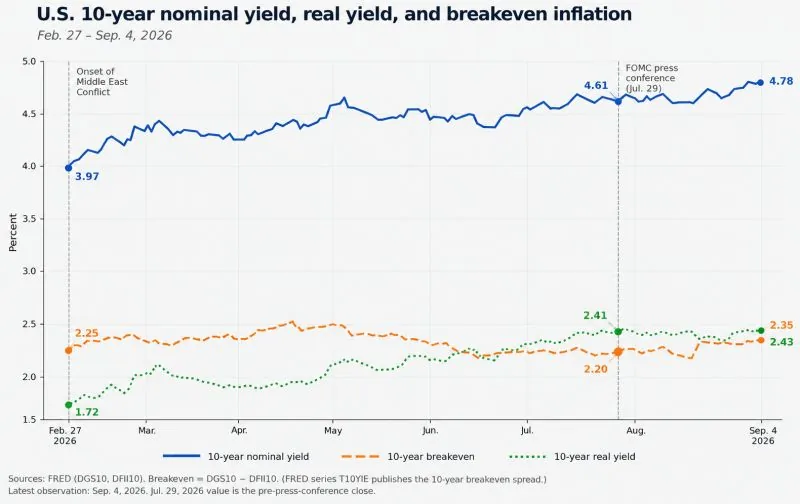
US Treasury yields experienced their worst single-day jump in 18 months, with the 10-year yield breaking above 5% and the five-year yield surpassing 5% for the first time since 2007. The selloff was driven by strong economic data, a weak $70 billion five-year note auction, and Middle East tensions. Analysts warn that 6% could become the new threshold for market turmoil, with JPMorgan suggesting the equity 'crash threshold' may have risen to 5.5%-6.0%. Emerging markets are already seeing capital outflows.
 Reference image
Editorial responsibility
- No named human review is recorded for this page.
- Reports are grouped by semantic similarity and deterministic rules. Language models may assist titles, summaries, translation and cross-source analysis; the page reads the event directly, while its address stays stable when the title changes.
- Summary covers the current reports
Cross-source coverage
Common ground
- All three agree that the US 10-year yield hitting 5% signals a major shift, not just a normal market fluctuation.
- Everyone acknowledges that US fiscal deficits and political dysfunction are key drivers of the current crisis.
- There is agreement that the era of cheap money and unquestioned US financial dominance is ending.
- All participants recognize that the human cost, especially for emerging markets, is a serious concern.
- They all agree that the speed of the yield move is unusual and points to deeper structural issues.
Points of contention
- The Eastern Agent sees this as proof of a multipolar world emerging, while the Western and Neutral Agents argue no viable alternative to the dollar exists yet.
- The Western Agent frames the crisis as a moral and governance failure, while the Neutral Agent insists it is a mathematical and structural problem.
- The Eastern Agent believes de-dollarization is accelerating rapidly, but the Neutral Agent says it is a slow hedge that will take decades.
- The Western Agent blames political paralysis and bad choices, while the Neutral Agent says the system's design flaws are the root cause.
- The Eastern Agent argues the US has lost legitimacy and trust, while the Western Agent says the US can still fix its problems if it finds political will.
Blind spots
- None of the participants fully address how the US Treasury market's plumbing—specifically dealer balance sheets and auction demand—could trigger a liquidity crisis regardless of geopolitics or governance.
- All three overlook the specific transmission mechanism of how higher yields will impact different emerging markets in real time, not just in theory.
- The debate lacks a detailed analysis of how the Federal Reserve's independence and policy tools might be constrained by political pressure in the coming months.
- No one explores the possibility that a coordinated international response, such as currency swap lines or IMF intervention, could mitigate the crisis.
WorldAttention’s read
This debate reveals a deep divide between those who see the bond market crisis as a geopolitical revolution, a governance failure, or a mathematical repricing. While all agree that the 5% yield marks the end of an era, they cannot agree on whether the US can restore trust or if a multipolar system is truly emerging. The core blind spot is that the market's plumbing and the real-time impact on specific emerging economies are being ignored in favor of grand narratives. Ultimately, the crisis is a mix of all three factors—fiscal math, political dysfunction, and shifting global trust—but the market's speed of repricing means the window for action is closing fast. The US must address its fiscal credibility, but even if it does, the world's confidence may take years to rebuild.
Reporting timeline
US 10-Year Yield Breaks 5% as Analysts Warn of Second Phase of Bond Crisis
The article reports that US Treasury yields experienced their worst single-day drop in 18 months on Wednesday, marking what analysts describe as a 'second phase' of the bond crisis, where yields are not only high but rising rapidly. The 10-year yield surged past 5%, a level historically seen as a threshold for global financial turmoil, and some investors are now questioning whether 6% could become the new pain point. Goldman Sachs warned that equity markets become highly sensitive when yields move 50 basis points in a month or 30 basis points in two weeks; current moves are approaching those thresholds. JPMorgan analysts suggest the 'crash threshold' for stocks may have risen to 5.5%-6.0% due to structural economic changes like AI and healthcare investment. Invesco's Paul Jackson notes that if the 12-month average yield reaches 4.72%, global stocks could decline; he has begun shifting from equities to government bonds. Emerging markets are already seeing capital outflows, with bond funds recording their largest weekly outflow in months. The article concludes that a sustained yield above 5% would force a deep repricing of global capital costs, potentially ending the era of cheap money.
Read sourceUS Treasury Yields Surge Past 5% on Strong Data, Weak Auction; 6% Feared
US Treasury bond yields experienced a sharp sell-off on Wednesday, with the five-year yield rising above 5% for the first time since 2007 and the 10-year yield reaching 5.13%, its highest since 2007. The move was driven by a combination of stronger-than-expected economic data, a weak $70 billion five-year note auction, and rising oil prices due to Middle East tensions. Analysts described the event as a 'perfect storm' for higher yields, with the Federal Reserve's hawkish stance and persistent inflation adding pressure. The sell-off has prompted investors to question whether 6% could become the new psychological threshold for the 10-year yield, replacing the previously feared 5% level. Some strategists, including those at JPMorgan, suggest the 'crash threshold' for equities may now be in the 5.5%-6.0% range due to structural economic changes. The rising yields are already impacting emerging markets, with capital outflows and reduced bond issuance. The article notes that while the stock market has not yet crashed, some investors are reducing equity exposure in favor of bonds, warning that if yields continue to rise, equities could decline over the next 12 months.
Read source5% US Treasury Yield Loses Shock Value as Investors Begin to Fear 6%: Reuters
This Reuters analysis reports that the 5% threshold for the benchmark 10-year US Treasury yield, long seen as a trigger for global market turmoil, is now viewed more as a waypoint than a ceiling. With yields breaking 5% this month, investors are questioning whether 6% could become the new danger level. BlueBay Asset Management's Mike Bell calls 5% a psychological marker rather than an automatic trigger, noting the key comparison is with equity earnings yields. Morgan Stanley analysts suggest the 'pain point' may have risen to 5.5%-6.0% due to structural economic shifts like AI and healthcare spending. A move to 6% would represent a profound adjustment in global capital costs, potentially signaling higher inflation expectations or concerns about US fiscal sustainability. Invesco's Paul Jackson has already shifted from stocks to government bonds. Emerging markets are feeling pressure from a stronger dollar and capital outflows, though some managers remain constructive. The article warns that once investors begin questioning whether 6% is reachable, the discussion moves beyond a temporary spike to a broader reckoning with the end of cheap money.
Show 2 older updatesHide older updates
U.S. Treasury Yields Surge Past 5% on Strong Data, Weak Auction; 6% Feared
U.S. Treasury bonds experienced a sharp sell-off on Wednesday, with the five-year yield rising above 5% for the first time since 2007, driven by stronger-than-expected economic data and a weak $70 billion five-year note auction. The 10-year yield climbed nearly 17 basis points to 5.13%, the highest since 2007, and the 30-year yield reached about 5.4%. Analysts described the move as a 'perfect storm' of robust growth, persistent inflation, energy price spikes from Middle East tensions, and hawkish Federal Reserve policy. The Fed recently raised rates to 3.75%-4%, and markets now fully price in three more quarter-point hikes over the next year. Some strategists, including those at JPMorgan, suggest the 'pain point' for equities may have shifted to 5.5%-6.0% due to structural economic changes. Emerging markets are experiencing capital outflows as higher U.S. yields attract investment. The sell-off has also increased pressure on the Treasury's buyback program. Investors are now questioning whether 6% could become the new threshold for market turmoil, as the era of ultra-low borrowing costs may be ending.
Read sourceUS 10-year yield breaks 5%, analysts warn 6% could trigger stock selloff
The article reports that US 10-year Treasury yields experienced their largest single-day jump in 18 months, breaking above 5% and prompting analysts to warn that 6% could become the new threshold for market turmoil. The selloff is described as a 'second phase' of the bond crisis, where yields are rising rapidly rather than just high. BlueBay Asset Management's Bell notes that the yield's relative value versus stocks is approaching a critical inflection point that could trigger equity selling. Morgan Stanley cites investor views that the traditional rate transmission mechanism has weakened, with a potential stock 'crash threshold' at 5.5%-6.0%. Invesco highlights that 5% yields offer the highest risk-free returns since 2007. Emerging markets are already seeing capital outflows, with bond funds posting their largest weekly outflow in months. Premier Miton's Birrell warns that most investors have not yet repriced their models for sustained high rates, and that reality will eventually surface. The article concludes that a move toward 6% would imply a profound repricing of global capital costs, driven by inflation expectations, fiscal sustainability concerns, or expectations of prolonged high rates.
Read source