US 10-Year Treasury Yield Breaks 5% as Over Half of Market Participants See 30-Year Yield Hitting 6%
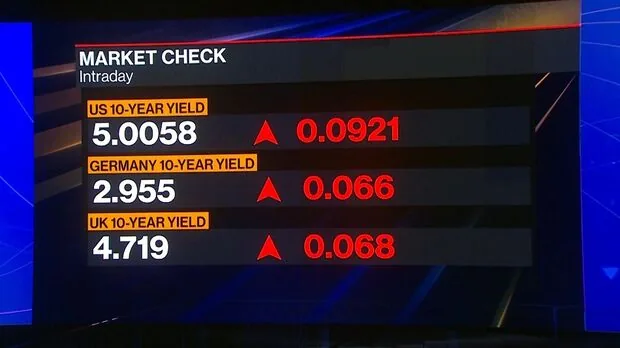
The US 10-year Treasury yield has breached 5% for the first time since 2007, driven by persistent inflation, resilient economic growth, and large fiscal deficits. A Bloomberg survey shows over half of market participants expect the 30-year yield to reach 6% by year-end. A structural shift in the buyer base, with price-sensitive hedge funds replacing foreign official investors, is increasing market volatility risk.
 Reference image
Editorial responsibility
- No named human review is recorded for this page.
- Reports are grouped by semantic similarity and deterministic rules. Language models may assist titles, summaries, translation and cross-source analysis; the page reads the event directly, while its address stays stable when the title changes.
- Summary awaiting refresh
Summary awaiting refresh
Cross-source coverage
Reporting timeline
Over Half of Market Participants Expect 30-Year US Treasury Yield to Hit 6% by Year-End
The article analyzes persistent upward pressure on long-term US Treasury yields, with the 10-year yield breaking above 5% for the first time since 2007. It attributes the rise to three factors: inflation remaining above the Federal Reserve's 2% target, resilient economic growth reducing the urgency for rate cuts, and expanding fiscal financing needs. A Bloomberg survey cited in the article shows over half of market participants expect the 30-year Treasury yield to reach 6% by year-end. The analysis highlights a structural shift in the buyer base, with price-sensitive hedge funds and private investors increasingly replacing foreign official buyers who are less sensitive to price. This change makes the market more vulnerable to sharp moves, as higher yields are needed to attract capital and rapid price declines could trigger forced selling. The article concludes that key factors to watch include fiscal borrowing requirements and the market's ability to absorb new supply.
Over half of market participants expect 30-year US Treasury yield to hit 6% by year-end
The US 10-year Treasury yield has broken above 5%, reaching levels not seen since 2007, as persistent inflation, a resilient economy, and the risk of further Federal Reserve rate hikes push long-term yields higher. The article, citing a Bloomberg survey, reports that over half of market participants expect the 30-year US Treasury yield to reach 6% before the end of the year. This pressure is compounded by a large US fiscal deficit requiring continuous debt issuance and increased borrowing by major tech companies for AI data center investments. A key structural shift is the changing composition of Treasury buyers: price-insensitive foreign official investors are reducing their participation, while hedge funds and other price-sensitive investors are taking a larger role. This makes the market more vulnerable to volatility, as these investors may quickly adjust positions or face margin calls during rapid yield moves. The article concludes that the key factors to watch are inflation, Fed policy, the scale of fiscal financing, and the market's ability to absorb new supply without a stable buyer base.
Read sourceOver Half of Market Participants Expect 30-Year US Treasury Yield to Hit 6% by Year-End
The article analyzes persistent upward pressure on long-term US Treasury yields, with the 10-year yield breaking above 5% for the first time since 2007. Key drivers include inflation remaining above the Fed's 2% target (PCE at 3.7%), resilient economic growth, and the possibility of further Fed rate hikes. Additionally, large fiscal deficits and increased debt issuance by tech companies for AI infrastructure are boosting supply. A critical factor is the changing composition of bond buyers: price-insensitive foreign official investors are reducing participation, while hedge funds and other price-sensitive investors are taking a larger share. This shift makes the market more vulnerable to sharp moves. A Bloomberg survey cited in the article indicates that over half of market participants expect the 30-year Treasury yield to reach 6% before the end of the year, reflecting growing concern about structurally higher long-term interest rates.
Read sourceShow 4 older updatesHide older updates
Wall Street Faces New Interest Rate Reality as 5% US Bond Yields May Become Norm
A September 25 report from 蓝鲸财经 (Blue Whale Finance) indicates that Wall Street and Washington are increasingly recognizing that the recent surge in US Treasury yields may represent a fundamental shift rather than a temporary downturn. Multiple factors are driving up US government borrowing costs, including oil prices at $100 per barrel, an artificial intelligence investment boom, and a record US budget deficit that has pushed national debt to $40 trillion. Meanwhile, the Federal Reserve remains committed to curbing inflation that has exceeded its target for years. As a result, nearly all benchmark US Treasury yields are hovering around 5% or higher. The five-year Treasury yield on Wednesday exceeded 5% for the first time since 2007, suggesting that 5% yields could become the new normal or even a floor.
Wall Street Faces New Rate Regime as 5% US Bond Yields May Become Norm or Floor
According to a report from CLS (Cai Lian She), Wall Street and Washington are increasingly recognizing that the recent surge in US Treasury yields may represent a fundamental shift rather than a temporary downturn. Multiple factors are jointly pushing up US government borrowing costs, including oil prices at $100 per barrel, an artificial intelligence investment boom, and a massive US budget deficit that has driven national debt to a record $40 trillion. Meanwhile, the Federal Reserve remains committed to curbing inflation, which has stayed above target for years. As a result, nearly all benchmark US Treasury yields are now hovering around 5% or higher, with the five-year note breaking above 5% for the first time since 2007. The article suggests that a 5% yield level could become the new normal or even the lower bound going forward.
Read sourceWall Street Faces New Interest Rate Regime as 5% US Bond Yield May Become Normal or Floor
An article from East Money's macro research, citing Caixin, reports that as US Treasury yields break through successive highs, Wall Street and Washington are increasingly recognizing that this may not be just a bond market decline but a fundamental shift. Multiple factors are jointly pushing up US government borrowing costs, including $100-per-barrel oil prices and artificial intelligence. The article suggests that a 5% US bond yield may become the new normal or even the floor, indicating a structural change in the interest rate landscape.
Read sourceInflation, Deficit, AI Debt Pressure Push Over Half of Traders to Expect 30-Year Yield at 6%
The article reports that the US 10-year Treasury yield has broken above 5%, reaching levels not seen since 2007, as long-term interest rate pressures persist. Key drivers include inflation remaining above the Federal Reserve's 2% target, resilient economic growth, and expanding fiscal financing needs. The Fed recently raised rates to 3.75%-4%, and officials signal further tightening may be needed. On the supply side, large fiscal deficits and increased corporate borrowing for AI data center infrastructure are adding to long-term funding demand. A notable shift in buyer composition is underway: price-insensitive foreign official investors are reducing participation, while hedge funds and other price-sensitive investors are taking a larger share. This makes the market more vulnerable to sharp moves. A Bloomberg survey found over half of market participants expect the 30-year Treasury yield to reach 6% before year-end. The article concludes that the key factors to watch are inflation, Fed policy, fiscal financing needs, and the market's ability to absorb new supply without triggering volatility.
Read source