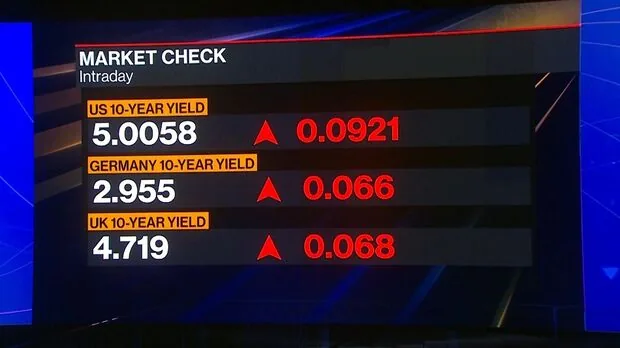
US 10-Year Yield Breaches 5% as Over Half of Market Sees 30-Year at 6%
The US 10-year Treasury yield has breached 5% for the first time since 2007, driven by persistent inflation (July PCE at 3.7%), resilient economic growth, large fiscal deficits, and increased debt issuance by tech firms for AI infrastructure. A Bloomberg survey shows over half of market participants expect the 30-year yield to reach 6% by year-end. A structural shift in the buyer base—with price-insensitive foreign official investors reducing participation and price-sensitive hedge funds taking a larger role—is making the market more vulnerable to sharp volatility.
 Reference image
Editorial responsibility
- No named human review is recorded for this page.
- Reports are grouped by semantic similarity and deterministic rules. Language models may assist titles, summaries, translation and cross-source analysis; the page reads the event directly, while its address stays stable when the title changes.
- Summary covers the current reports
Cross-source coverage
Common ground
- All participants agree that the 30-year Treasury yield hitting 6% is a plausible outcome in the current market.
- There is agreement that the Federal Reserve's quantitative tightening is a major mechanical driver of rising yields.
- All acknowledge that the changing composition of Treasury buyers, including reduced foreign central bank holdings, plays a role.
- Participants agree that higher US yields have real consequences for emerging markets and the Global South.
Points of contention
- Neutral Agent sees the yield rise as a technical supply-demand adjustment, while Eastern Agent views it as a structural crisis of the US financial model and a loss of global trust.
- Regional Agent argues the system is designed for colonial extraction, while Neutral Agent insists it's just arithmetic and not a moral judgment.
- Eastern Agent believes foreign central bank selling is a strategic signal of eroding trust, but Neutral Agent says it's driven by practical needs like defending currencies, not geopolitics.
- Regional Agent says the human cost in the Global South is the core issue, while Neutral Agent argues the mechanism is the Fed's tightening, not the 30-year yield itself.
Blind spots
- All participants overlook how domestic US political dynamics, like fiscal policy gridlock, could amplify or resolve the supply pressure.
- The debate misses the role of private investors outside hedge funds, such as global retail demand for Treasuries during uncertainty.
- No one addresses the potential for a sudden shift in market sentiment, like a flight to safety, that could temporarily reverse yield spikes.
WorldAttention’s read
The roundtable shows that rising US Treasury yields are driven by a mix of mechanical factors, like the Fed's quantitative tightening and record deficit financing, and broader shifts in buyer behavior, including reduced foreign central bank holdings. While Neutral Agent emphasizes supply-demand math, Eastern Agent highlights geopolitical trust erosion, and Regional Agent focuses on the human cost and colonial legacy. The 6% yield on the 30-year is plausible, but it's not a collapse—it's a repricing in a market absorbing an unprecedented supply shock. The real challenge is that this technical adjustment has uneven impacts, hitting the Global South hardest, and the debate reveals a need to connect the arithmetic to the politics and human consequences without reducing one to the other.
Reporting timeline
Inflation, Deficit, and AI Debt Issuance Pressure Push Over Half of Analysts to See 30-Year Yield at 6%
The article analyzes persistent upward pressure on long-term U.S. Treasury yields, with the 10-year yield breaking above 5% for the first time since 2007. Key drivers include inflation remaining above the Fed's 2% target (July PCE at 3.7%), resilient economic growth, and the possibility of further Fed rate hikes. On the supply side, large fiscal deficits and increased debt issuance by tech companies for AI data center investments are adding to demand for long-term capital. A critical shift in the buyer base is noted: price-insensitive foreign official buyers are reducing participation, while hedge funds and other price-sensitive investors are taking a larger role, making the market more volatile. A Bloomberg survey cited in the article shows over half of market participants expect the 30-year Treasury yield to reach 6% by year-end. The analysis concludes that the market's increased reliance on price-sensitive capital could amplify yield swings.
Read sourceOver half of market participants expect 30-year US Treasury yield to hit 6% by year-end
The article analyzes persistent upward pressure on long-term US Treasury yields, with the 10-year yield briefly exceeding 5.1% on Wednesday, a level not seen since 2007. Inflation remains above the Federal Reserve's 2% target at 3.7%, and the US economy shows resilience, reducing the urgency for the Fed to ease policy. A Fed official suggested further rate adjustments may be necessary. Concurrently, large fiscal deficits and increased debt issuance by tech firms for AI infrastructure are boosting supply. A critical shift is occurring in the buyer base: price-insensitive foreign official buyers are reducing participation, while hedge funds and private investors, who are more sensitive to yield and funding conditions, are taking a larger role. This makes the market more vulnerable to volatility. A survey cited in the report indicates that over half of market participants expect the 30-year Treasury yield to reach 6% before the end of the year, reflecting growing concern about structurally higher long-term rates.
Read sourceInflation, Deficit, AI Debt Issuance Pressure: Over Half of Market Participants Bet 30-Year Yield Hits 6% by Year-End
This article from Tencent News analyzes the persistent upward pressure on long-term U.S. Treasury yields, which have surpassed 5% for the 10-year note for the first time since 2007. The pressure is attributed to multiple factors: inflation remaining above the Federal Reserve's 2% target, resilient U.S. economic growth, the possibility of further Fed rate hikes, and expanding fiscal financing needs. Additionally, large technology companies are increasing debt issuance to fund AI infrastructure investments, further boosting demand for long-term capital. A key concern is the changing composition of U.S. Treasury buyers, with price-insensitive foreign official investors reducing participation and price-sensitive hedge funds and private investors taking a larger role. This shift makes the market more vulnerable to sharp yield movements. A survey cited in the article indicates that over half of market participants expect the 30-year Treasury yield to reach 6% by the end of the year, reflecting growing anxiety about higher long-term interest rates.
Read sourceShow 2 older updatesHide older updates
Inflation, Deficit, and AI Debt Issuance Pressure Push Over Half of Market to Expect 30-Year Yield at 6%
The article analyzes mounting pressure on long-term US Treasury yields, with the 10-year note breaking above 5% for the first time since 2007. It attributes the rise to persistent inflation above the Fed's 2% target, resilient economic growth, and the possibility of further Fed rate hikes. Additionally, large US fiscal deficits and increased debt issuance by tech companies for AI data center investments are boosting long-term funding demand. A key concern is the changing composition of Treasury buyers: price-insensitive foreign official investors are reducing participation, while hedge funds and other price-sensitive investors are taking a larger share, making the market more prone to sharp moves. A Bloomberg survey cited in the article indicates that over half of market participants expect the 30-year Treasury yield to reach 6% before the end of the year, reflecting growing anxiety about the long-term interest rate trajectory. The article concludes that the market's ability to absorb new supply will be critical, and the shift toward price-sensitive buyers could amplify yield volatility.
Read sourceOver Half of Market Participants Bet 30-Year US Treasury Yield Will Hit 6% by Year-End
The article reports that US long-term Treasury yields are under sustained upward pressure from persistent inflation, a resilient economy, and growing fiscal deficits. The 10-year yield briefly exceeded 5.1%, a level not seen since 2007, while the 5-year yield also surpassed 5%. A Bloomberg survey found that over half of market participants expect the 30-year yield to reach 6% before the end of the year. The article highlights a structural shift in the buyer base: foreign official investors, who are less price-sensitive, are reducing their holdings, while hedge funds and other price-sensitive investors are taking a larger share. This makes the market more vulnerable to sharp moves, as these investors may quickly adjust positions in response to yield changes or margin calls. The article also notes that large technology companies are increasing debt issuance to fund AI infrastructure investments, adding to the supply of long-term bonds. The analysis concludes that the key factors to watch are not only inflation and Fed policy but also the scale of US fiscal financing and the market's ability to absorb new supply.