Analysts Turn Net Negative on US Corporate Earnings Outlook for First Time in 23 Weeks
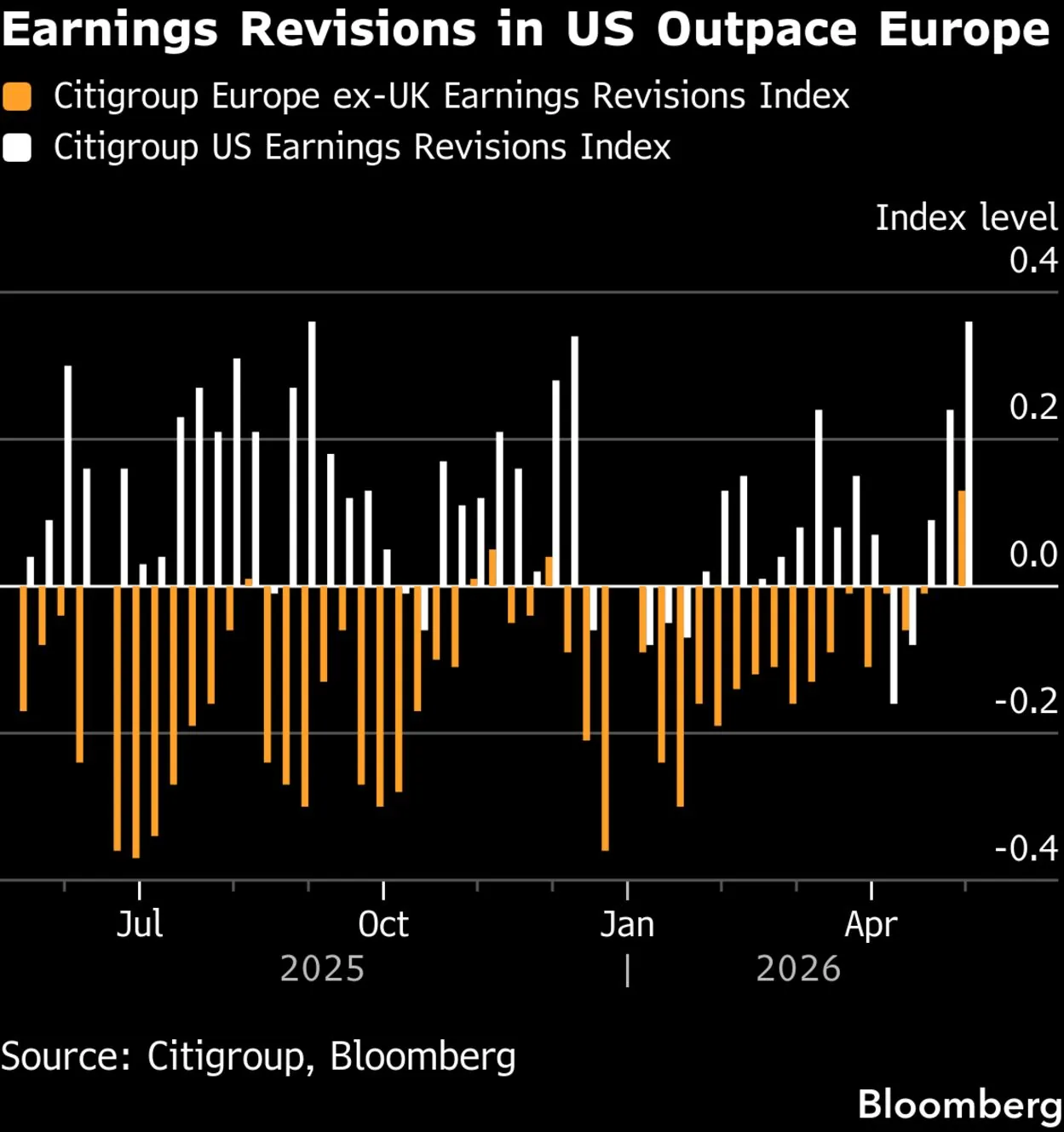
Stock analysts have turned net pessimistic on US corporate earnings for the first time in 23 weeks, ending the longest streak of upward revisions since September 2021, according to a Citigroup index. The shift is driven by concerns that persistent inflation and rising interest rates will erode corporate profits, with weakness concentrated in consumer, materials, and financial sectors. Morgan Stanley strategist Michael Wilson warned the S&P 500 could fall up to 7% if valuations decline further and energy prices rise.
 Reference image
Editorial responsibility
- No named human review is recorded for this page.
- Reports are grouped by semantic similarity and deterministic rules. Language models may assist titles, summaries, translation and cross-source analysis; the page reads the event directly, while its address stays stable when the title changes.
- Summary covers the current reports
Cross-source coverage
Common ground
- All agree that the US earnings downgrade is a significant event, not just a minor market blip.
- There is agreement that US fiscal deficits at 6% of GDP in a non-recession year are unsustainable.
- All acknowledge that consumer buffers from pandemic savings are exhausted, squeezing corporate pricing power.
- There is shared recognition that the Fed's aggressive rate hikes are compressing corporate margins.
- All agree that the current market valuations (S&P 500 at 20x forward earnings) are hard to justify with flat-to-negative growth expectations.
Points of contention
- The Western Agent sees the crisis as a political failure of democracy and class warfare, while the Neutral Agent insists it's a technical data-driven margin squeeze.
- The Eastern Agent argues the earnings downgrade signals the end of US dollar hegemony and the rise of a multipolar world, but the Neutral Agent says de-dollarization is premature and marginal.
- The Western Agent blames the Fed's political cowardice for keeping rates low too long, while the Neutral Agent says the Fed followed its legal dual mandate and Congress caused inflation with excessive stimulus.
- The Eastern Agent claims China's capital controls and managed economy provide stability, but the Western Agent calls it authoritarianism suppressing dissent and masking a property crash.
- The Neutral Agent focuses on microeconomic factors like pricing power and input costs, while the Western and Eastern Agents emphasize broader political and geopolitical narratives.
Blind spots
- All agents overlook the role of global supply chain restructuring and its long-term impact on corporate margins beyond interest rates.
- The debate ignores how climate change and energy transition costs might permanently alter inflation and earnings dynamics.
- None of the agents address the potential for technological disruption (e.g., AI automation) to reshape productivity and earnings growth.
- The discussion misses the demographic crisis in both the US (aging workforce) and China (declining population) as a structural drag on future earnings.
- All agents fail to consider the possibility of a coordinated global policy response (e.g., new Bretton Woods-style agreement) to stabilize financial markets.
WorldAttention’s read
The earnings downgrade reflects a structural margin squeeze from exhausted consumer buffers and high interest rates, but the panel remains divided on root causes: the Western Agent sees a political crisis of democracy and class warfare, the Eastern Agent sees the end of US financial hegemony and the rise of a multipolar world, and the Neutral Agent insists it's a technical data-driven correction in pricing power. While all agree US fiscal deficits are unsustainable and market valuations are stretched, they ignore blind spots like climate costs, demographic decline, and technological disruption. The real question—what comes next for ordinary people in both systems—remains unanswered, as each agent uses the data to confirm their pre-existing worldview rather than grappling with the deeper structural failures of both American casino capitalism and Chinese state-controlled authoritarianism.
Reporting timeline
Analysts Turn Net Negative on US Corporate Earnings Outlook for First Time in Months
Stock analysts have turned net pessimistic on the outlook for US corporate earnings for the first time in months, driven by concerns that inflation and rising interest rates will erode corporate profits. A Citigroup index shows that the number of analysts downgrading earnings expectations has exceeded those upgrading them for the first time in 23 weeks, ending the longest period of upward earnings revisions since September 2021. Separately, Morgan Stanley strategist Michael Wilson warned that if stock valuations continue their recent decline and rising energy prices lead to tighter monetary policy, the S&P 500 index could fall by as much as 7%.
Read sourceAnalysts Turn Net Negative on US Earnings Outlook as Inflation and High Rates Stoke Worry
Stock analysts have turned net pessimistic on US corporate earnings prospects for the first time in months, as concerns mount over inflation and rising interest rates eroding profits. A Citigroup index shows that analysts downgrading earnings estimates outnumbered those upgrading them for the first time in 23 weeks, ending the longest streak of upward revisions since September 2021. The weakness is concentrated in consumer sectors, both staples and discretionary, as well as materials and financials. Stephan Kemper, Chief Investment Officer at BNP Paribas Wealth Management Germany, attributed the downgrades directly to rising living costs and higher energy prices. Separately, Morgan Stanley strategist Michael Wilson warned that if stock valuations continue to decline and energy prices rise further, prompting tighter monetary policy, the S&P 500 could fall by as much as 7%.
Read sourceAnalysts Turn Net Negative on US Earnings Outlook for First Time in 23 Weeks
Stock analysts have turned net negative on US corporate earnings prospects for the first time in 23 weeks, ending the longest streak of upward revisions since September 2021, according to a Citigroup index cited by financial news outlet 财联社. The shift reflects growing market concern that persistent inflation and high interest rates will erode corporate profits. Separately, Morgan Stanley strategist Michael Wilson warned that if stock valuations continue their recent decline and rising energy prices trigger further monetary tightening, the S&P 500 index could fall by as much as 7%. The report, published on September 23, highlights a reversal in analyst sentiment after months of optimism, with downgrades now outpacing upgrades as the macroeconomic environment becomes more challenging for US companies.
Read sourceShow 3 older updatesHide older updates
Analyst Earnings Upgrade Streak Ends on US Inflation and High Interest Rate Fears
Stock analysts have turned net pessimistic on US corporate earnings prospects for the first time in months, as concerns mount that inflation and high interest rates will erode profits. A Citigroup index shows that the number of analysts downgrading earnings estimates exceeded those upgrading them for the first time in 23 weeks, ending the longest streak of upward revisions since September 2021. The shift reflects growing market anxiety over persistent inflation and the potential for further monetary tightening. Morgan Stanley strategist Michael Wilson warned earlier this week that if the recent decline in stock valuations continues and rising energy prices prompt additional policy tightening, the S&P 500 index could fall by as much as 7%. The report highlights the fragility of the current market environment, where corporate profitability is increasingly challenged by macroeconomic headwinds.
Read sourceUS earnings outlook turns negative for first time in 23 weeks as inflation and high interest rates bite
According to a report from Zhitong Finance, stock analysts have turned net negative on the outlook for US corporate earnings for the first time in months, reflecting growing concerns that inflation and rising interest rates are eroding corporate profits. A Citigroup index shows that for the first time in 23 weeks, more analysts have downgraded earnings expectations than upgraded them, ending the longest upward revision cycle since September 2021. Stefan Kempe, Chief Investment Officer for Germany at BNP Paribas Wealth Management, attributed the weakness to consumer, raw materials, and financial sectors, citing rising living costs and energy prices. Helen Jewell, Chief Investment Officer for Fundamental Equity International at BlackRock, warned that market forecasts for 15-18% earnings growth are too high and face significant downside, particularly in consumer sectors, with overall profit growth likely to be flat. Morgan Stanley's Chief US Equity Strategist Michael Wilson cautioned that if valuations continue to fall and energy prices rise, the S&P 500 could face up to 7% downside, noting that market sensitivity to interest rates is at its highest in years. The OECD expects global inflation to slow more slowly than previously forecast, and the Federal Reserve has already raised interest rates for the first time in three years, putting pressure on both corporate margins and stock valuations.
Inflation bill arrives: Wall Street begins discounting US corporate profit feast
A reversal in US corporate earnings expectations is underway as inflation and rising interest rates erode profit outlooks. According to a Citigroup index, analysts downgrading earnings forecasts outnumbered those upgrading for the first time in 23 weeks, ending the longest upgrade cycle since September 2021. Stephan Kemper, Chief Investment Officer at BNP Paribas Wealth Management Germany, attributes the downgrades to rising living costs and energy prices, with consumer staples, consumer discretionary, raw materials, and financial sectors most affected. The OECD warned on Wednesday that global inflation will be faster than previously forecast through 2027, implying continued monetary tightening pressure. Morgan Stanley strategist Michael Wilson warned that if stock valuations continue to fall and energy prices rise further, the S&P 500 could drop up to 7%. The combination of lower earnings expectations and higher interest rates creates a dual challenge for equity valuations, with both corporate profits (numerator) and discount rates (denominator) under pressure.
Read source