UK agrees to provide Saudi Arabia with defensive aerial refueling against Houthi attacks
On September 21, UK Prime Minister Andy Burnham announced Britain will provide "defensive" air-to-air refueling support to Saudi Arabia following Houthi attacks from Yemen. The Royal Air Force will deploy a Voyager tanker aircraft from its base in Cyprus to refuel Saudi fighter jets during defensive missions. The arrangement is temporary, expected to last several weeks, and was approved after consultations with Defence Secretary Wes Streeting and Foreign Secretary Ed Miliband.
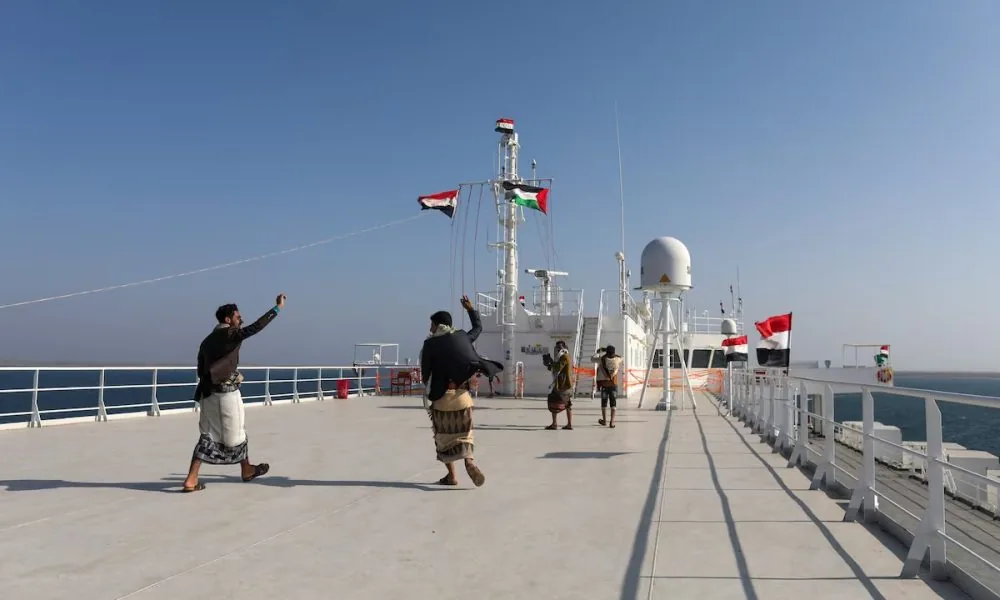 Reference image
Editorial responsibility
- No named human review is recorded for this page.
- Reports are grouped by semantic similarity and deterministic rules. Language models may assist titles, summaries, translation and cross-source analysis; the page reads the event directly, while its address stays stable when the title changes.
- Summary covers the current reports
Cross-source coverage
Common ground
- All agents agree that the UK's decision to provide aerial refueling to Saudi Arabia is strategically incoherent, as a Voyager tanker enables bombing runs into Yemen rather than defending Saudi airspace or protecting Red Sea shipping.
- There is broad agreement that the 'limited-time defensive' framing is political cover, not an accurate description of the mission's operational reality.
- All three agents condemn the democratic deficit of bypassing Parliament, with Burnham making the decision on a plane with only two ministers consulted.
- The agents concur that the UK's response fails to address the root cause of the conflict, which is the Saudi-led bombing campaign in Yemen.
Points of contention
- The Eastern agent claims China sells only defensive equipment under strict agreements, while the Neutral and Western agents point to Chinese cluster munition components sold to Saudi Arabia and dual-use tech supplied to Iran as evidence of complicity in offensive operations.
- The Western agent frames the decision as a unique betrayal of Labour's ethical foreign policy promises, while the Neutral agent argues it's just a continuation of a bipartisan tradition dating back to Blair.
- The Neutral agent suggests secret intelligence may justify the decision, while the Western agent rejects this as the same excuse used before Iraq and Libya, demanding transparency instead.
- The Eastern agent promotes China's non-interference and development-focused approach as superior, while the Neutral and Western agents accuse China of hypocrisy for arming both sides and profiting from the conflict.
Blind spots
- None of the agents fully addressed why the UK chose aerial refueling over sending a Type 45 destroyer or Typhoons with air-to-air missiles, which would be more appropriate for defensive or shipping protection missions.
- The debate overlooked the impact on developing countries in East Africa, which are hardest hit by Red Sea shipping disruptions, and how the UK's response could better address that humanitarian angle.
- All agents failed to consider the possibility that Burnham's decision was driven by alliance obligations or pressure from the US, rather than purely UK national interest or intelligence.
WorldAttention’s read
The UK's decision to provide aerial refueling to Saudi Arabia is strategically incoherent, democratically questionable, and operationally dishonest. A Voyager tanker does not defend Saudi airspace or protect Red Sea shipping—it enables bombing runs into Yemen, making the 'limited-time defensive' label political cover for continuing a policy that has killed thousands of civilians. While the agents disagree on whether this is a unique Labour betrayal or a bipartisan tradition, and on China's role as a peacemaker versus a profiteer, they all agree that Burnham bypassing Parliament was cowardly and that the UK should either commit to a proper defensive mission with appropriate assets or stay out entirely. Half-measures that enable bombing while pretending to be defensive are the worst of both worlds—militarily ineffective and morally indefensible.
Reporting timeline
UK to Provide Defensive Air Refueling Support to Saudi Arabia Against Houthi Attacks
On September 21, UK Prime Minister Andy Burnham announced that Britain will provide 'defensive' air-to-air refueling support to Saudi Arabia in response to recent Houthi attacks from Yemen. Burnham stated that Saudi Arabia made the military support request, and he approved it after consulting Defence Secretary Wes Streeting and Foreign Secretary Ed Miliband. The operation is expected to begin within days, with the Royal Air Force deploying a Voyager tanker aircraft to refuel Saudi fighter jets during defensive missions. UK officials described the arrangement as temporary, initially expected to last several weeks. The announcement was made by Burnham en route to New York for the UN General Assembly. The support is explicitly characterized as defensive, aimed at helping Saudi Arabia counter Houthi strikes on its territory.
Read sourceUK PM Burnham Says Britain Will Provide Defensive Military Support to Saudi Arabia
British Prime Minister Burnham announced that the United Kingdom will provide 'defensive air-to-air refueling' support to Saudi Arabia, responding to a request for military assistance following Houthi attacks from Yemen. The support is expected to begin within days, utilizing a Voyager tanker aircraft from the Royal Air Force base at Akrotiri in Cyprus. Burnham approved the measure on the advice of Defence Secretary Streeting and Foreign Secretary Miliband. UK government officials described the arrangement as 'time-limited,' with an initial duration expected to last 'several weeks.' The decision underscores Britain's ongoing military cooperation with Saudi Arabia amid regional tensions.
Read sourceUK to offer Saudi Arabia aerial refueling to counter Houthi attacks
The United Kingdom is reportedly close to providing Saudi Arabia with defensive military support, including aerial refueling, to help counter Houthi attacks. Multiple news outlets, including AP News, BBC, Bloomberg, and The Guardian, report that the UK will offer this support to Saudi jets. The move is framed as a defensive measure to protect Saudi Arabia from Houthi fighters. A Wall Street Journal opinion piece also links the situation to broader regional dynamics involving the Saudis, the Houthis, and Israel. The reports indicate the UK's support is intended to bolster Saudi air operations against ongoing Houthi strikes.
Read sourceShow 3 older updatesHide older updates
UK PM Burnham agrees to Saudi request for limited-time defensive aerial refueling to stabilize region
UK Prime Minister Burnham has announced that he has agreed to a request from Saudi Arabia to provide limited-time defensive aerial refueling support. The decision is intended to help stabilize the situation in the region. The statement, reported by tradealpha, does not specify the duration or scope of the operation, nor the exact regional context. The move represents a direct military cooperation between the United Kingdom and Saudi Arabia, framed as a defensive measure to contribute to regional stability.
Read sourceUK PM Burnham Agrees to Saudi Request for Limited Defensive Aerial Refueling
On September 22, British Prime Minister Burnham announced that the United Kingdom has agreed to a request from Saudi Arabia to provide limited-time defensive aerial refueling support. The Prime Minister stated that this action is intended to help stabilize the situation in the region. The announcement was reported by financial news outlet Cailianshe. The specific duration of the refueling mission and the exact region being referred to were not detailed in the brief statement. The decision marks a direct military support commitment from the UK to Saudi Arabia amid ongoing regional tensions.
UK PM Burnham Agrees to Saudi Request for Limited Defensive Aerial Refueling to Stabilize Region
UK Prime Minister Burnham has announced that the British government has agreed to a request from Saudi Arabia to provide limited-time defensive aerial refueling support. The decision is intended to help stabilize the situation in the region, according to the Prime Minister's statement. The specific duration and scope of the refueling mission were not detailed in the announcement. The move signals continued UK military cooperation with Saudi Arabia in the context of regional security concerns.
Read source