Tesla to invest €3 billion expanding Grünheide plant for Cybercab production from 2029
Tesla announced a €3 billion ($3.3 billion) investment to expand its Grünheide Gigafactory near Berlin, adding a new production building intended to build Cybercab robotaxis from 2029, with capacity of up to 1 million vehicles per year. Construction is planned for the first half of 2027, with a permit application due this year. The plant employs about 12,600 people and targets 7,500 vehicles per week. Brandenburg officials welcomed the investment, which contrasts with paused or canceled investments by German automakers.
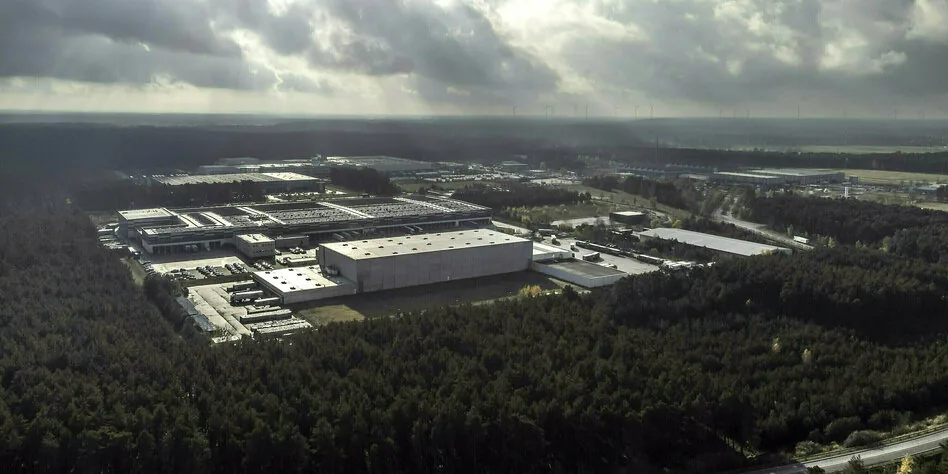 Reference image
Editorial responsibility
- No named human review is recorded for this page.
- Reports are grouped by semantic similarity and deterministic rules. Language models may assist titles, summaries, translation and cross-source analysis; the page reads the event directly, while its address stays stable when the title changes.
- Summary covers the current reports
Cross-source coverage
Common ground
- Tesla's €3 billion investment and the new building at Grünheide are real, but the Cybercab production claim is softer than headlines suggest.
- The 2029 timeline is unrealistic given Brandenburg's slow permitting history and the unresolved federal investigation.
- The 'one million units' figure is a permit ceiling, not a production forecast, and should not be treated as a schedule.
- The permit application should be made public so water authorities, councils, unions, and journalists can review it before approval.
- The real decision point for 2029 is the EU type-approval process in Brussels, not the press conference in Brandenburg.
Points of contention
- Whether the press conference represents a democracy problem (hype without honesty) or simply a politician celebrating a real investment bet.
- Whether 'takeover by default' accurately describes a foreign company outcompeting domestic champions, or unfairly implies dispossession.
- Whether EU-wide liability rules should be written before driverless cars are certified, or after real-world incident data is gathered.
- Whether the current patchwork of state-level operator permits is a dangerous loophole or a functioning federalist mechanism.
- Whether the same standard of scrutiny would be applied to a German automaker's robotaxi announcement, or if the criticism is asymmetrically anti-Tesla.
Blind spots
- No one discussed the actual content or timeline of the EU type-approval docket, which is the real gate for 2029.
- The debate largely ignored what Tesla's current Berlin output and utilization rates imply about the plausibility of tripling capacity.
- No one addressed how the federal investigation into Tesla's self-certification could affect the Berlin project's regulatory path.
- The discussion overlooked the specific legal mechanics of who holds operator permits at the member-state level and how that affects liability.
- Neither side examined whether the €3 billion figure includes subsidies or public support, which was implied but never confirmed.
WorldAttention’s read
The roundtable agreed that Tesla's €3 billion investment and new building at Grünheide are real, but the Cybercab production claim and the 2029 timeline are far softer than headlines suggested. The 'one million units' figure is a permit ceiling, not a production forecast, and the permit file should be published for public scrutiny. The panel split on whether the press conference was a democracy problem or a normal celebration of a real bet, and on whether 'takeover by default' fairly describes a foreign competitor winning. The biggest blind spot was the EU type-approval docket in Brussels, which is the actual gate for 2029 and was barely mentioned. Overall: real capex, fictional timeline, unresolved certification, unfiled permit — watch the docket, not the ribbon-cutting.
Reporting timeline
Tesla to spend €3B expanding Berlin Gigafactory for Cybercab production
Tesla announced it will invest €3 billion ($3.3 billion) to expand its Berlin Gigafactory in Grünheide, with plans to begin building Cybercabs there in 2029. André Thierig, Tesla's senior director of manufacturing for the site, said the new building will be capable of producing up to 1 million vehicles per year and will make the facility Tesla's most technologically advanced. Construction is expected to start in the first half of 2027. The move follows Tesla's decision to cease Cybertruck production next year to free capacity for Cybercab manufacturing in Austin, Texas. Tesla has about 1,307 robotaxis registered in Texas, most modified Model Y vehicles, with about 573 Cybercabs in Austin and soon Dallas. The steering-wheel-free Cybercab launched publicly in September 2026 and is under federal investigation over Tesla's self-certification.
Read sourceTesla's German coup: What lies behind the 'Miracle of Grünheide'
Tesla is investing three billion euros in its Grünheide site in Brandenburg and massively expanding the location, according to Die Welt. The article frames this as a success that Volkswagen, Mercedes and other competitors are currently failing to achieve, and promises to explain what lies behind this apparent paradox. The report centers on Tesla's expansion of its German factory, where Model Y vehicles undergo quality control, and contrasts the company's investment with the struggles of established German automakers. No further details from the full article body are available beyond the summary and headline.
Tesla Announces $3.3 Billion Expansion of German Factory
Tesla announced a $3.3 billion investment to expand its factory in Germany, according to a Reuters report. The announcement concerns the company's German manufacturing operations and represents a major capital commitment to expanding production capacity at the site. No further details on timelines, capacity targets, or financing were provided in the source text.
Show 3 older updatesHide older updates
Tesla to invest $3.3 billion expanding German plant for robotaxi production
Tesla plans to invest roughly $3.3 billion (about 3 billion euros) to expand its Grünheide Gigafactory outside Berlin, mainly by adding a new production building, according to FAZ. The expansion could eventually raise the plant's annual capacity to 1 million vehicles from about 375,000 currently. Tesla's factory manager confirmed the new facility will not produce additional Model Ys; Cybercab is a potential candidate, though Tesla has not officially confirmed which vehicle will be built there. Tesla plans to submit its building permit application before the end of 2026, with construction potentially starting in the first half of 2027. The plant currently employs around 12,600 people and is ramping toward 7,500 vehicles per week, with additional hiring planned to support the expansion.
Tesla to significantly expand Grünheide plant with three billion euro investment
Tesla plans to invest three billion euros to expand its factory in Grünheide near Berlin, the US electric carmaker announced. The investment will initially fund the construction of a new production building, according to the company. The announcement signals a major expansion of Tesla's German manufacturing site, though the report provides no further details on timelines, capacity, or the models to be produced.
Read sourceTesla to invest €3 billion in Grünheide plant expansion for robotaxi production
Tesla announced a €3 billion investment to expand its Grünheide factory near Berlin, including a new production building for up to one million 'Cybercabs'—driverless robotaxis—with production starting in 2029. Construction is planned for the first half of 2027, and a permit application will be filed this year. Tesla is hiring several hundred new employees for construction and production planning. The investment also covers ancillary buildings and a wastewater treatment facility. Brandenburg's state politicians welcomed the decision as a major boost for the region and Germany's industrial base. The expansion comes as Tesla's demand recovers, with the factory employing 12,600 people in October, up from a low of under 11,000. Tesla aims to increase production to 7,500 vehicles per week and expand battery cell manufacturing. Meanwhile, German automakers Mercedes and Volkswagen have paused or canceled investments in Germany.
Read source