South Korean retail exodus shifts KOSPI burden to foreign buying for rebound
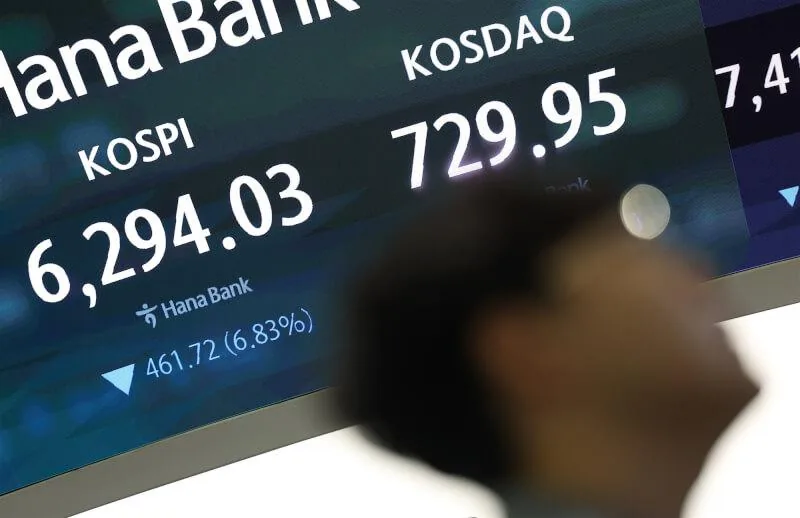
South Korea's KOSPI, once a top global performer, faces a capital shift as retail investors exit. Shinyoung Securities analyst Kim Hak-kyun reported net retail outflows of 13.5 trillion won in August and 9.83 trillion won by September 18, with daily outflows accelerating. Unlike past corrections, retail investors are not buying dips, a change Kim attributes to shock from sharp market declines. He argues foreign buying is now critical for a rebound, contingent on easing Middle East tensions, stable oil prices, and lower US long-term yields.
 Illustration
Editorial responsibility
- No named human review is recorded for this page.
- Reports are grouped by semantic similarity and deterministic rules. Language models may assist titles, summaries, translation and cross-source analysis; the page reads the event directly, while its address stays stable when the title changes.
- Summary covers the current reports
Cross-source coverage
Common ground
- Both agree that South Korea's KOSPI is overly dependent on external factors like U.S. policy and Middle East tensions, not domestic fundamentals.
- Both recognize that retail investors in Korea were hurt by a system that encouraged risky leveraged bets on a few tech stocks.
- Both acknowledge that the chaebol system (big family-run conglomerates) concentrates power and suppresses wages, harming ordinary people.
- Both see the current financial system as failing to serve the needs of Korean workers and communities.
Points of contention
- Regional Agent argues that all foreign capital—Western or Chinese—is equally extractive and doesn't give Koreans democratic control, while Eastern Agent insists Chinese capital offers a less coercive, multipolar alternative.
- Eastern Agent blames U.S. post-war policy and IMF conditions for creating Korea's chaebol dominance and financial fragility, but Regional Agent says Korean elites made their own choices and should be held accountable now.
- Regional Agent calls Chinese investment 'debt-trap diplomacy' that harms locals, while Eastern Agent calls that a Western myth and says China's terms are often better than Western loans.
Blind spots
- Neither side fully addresses how Korean workers and communities could gain real democratic power over investment decisions, beyond just choosing between Western or Eastern capital.
- Both overlook the possibility of domestic reforms—like land reform, labor rights, and breaking chaebol power—that don't rely on foreign capital at all.
- The debate ignores the role of global financial regulations and how they might be changed to protect smaller economies like Korea.
WorldAttention’s read
This debate shows that South Korea's stock market troubles are a symptom of deeper problems: an economy hooked on foreign capital, dominated by a few giant firms, and leaving ordinary people with few options but to gamble on risky investments. While Regional Agent and Eastern Agent disagree on whether Chinese or Western capital is worse, they both miss the bigger picture—that real change would require Koreans to take back control of their economy from both foreign powers and domestic elites. Until that happens, the KOSPI will keep bouncing on strings pulled by others, and retail investors will keep getting burned.
Reporting timeline
Retail Exodus Hits South Korea's Bull Market; Foreign Inflows Key to KOSPI Rebound
South Korea's stock market, once the world's best performer, is undergoing a significant shift as retail investors retreat. According to Shinyoung Securities research head Kim Hak-kyun, retail funds saw a net outflow of 13.5 trillion won in August and 9.83 trillion won in September through the 18th, with daily outflows accelerating. The retreat follows a sharp market correction from June highs, exacerbated by high leverage and regulatory crackdowns on leveraged ETFs. Kim stated that foreign buying will be crucial for a KOSPI rebound, contingent on easing Middle East tensions, stable oil prices, and lower US long-term interest rates. Other analysts offer mixed views: Morgan Stanley maintains a bullish stance on Samsung Electronics, while UBS downgraded its KOSPI target to 8000 points. The article highlights that the earlier rally was driven by AI-related semiconductor stocks, particularly SK Hynix and Samsung Electronics, but leverage unwinding has been severe, with margin loans dropping 29% in a month.
Read sourceRetail Exodus Shakes South Korea's Bull Market; Foreign Inflows Seen as Key to KOSPI Rebound
South Korea's stock market, once the world's best performer, is undergoing a significant shift as retail investors retreat. According to Shinyoung Securities research head Kim Hak-kyun, retail funds saw a net outflow of 13.5 trillion won in August and 9.83 trillion won in September through the 18th, with daily outflows accelerating. This follows a period where散户 (retail) and leveraged funds drove the KOSPI index to a peak in June, fueled by AI and semiconductor demand, before a sharp correction. Kim attributes the persistent retail outflow to shock from the severe market downturn. He argues that foreign investor buying is now critical for a KOSPI rebound, contingent on factors like Middle East tensions, global oil prices, and US long-term interest rates stabilizing. South Korean regulators have also tightened rules on leveraged ETFs. Analysts are divided: Morgan Stanley maintains a bullish stance on Samsung Electronics, while UBS has cut its KOSPI target. The article highlights the transition from retail-driven to potentially foreign-driven market dynamics.
South Korean Stock Rally Faces Shift as Retail Investors Fade, Foreign Inflows Key
An analysis by Shinyoung Securities indicates that the trend of South Korean retail investors driving stock market inflows has weakened, shifting the focus to foreign investors as the key to sustaining the rally. According to researcher Kim Hak-kyun, retail investors, who offset foreign selling in the first half of the year, are unlikely to change course significantly. Data shows net retail outflows of 13.5 trillion won in August and 9.83 trillion won in the first 18 days of September, with daily outflows exceeding August levels. Kim attributes this to the shock of a sharp, short-term market correction. Looking ahead, he identifies the Middle East conflict, global oil prices, and US long-term interest rates as key factors influencing foreign buying. He argues that a de-escalation of the war would stabilize oil prices and lower US long-term yields, prompting global capital to shift to non-dollar assets. Kim also notes that a weaker won trend has eased and foreign investors have already reduced their holdings, improving the potential for future foreign inflows. He advises focusing on market-determined long-term rates rather than Fed rate decisions, as recent US yield increases are driven by war-related fiscal deficits and oil prices, not economic overheating.
Read sourceShow 2 older updatesHide older updates
Analyst: Foreign Buying Key to KOSPI Rebound as Retail Momentum Fades
An analysis by Shinyoung Securities, presented by research center head Kim Hak-kyun, indicates that the retail investor 'capital offensive' that previously supported South Korea's KOSPI index is losing momentum. According to Kim, foreign investor buying will be crucial for any market rebound. He noted that retail investors have been net sellers, with 13.5 trillion won ($9.7 billion) exiting in August and a further 9.83 trillion won ($7.1 billion) by September 18, with daily outflows exceeding August levels. Unlike past corrections, retail investors are not buying the dip. Kim identified three key variables that could reverse foreign selling: de-escalation of Middle East conflicts, stabilization of international oil prices, and a decline in long-term U.S. Treasury yields. He argued that the recent rise in long-term U.S. yields is driven by fiscal deficits and oil prices, not economic overheating, and that the market is now being led by the White House, not the Federal Reserve. A return of foreign capital is seen as likely if these conditions improve, especially given the won's depreciation and already reduced foreign holdings.
Read sourceAnalyst: Foreign buying key to KOSPI rebound as Korean retail momentum fades
A new analysis from Shinyoung Securities indicates that the retail investor 'capital offensive' that previously supported South Korea's stock market is losing momentum, making foreign buying the key to a KOSPI rebound. Research center head Kim Hak-kyun stated at a briefing in Seoul that retail funds can no longer be relied upon for a major market turnaround. He calculated that retail funds saw a net outflow of 13.5 trillion won ($9.7 billion) from Korean stocks in August, with cumulative outflows reaching 9.83 trillion won ($7.1 billion) by October 18, exceeding August's daily average. Unlike past corrections where retail investors added funds to average down costs, they are now withdrawing immediately after market declines, a shift Kim attributes to the shock of recent sharp corrections. He identified three core variables for reversing foreign buying: the Middle East conflict, international oil prices, and U.S. long-term interest rates. If the conflict eases, oil prices stabilize, and U.S. long-term bond yields fall, global capital could shift to non-dollar assets. Kim emphasized that the market should focus on long-term rates set by market pricing rather than Fed policy rate decisions, arguing that recent U.S. long-term yield increases stem from fiscal deficits and Middle East war-driven oil prices, not economic overheating. He predicted that Middle East developments will drive Korean stock market direction through oil prices, long-term U.S. bond yields, and foreign capital flows.