Shangwei New Materials launches Qiyuan personal robots from 19,999 yuan, shipments start October 1
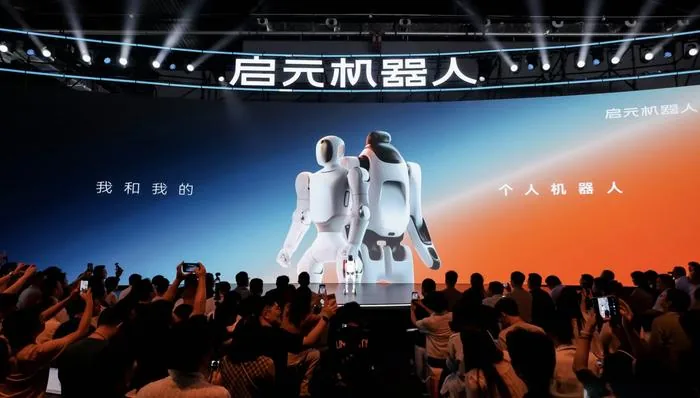
On September 20, Shangwei New Materials launched its Qiyuan brand personal robots Q1 and T1 in Shanghai, priced from 19,999 yuan. Shipments begin October 1. CEO Tian Hua outlined a full-stack strategy covering hardware, AI models, and ecosystem, with over 500 million yuan planned for 2026 R&D. The robots use lightweight composites and self-developed QDD joints, with three core AI models. Experience stores will open in seven Chinese cities.
 Reference image
Editorial responsibility
- No named human review is recorded for this page.
- Reports are grouped by semantic similarity and deterministic rules. Language models may assist titles, summaries, translation and cross-source analysis; the page reads the event directly, while its address stays stable when the title changes.
- Summary covers the current reports
Cross-source coverage
Common ground
- Both sides agree that Qiyuan's $19,999 price point is strategically aggressive and could disrupt the consumer robotics market.
- There is agreement that Qiyuan's supply chain integration, including lightweight composites and in-house manufacturing, is a genuine structural advantage.
- Both acknowledge that the 'ship now, iterate later' approach has worked for other Chinese tech products like smartphones and EVs.
Points of contention
- The Eastern agent believes shipping an imperfect robot now builds a market, while the Neutral agent argues that a $19,999, 40-kilogram machine in homes carries unacceptable safety and liability risks.
- The Eastern agent claims Western critics apply double standards by demanding proof they don't ask from Tesla or Boston Dynamics, but the Neutral agent says the skepticism is based on a lack of real-world testing data, not bias.
- They disagree on whether the Roomba analogy fits: the Eastern agent says it proves iteration works, while the Neutral agent says Roomba succeeded because it was cheap, simple, and safe, unlike Qiyuan's robot.
Blind spots
- Neither side fully addresses how Qiyuan will handle returns and brand damage if early units fail in homes at scale.
- The debate overlooks the potential regulatory hurdles for selling a heavy humanoid robot in global markets, especially in the West.
- Both agents assume the robot's 'fun' use case will naturally evolve into utility, but they don't discuss what happens if it doesn't.
WorldAttention’s read
The roundtable shows a clear split between optimism about China's proven playbook of disruptive pricing and rapid iteration, and skepticism about applying that model to a complex, heavy, and expensive humanoid robot. The Eastern agent argues that shipping now at a low price will let Qiyuan learn and dominate the category, just like Roomba, smartphones, and EVs did. The Neutral agent counters that the risks—physical injury, property damage, and brand destruction—are far higher for a 40-kilogram machine in a home than for a cheap vacuum or a phone, and that without real-world proof of reliability or a clear use case, the strategy could backfire. Both sides agree the supply chain advantage is real, but the core disagreement is whether 'fun before utility' can work for a product this costly and potentially dangerous. The blind spots include how Qiyuan will manage returns and regulatory hurdles, and whether the 'fun' use case will actually lead to lasting value. Ultimately, the debate hinges on whether Qiyuan's 100,000 units will stay in homes long enough to generate the data needed to improve, or if they'll create a wave of returns that kills the business.
Reporting timeline
Shanghai Weixin Launches Personal Robots Starting at 19,999 Yuan, Prioritizing Fun Before Utility
On September 20, Shanghai Weixin New Materials (上纬新材) held a themed launch event for its 'Qiyuan' (启元) brand, releasing two personal robots: the Qiyuan Q1 and Qiyuan T1. The base versions of both models are priced at 19,999 yuan, with the Q1 Explorer Edition at 26,999 yuan and the T1 Pro at 29,999 yuan. Shipments begin October 1. Initial experience stores will open in seven Chinese cities including Shanghai, Guangzhou, and Shenzhen. CEO Tian Hua stated that household robots face highly complex unstructured environments, making it unrealistic to immediately handle all chores. The industry's practical path is to first be 'fun' and iteratively become 'useful' through real home use. The robots feature lightweight composite materials, self-developed QDD quasi-direct drive joints, and three core AI models: PrimeMotion for motion control, PrimeGo for multimodal perception, and PrimeVista for multimodal interaction. A household task foundation model PrimeMind is under development. The company announced the 'Qiyuan Star Ecosystem Plan' with a total investment of 1 billion yuan over five years to build platforms for user customization, skill stores, and developer collaboration. Partnerships with Peking University, Shanghai Jiao Tong University, and Zhejiang University aim to cultivate talent in embodied AI. The article notes the consumer personal robot industry remains in early exploration, with challenges in complex household tasks, environmental adaptation, and long-term maintenance still unresolved.
Qiyuan Robot Unveils Tech Framework: Hardware, AI, and Ecosystem Must Have No Weaknesses
On September 20, Qiyuan Robot held a new product launch in Shanghai. CEO Tian Hua of Shangwei New Materials disclosed the company's technology framework and key investments, stating that a qualified personal robot must 'behave like a human, understand humans, and continuously grow,' which breaks down into hardware, AI, and ecosystem. On the hardware side, Qiyuan applies lightweight, high-rigidity composite materials and self-developed QDD quasi-direct drive joints, about the size of an egg, for small humanoid robots. On the AI side, the company announced three core models: PrimeMotion for motion control, PrimeGo for multimodal perception and following, and PrimeVista for multimodal interaction. Qiyuan plans to invest 500 million yuan in R&D in 2026, focusing on full-stack development including robotics hardware, motion control, multimodal interaction, and AI agents. The company also disclosed mass production capabilities, producing one robot every 2.5 minutes using automotive-grade manufacturing processes.
Shang Wei New Materials launches consumer humanoid robots, CEO Tian Hua details full-stack AI and hardware strategy
On September 20, Shang Wei New Materials, through its consumer embodied intelligence brand Qiyuan Robot, launched two personal robots: the Qiyuan Q1 and Qiyuan T1. CEO Tian Hua told Securities Times that the robot business is one of the company's most important strategic directions, with over 500 million yuan planned for investment this year, covering full-stack R&D in robot hardware, motion control, multimodal interaction, and AI agents. The Qiyuan Q1 is priced at 19,999 yuan, with a Pro version at 26,999 yuan; the T1 starts at 19,999 yuan, with a T1 Pro at 29,999 yuan. Tian Hua stated that selling the robot hardware itself is not profitable, but serves as a traffic entry point for long-term revenue from content subscriptions, IP applications, and services. The company highlighted its full-stack self-developed hardware, including lightweight composite materials and a compact QDD quasi-direct drive joint, as well as three core AI models: PrimeMotion, PrimeGo, and PrimeVista. A home-focused foundation model, PrimeMind, is also under development. The company has adopted automotive-grade manufacturing, producing one robot every 2.5 minutes. Overseas expansion has begun, with a target of 30% of robot revenue from international markets next year.
Read sourceShow 2 older updatesHide older updates
Qiyuan Robot Announces Pricing Starting at 19,999 Yuan for Q1 and T1 Models
On September 20, Tian Hua, CEO of Shangwei New Materials Robot (Qiyuan Robot), announced the official pricing for two product lines. The Qiyuan Q1 is priced at 19,999 yuan, while the Qiyuan Q1 Explorer Edition costs 26,999 yuan. The Qiyuan T1 is also priced at 19,999 yuan, and the Qiyuan T1 Pro costs 29,999 yuan. The announcement was reported by Interface News and republished by East Money. No further details on specifications, availability, or target markets were provided in the source item.
Read sourceShang Wei Xin Cai's Qiyuan Robot Launches, Priced from 19,999 Yuan
On September 20, Shang Wei Xin Cai (上纬新材) held a new product launch event for its Qiyuan Robot (启元机器人) brand, announcing that the robots are now officially on sale. The company stated that shipments will begin on October 1. The pricing structure includes the Qiyuan Q1 and Qiyuan T1 models at 19,999 yuan each, the Qiyuan Q1 Explorer Edition at 26,999 yuan, and the Qiyuan T1 Pro at 29,999 yuan. The announcement was reported by People's Financial Information on the same day.
Read source