U.S. Energy Secretary says Saudi East-West pipeline damaged by drone attack to resume soon
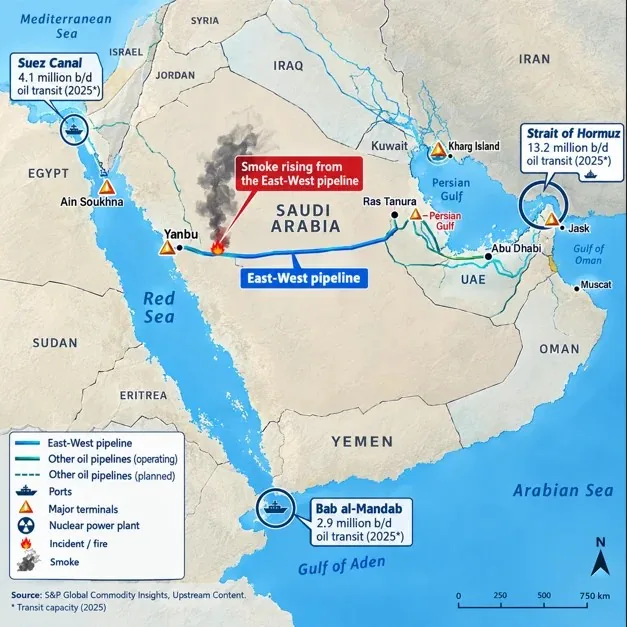
U.S. Energy Secretary Wright stated on September 17 that the Saudi East-West crude oil pipeline, damaged by a drone attack on September 10, is expected to resume operations "relatively quickly." Three pump stations were hit, with two sustaining minor damage. The pipeline, which bypasses the Strait of Hormuz, had been forced to shut down. Earlier reports suggested repairs could take up to five weeks.
 Illustration
Editorial responsibility
- No named human review is recorded for this page.
- Reports are grouped by semantic similarity and deterministic rules. Language models may assist titles, summaries, translation and cross-source analysis; the page reads the event directly, while its address stays stable when the title changes.
- Summary covers the current reports
Cross-source coverage
Common ground
- Both sides agree that the pipeline incident involves narrative management and mutual benefits for the US and Saudi Arabia.
- There is agreement that the contradictory statements from the US Energy Secretary suggest some form of strategic communication, not just random errors.
- Both recognize that the Houthis, Saudis, and US all have incentives to exaggerate or spin the event for their own purposes.
- The timeline of a 'within days' reopening after a damage assessment is seen as inconsistent by both participants.
Points of contention
- Neutral Agent sees the incident as a minor event inflated by mutual theater, while Eastern Agent views it as evidence of US hegemony eroding.
- Eastern Agent argues that Gulf states buying US weapons shows fear and declining trust, while Neutral Agent says it shows increased security cooperation and confidence.
- Neutral Agent believes bureaucratic incompetence or sloppy communication explains the contradictions, but Eastern Agent insists it's deliberate strategic ambiguity.
- Eastern Agent claims the US needs stable oil prices more than Saudi Arabia, but Neutral Agent counters that Saudi Arabia depends on oil revenue for its survival more than the US does.
Blind spots
- Neither side fully addresses whether the pipeline was actually damaged or if this was a pre-existing issue used for leverage.
- The discussion overlooks the possibility that the Houthis may not have been involved at all, and the attack could be a false flag or unrelated incident.
- Both participants assume the US and Saudi Arabia are the main actors, but ignore the role of other regional powers like Iran, China, or Russia in shaping the narrative.
- The psychological impact on smaller Gulf states is mentioned but not explored in depth—how they might react privately versus publicly.
WorldAttention’s read
After five rounds of debate, the core disagreement boils down to how to interpret the same set of facts. Neutral Agent sees the pipeline incident as a minor event blown out of proportion by all sides for their own gain—a 'nothingburger' inflated by mutual theater, bureaucratic sloppiness, and a hunger for dramatic narratives. Eastern Agent, while agreeing on the mutual benefits, argues that this is part of a larger pattern of US energy hegemony slowly eroding through small cracks, with each drone attack and contradictory statement chipping away at Washington's credibility in the Gulf. Both sides agree that the pipeline will likely reopen quickly and that the market barely reacted, but they split on whether this signals a stable system or one under stress. The blind spots include a lack of hard evidence about the actual damage, the role of other global powers, and the deeper psychological effects on smaller Gulf states. Ultimately, the truth may be boring: a minor incident that everyone used to score points, but which reveals more about our need for clear narratives than about any real shift in power.
Reporting timeline
US Says Saudi Oil Pipeline Damaged in Drone Attack to Resume Operations Relatively Quickly
According to US sources, US Energy Secretary Wright stated on September 17 that the East-West Crude Oil Pipeline in Saudi Arabia, damaged by a drone attack on September 10, is expected to resume operations 'relatively quickly.' The pipeline was forced to shut down after being hit by drones. It enables Saudi Arabia to export oil bypassing the Strait of Hormuz. Earlier reports suggested the pipeline might require up to five weeks of repairs. Wright noted that three pump stations along the pipeline were attacked, with two sustaining only minor damage, and reiterated that the pipeline would return to service 'relatively quickly.' The information was reported by Cailian Press, citing CCTV News.
Read sourceU.S. Energy Secretary Wright Reaffirms Saudi East-West Pipeline Will Soon Be Operational
U.S. Energy Secretary Wright has reaffirmed that Saudi Arabia's East-West pipeline will soon become operational. The statement, reported by financial news outlet Jin10, indicates progress on the strategic crude oil pipeline that connects Saudi Arabia's eastern oil fields to the Red Sea coast, bypassing the Strait of Hormuz. The pipeline's activation could enhance global oil supply security by providing an alternative export route, reducing dependence on the narrow chokepoint. Secretary Wright's reaffirmation suggests ongoing diplomatic and energy coordination between the United States and Saudi Arabia, though no specific timeline or operational details were provided in the report.
Read sourceU.S. Energy Secretary Wright Says Damage Assessment of Saudi East-West Pipeline Is Underway
U.S. Energy Secretary Wright announced that a damage assessment of the Saudi East-West pipeline is currently underway. The statement, reported by financial news outlet Jin10, provides a brief update on the status of the critical oil infrastructure in Saudi Arabia. The East-West pipeline is a key conduit for Saudi crude oil, running from the eastern oil fields to the Red Sea coast, bypassing the Strait of Hormuz. The assessment suggests potential damage or disruption to the pipeline, though no further details on the cause, extent, or timeline were provided in the report. The announcement comes amid ongoing regional tensions and concerns about global energy supply security. The U.S. official's remarks indicate American interest in the stability of Saudi energy infrastructure.
Read sourceShow 4 older updatesHide older updates
U.S. Energy Secretary Wright Says Saudi East-West Pipeline to Resume Within Days
U.S. Energy Secretary Wright stated on September 15 that he believes the Saudi East-West pipeline will soon resume operations, with the reopening expected to be completed within days. The pipeline, which transports crude oil from Saudi Arabia's eastern oil fields to the Red Sea coast, has been a critical infrastructure asset for global energy markets. Wright's forecast suggests a swift resolution to any prior disruptions, though the source does not specify the cause of the shutdown or provide further details on operational status. The statement comes amid ongoing attention to global oil supply stability and Saudi Arabia's role as a key producer. The report is attributed to Cailian Press, a Chinese financial news outlet.
Read sourceU.S. Energy Secretary Wright Says Saudi East-West Pipeline to Resume Operations Soon
U.S. Energy Secretary Wright stated his belief that the Saudi East-West pipeline will resume operations soon. The pipeline, which runs across Saudi Arabia from the eastern oil fields to the Red Sea, has been a key piece of energy infrastructure. Wright's forecast suggests a potential increase in Saudi oil export capacity via the Red Sea route, bypassing the Strait of Hormuz. The statement was reported by Jin10, a Chinese financial news outlet, and carries the authority of a senior U.S. energy official. No specific timeline or conditions for the resumption were provided in the brief report.
U.S. Energy Secretary Says Saudi East-West Pipeline to Be Operational Soon
On September 14, U.S. Energy Secretary Wright announced that the Saudi East-West pipeline is expected to become operational soon. The statement, reported by Cailian Press, indicates progress on a key energy infrastructure project that could impact global oil transportation routes. The pipeline, which runs across Saudi Arabia from the eastern oil fields to the Red Sea, provides an alternative to the Strait of Hormuz for crude exports. Wright's forecast suggests the project is nearing completion, though no specific timeline or capacity details were provided. The announcement comes amid ongoing discussions about global energy security and supply diversification.
Read sourceU.S. Energy Secretary Wright Says Saudi East-West Pipeline Expected to Be Operational Soon
U.S. Energy Secretary Wright stated that the Saudi East-West pipeline is expected to become operational soon. The pipeline, which runs across Saudi Arabia from the eastern oil-producing regions to the Red Sea coast, is a key infrastructure asset for transporting crude oil, bypassing the Strait of Hormuz. Wright's forecast suggests a near-term increase in Saudi oil export capacity via this route, potentially impacting global oil supply dynamics and reducing reliance on the strategic chokepoint. The statement was reported by financial news outlet Jin10, attributed directly to the U.S. Energy Secretary, though no specific timeline or technical details were provided. The pipeline's operational status has been a subject of market speculation, and this announcement may influence oil price expectations and geopolitical assessments of energy security in the Middle East.