Royal Navy Chief Calls Russia 'Greatest Threat,' Urges Atlantic Defense Buildup
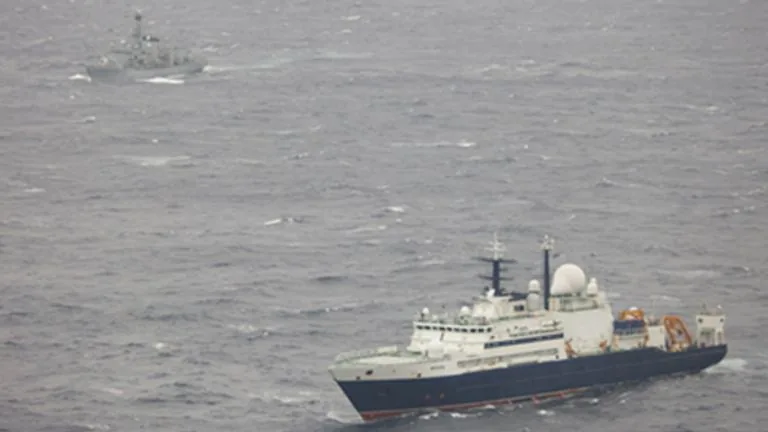
First Sea Lord General Sir Gwyn Jenkins declared Russia the "greatest threat" to UK security in a speech at Admiralty House in London, warning of Cold War-level dangers in the North Atlantic. He called for expanded maritime capabilities, a "whole-nation effort" to protect sea lanes and undersea infrastructure, and announced a "Northern Navies" agreement among ten Joint Expeditionary Force nations. The Royal Navy now deploys two warships weekly to monitor Russian vessels.
 Illustration
Editorial responsibility
- No named human review is recorded for this page.
- Reports are grouped by semantic similarity and deterministic rules. Language models may assist titles, summaries, translation and cross-source analysis; the page reads the event directly, while its address stays stable when the title changes.
- Summary covers the current reports
Cross-source coverage
Reporting timeline
Russia Is 'Greatest Threat' to U.K. Security, Says Royal Navy's First Sea Lord
In a speech last week at Admiralty House in London, First Sea Lord General Sir Gwyn Jenkins, head of the Royal Navy, declared that Russia is the 'greatest threat' to U.K. security, particularly in the maritime domain of the North Atlantic and the High North. He called for Britain to expand its maritime capabilities and strengthen the U.K.-led Joint Expeditionary Force coalition to prepare for a potential conflict with Russia. Jenkins emphasized that control of the Atlantic is critical, and the threat is felt most acutely at sea. The remarks, reported by USNI News, underscore growing concerns among British military leadership about Russian naval activity and the need for enhanced NATO and coalition readiness in the North Atlantic region.
UK First Sea Lord Calls Russia 'Greatest Threat' to British Security, Urges Maritime Expansion
The head of the Royal Navy, First Sea Lord Gen. Sir Gwyn Jenkins, declared Russia the 'greatest threat' to UK security during a speech at Admiralty House in London, as reported by USNI News. Speaking at the Department of Naval Research, Jenkins argued that this threat is most acute in the maritime domain, specifically the North Atlantic and the High North. He called for Britain to expand its maritime capabilities and strengthen the UK-led Joint Expeditionary Force (JEF) coalition to prepare for a potential conflict with Russia. The speech underscores a heightened focus on naval readiness and NATO's northern flank amid ongoing tensions with Moscow. Jenkins' remarks represent a senior UK military official's assessment of the strategic landscape, advocating for concrete force posture changes to counter perceived Russian aggression in Atlantic waters.
UK must focus on Atlantic as foundation of security, says Royal Navy chief
The United Kingdom must strengthen naval readiness to keep the Atlantic open and protect sea lanes, undersea cables and energy infrastructure vital to the country, the chief of the Royal Navy said. First Sea Lord General Gwyn Jenkins, in a speech at Admiralty House in London, warned that Britain faces threats not seen since the Cold War, with Russia increasingly probing the North Atlantic and critical underwater infrastructure. Jenkins cited Winston Churchill's memoirs on the Atlantic's existential importance, stating that a 'whole-nation effort' is required to defend the sea. He noted that almost all UK trade, energy, food, raw materials and exports flow via maritime routes, creating a 'dangerous paradox' where the Atlantic matters more than ever but is increasingly invisible to the public. The Navy chief said the Royal Navy is spending growing time and resources monitoring Russian vessels, deploying an average of two British warships each week for that purpose. He also defended plans for a 'hybrid Navy' combining crewed vessels, drones, artificial intelligence and real-time data sharing, arguing it is no longer possible to defend a vast ocean using only manned ships.
Show 2 older updatesHide older updates
UK Navy Chief Says Atlantic Is 'Foundation' of Security, Must Boost Readiness Against Russia
First Sea Lord General Gwyn Jenkins stated that the United Kingdom must strengthen naval readiness to keep the Atlantic open and protect vital sea lanes, undersea cables, and energy infrastructure. Speaking at Admiralty House in London, Jenkins warned of threats not seen since the Cold War, with Russia increasingly probing the North Atlantic and critical underwater infrastructure. He emphasized that the Atlantic remains central to UK security and NATO's ability to reinforce Europe, calling for a 'whole-nation effort' to defend the sea. Jenkins noted a 'dangerous paradox' where the Atlantic has never mattered more to Britain yet is increasingly invisible to the public. He highlighted the importance of the Greenland-Iceland-UK gap and the Norwegian Sea, stating they form the UK's 'open sea border with Russia.' The Royal Navy is deploying an average of two warships each week to monitor Russian vessels. Jenkins defended plans for a 'hybrid Navy' integrating crewed vessels, drones, and autonomous sensors, arguing that defending a contested ocean with crewed warships alone is no longer possible.
UK Navy chief says Atlantic is foundation of Britain's security, warns of Russian threats
First Sea Lord General Gwyn Jenkins delivered a speech at Admiralty House in London on September 17, 2026, asserting that the Atlantic Ocean remains central to UK security and NATO's ability to reinforce Europe. Jenkins warned that Britain faces threats not seen since the Cold War, with Russia increasingly probing the North Atlantic and critical underwater infrastructure. He cited a 'dangerous paradox' where the Atlantic has never mattered more to the UK—carrying almost all trade, energy, food, and raw materials—yet is increasingly invisible to the public. The Royal Navy now deploys an average of two warships every week to monitor Russian vessels. Jenkins announced that the ten-nation Joint Expeditionary Force will finalize a 'Northern Navies' agreement this year to create a persistent integrated maritime force. He defended plans for a 'hybrid Navy' combining crewed vessels with drones and autonomous sensors, arguing that defending a contested ocean with crewed warships alone is no longer possible.