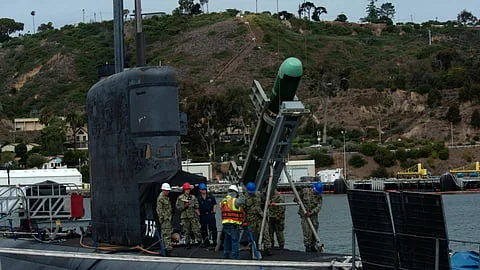
The UK Ministry of Defence discovered that cameras on Royal Navy K3 Scout unmanned surface vessels, used by special forces, were sending "heartbeat" signals to a Chinese IP address. The issue was found during a routine cyber assessment. The MoD stated no sensitive data was compromised and removed internet connectivity to the cameras. The drones, built by Kraken Technology Group, used third-party components from outside the UK, highlighting supply chain vulnerabilities in Western military technology.
On August 3, 2026, Nigel Farage’s hard-right Reform UK party announced "Operation Fortress," a plan to deploy the Royal Navy to intercept and return migrant boats in the English Channel, calling it the largest military operation there since WWII. The French government rejected the plan as a violation of sovereignty and international law. Former Royal Navy officers and political rivals dismissed it as impractical and unworkable. The announcement comes amid scandals and falling poll numbers for Reform UK.
The UK Ministry of Defence awarded BAE Systems a £135 million ($181m) Torpedo Repair and Maintenance (TRAM) contract for the Royal Navy's Spearfish and Sting Ray torpedoes, running from July 2026 to June 2029. The contract sustains 315 jobs, including 150 skilled roles at sites in Portsmouth, Edinburgh, Chelmsford, and near Glasgow, plus 165 supply chain positions. It ensures operational readiness for submarines, surface warships, and maritime patrol aircraft, supporting the UK's nuclear deterrent and anti-submarine warfare capability, while bridging to the future WHITEHEAD2 programme.
The UK government awarded a £5.9 billion contract to BAE Systems for the Dreadnought-class nuclear submarine program, covering construction of four submarines to replace the Vanguard fleet and maintain the Continuous at Sea Deterrent. Part of an £8.4 billion parliamentary-approved package, the program supports approximately 30,000 jobs and involves over 1,500 UK suppliers. Defence Secretary Wes Streeting and BAE Systems CEO Charles Woodburn emphasized its strategic importance for national security and British industry.
Royal Fleet Auxiliary (RFA) personnel, who provide logistical support to the Royal Navy globally, have accepted a new pay deal offering above-inflation raises and improved conditions. The agreement includes a 4.5% pay rise backdated to April 2025 and a further 3.6% rise from April 2026, along with enhanced leave arrangements, a one-off leave buy-back, and a £250 payment. Both the RMT and Nautilus unions confirmed acceptance. Minister for Veterans and People Calvin Bailey MBE MP announced the deal during a visit to Portland Port on July 28, 2026, meeting crews aboard RFA Tidespring and RFA Mounts Bay. The Ministry of Defence stated the deal aims to improve recruitment and retention, particularly for crewing future Fleet Solid Support Ships. The RFA is a civilian-crewed fleet owned by the MoD, critical for sustaining Royal Navy operations worldwide.
Babcock and the Royal Navy are opening the gates of Devonport naval base for a second consecutive year, with an estimated 15,000 visitors expected across a family day and a public open day. The two-day event in Plymouth offers interactive displays, hands-on STEM experiences, river rides, exhibitions from local partners, and the chance to board Royal Navy vessels. Babcock's Managing Director John Gane emphasized the unprecedented investment and growth in Plymouth, while Naval Base Commander Commodore Jane Roe highlighted the base's role in national defence and the professionalism of personnel. The event aims to give the local community insight into the base's work, including its role in maintaining the Continuous At Sea Deterrent through nuclear submarine refits, and to inspire future engineers and scientists.
The Royal Navy, alongside US and Australian forces, completed Exercise Lanternfish, a six-week trial of uncrewed underwater systems to protect critical seabed infrastructure. Conducted under the AUKUS Pillar 2 agreement, the exercise took place in Virginia, Washington state, and waters off southwestern Australia. Royal Navy divers and hydrographic experts used the VideoRay Defender submersible for mine detection and the Teledyne Gavia autonomous system for surveying undersea infrastructure. The exercise aimed to improve detection, monitoring, and response to underwater threats, with a focus on interoperability and common operating procedures. The Royal Navy linked the exercise to rising threats from foreign state actors, citing Russian submarine activity near UK waters. Planning is underway for the next AUKUS Pillar 2 exercise integrating maritime, air, cyber, and space domains.
The Royal Navy, alongside US and Australian forces, conducted Exercise Lanternfish, a six-week trial of uncrewed underwater systems to protect critical seabed infrastructure. The exercise, held in Virginia, Washington, and waters off southwestern Australia, was part of the AUKUS Pillar 2 agreement focusing on advanced military capabilities. Royal Navy divers and hydrographic experts used systems like the VideoRay Defender and Teledyne Gavia autonomous underwater vehicle to survey infrastructure and rehearse responses to hostile activity. The exercise aimed to improve detection, monitoring, and threat response through shared expertise and common operating procedures. Officials highlighted interoperability and rapid capability iteration. The Royal Navy linked the exercise to rising threats from foreign state actors, citing Russian submarine operations near UK waters. Planning for the next AUKUS Pillar 2 exercise, covering maritime, air, cyber, and space domains, is already underway.
Ferguson Marine, in collaboration with Malin Abram and Coastworks, has completed and delivered three structural steel units for HMS Birmingham, the fourth Type 26 frigate being built for the Royal Navy by BAE Systems. The units were fabricated at Ferguson Marine's Port Glasgow shipyard and transported by sea to BAE Systems' Govan yard in a coordinated heavy-lift operation. The delivery marks a milestone for the Clyde-based supply chain and highlights the region's role in UK defence projects. Ferguson Marine CEO Graeme Thomson praised the workforce for meeting world-class standards and providing engineering experience for apprentices. The company is also preparing to deliver the ferry MV Glen Rosa and is investing £14.2 million from the Scottish Government for infrastructure upgrades. HMS Birmingham is one of eight Type 26 anti-submarine warfare frigates planned for the Royal Navy, with variants also selected by Australia, Canada, and Norway.
Ferguson Marine, in collaboration with Malin Abram and Coastworks, has completed and delivered three structural units for the Royal Navy's Type 26 frigate HMS Birmingham. The steel blocks were fabricated at Port Glasgow and transported by sea to BAE Systems' Govan shipyard in a coordinated heavy-lift operation. This milestone highlights the integrated supply chain on the Clyde and its role in UK defence. Ferguson Marine CEO Graeme Thomson praised the workforce's skill and the experience gained by apprentices. Malin Abram and Coastworks executives emphasized the successful collaboration and investment in local capabilities. Ferguson Marine is also preparing to deliver the ferry MV Glen Rosa and is investing £14.2 million from the Scottish Government for infrastructure upgrades, with potential contracts for four new vessels. HMS Birmingham is the fourth of eight Type 26 anti-submarine warfare frigates being built for the Royal Navy, with variants also selected by Australia, Canada, and Norway.
The UK Royal Marines' Commando Logistic Regiment (CLR) is being renamed 48 Commando Support Group Royal Marines, effective 1 August 2026, with approval from King Charles. The change revives the name of a World War II commando unit that landed on Juno Beach on D-Day and fought at Walcheren. The new designation aligns the unit with the naming conventions of the UK Commando Force, which includes units like 40, 42, and 45 Commando. The unit, based at Chivenor in North Devon, will continue its logistics role—providing supply, medical care, transport, and vehicle repair—while being recognized as a fighting component. Commanding Officer Lieutenant Colonel Jolyon Simpson emphasized that the change merges the offensive heritage of 48 Commando with CLR's 54 years of sustainment operations in conflicts including the Falklands, Iraq, and Afghanistan. Senior officials stated the rename reflects modern dispersed battlefield operations and the integration of logistics into combat roles.
British company ACUA Ocean and American firm Teledyne FLIR Defense completed a UK Ministry of Defence-funded demonstration pairing the SkyCarrier drone launch system with the USV Pioneer uncrewed surface vessel. In January 2026, the Pioneer maintained stability in 4.25-meter waves, reducing roll by 60% compared to monohull vessels. The tethered SkyRanger R70 drone received continuous power and data from the boat, enabling persistent aerial surveillance without landing for recharging. The drone features onboard AI for real-time object detection and classification. The Pioneer has already completed Royal Navy contracts for intelligence, surveillance, reconnaissance, and anti-submarine warfare. The demonstration could change how the Royal Navy monitors its waters using fully autonomous systems.
British maritime robotics firm ACUA Ocean and American sensor manufacturer Teledyne FLIR Defense completed a UK Ministry of Defence-funded demonstration pairing the SkyCarrier drone launch system with the USV Pioneer uncrewed surface vessel. In January 2026, the USV Pioneer maintained stability in 4.25-meter waves, reducing roll by 60% compared to monohull vessels. During the trial, the SkyCarrier autonomously launched a SkyRanger R70 drone from the Pioneer's deck, with the drone remaining tethered for continuous power and data. The tethered uncrewed aerial system (T-UAS) enables persistent aerial surveillance without needing to land for recharging. The Pioneer has previously completed Royal Navy contracts for intelligence, surveillance, reconnaissance, and anti-submarine warfare. The demonstration could change how the Royal Navy monitors its waters.
QinetiQ, a UK defence technology company, announced a £20 million investment to accelerate the development and production of high-energy laser directed energy weapons. The company unveiled its HELENA brand of coherent beam combination laser sources at the Farnborough International Airshow. These laser sources are critical components for systems designed to defend against drones and advanced threats. QinetiQ is a member of the UK's DragonFire consortium, alongside MBDA and Leonardo, which aims to deliver laser weapon systems to the Royal Navy from 2027. The investment will expand production capacity at QinetiQ's sites in Farnborough and Malvern and support 150 existing jobs. CEO Steve Wadey highlighted the technology's low cost per shot and near-infinite magazine depth, positioning it as a game-changer in battlefield economics against drone threats.
Navantia UK is constructing a new Rubb building at its Methil yard in Fife, funded by £26.7 million from a broader £157 million UK-wide investment programme. The facility will provide covered space for blasting, coating, and finishing work, enabling year-round operations. The Methil workforce has grown from 180 to over 260, including more than 50 apprentices. After delivering the Navantia UK Seahorse transport barge earlier this year—the yard's first major project since Navantia began operations in January 2025—the yard is now working on a major export order. The investment also includes roof repairs, refurbished cranes, a new cutting machine, a steel plate storage facility, a training centre, and a self-propelled modular transporter. Navantia UK, the British arm of the Spanish state-owned shipbuilder, acquired four former Harland & Wolff yards in early 2025. The Methil yard is positioned for Scotland's offshore wind programme and has been proposed for Royal Navy's Programme Euston for floating dry docks.
Warships from NATO's Standing Maritime Group One (SNMG1) have arrived on the River Clyde in Glasgow, Scotland. The Canadian frigate HMCS Ville de Québec, currently the flagship of the group, berthed at King George V Dock alongside the Norwegian frigate HNoMS Fridtjof Nansen. The German fleet tanker FGS Rhön arrived a day earlier. The Ville de Québec assumed flagship duties from the German frigate FGS Sachsen during a port visit to Halifax, Nova Scotia earlier in July. The frigate is operating under Operation Reassurance, Canada's contribution to NATO deterrence in Europe, and is scheduled to operate in the North Atlantic, North Sea, and Baltic Sea until December. SNMG1 is one of NATO's four standing naval forces, held at readiness to provide persistent maritime presence and respond to emerging threats. The group also includes the Dutch frigate HNLMS Van Amstel, combat support ship HNLMS Den Helder, the Turkish frigate TCG Oruçreis, and FGS Sachsen.
Five Ukrainian minehunters, donated by Britain, Belgium, and the Netherlands, completed a two-week training exercise called Sea Breeze 26-2 off the coast of Portland, Dorset, alongside NATO allies. The exercise was co-led by the US Sixth Fleet and Ukraine, hosted by the Royal Navy, and involved 16 countries including Japan, Sweden, and Turkey. Crews practiced minehunting, bomb disposal, diving, salvage, live firing, and uncrewed systems. Two ships from Standing NATO Mine Countermeasures Group 1 participated. The exercise, originally held in the Black Sea since 1997, moved after Russia's 2022 invasion due to restrictions under the Montreux Convention. Ukraine lost its main naval bases in Crimea and rebuilt its fleet with allied donations. The minehunters are intended to clear approaches to Ukrainian ports and facilitate grain exports.
A two-week NATO-led minehunting exercise, Sea Breeze 26-2, concluded off the coast of Portland, Dorset, involving five Ukrainian Navy minehunters donated by Britain, Belgium, and the Netherlands. The exercise, co-led by the US Sixth Fleet and Ukraine and hosted by the Royal Navy, included 16 countries: Bulgaria, Denmark, Estonia, France, Georgia, Greece, Japan, Latvia, Lithuania, Poland, Spain, Sweden, Turkey, Ukraine, the UK, and the US. Crews practiced minehunting, bomb disposal, diving, salvage, live firing, and uncrewed systems. Two ships from Standing NATO Mine Countermeasures Group 1 also participated. The training aimed to enhance interoperability and maritime security. The Sea Breeze exercise, which began in 1997, was moved from the Black Sea after Russia's 2022 invasion due to restrictions under the Montreux Convention and drifting mine hazards. Ukraine, having lost its main naval bases in Crimea, has rebuilt its fleet with allied donations, and these minehunters are intended to clear approaches to Ukrainian ports to facilitate grain exports.
HMS Prince of Wales returned to Portsmouth on July 24, 2026, after a three-month deployment on NATO's Northern Flank under Operation Firecrest. The carrier strike group, including destroyer HMS Duncan and tanker RFA Tidespring, conducted NATO's Iceland air policing mission from its deck for the first time by a European carrier, intercepting Russian aircraft near the Arctic. The group also participated in Exercise Neptune Strike, with F-35B jets from 809 Naval Air Squadron reaching as far as Poland using aerial refueling from RAF and Italian tankers. The deployment involved 19 allied nations, exercises including Ramstein Flag, Dynamic Mongoose, and Tamber Shield, and port visits to Iceland, Norway, Denmark, and Scotland. The second phase of the deployment is scheduled for autumn in northern European waters.
Commander Daniel Herridge has handed over command of the Royal Navy's Mine and Threat Exploitation Group (MTXG) to Commander Tim Castrinoyannakis on 16 July at HM Naval Base Clyde. The group, comprising around 250 personnel, is headquartered at Clyde and organized into four squadrons based at Portsmouth and Clyde. It leads the integration of autonomous technologies including AI, machine learning, and uncrewed systems for minehunting. During his tenure, Herridge oversaw a shift from crewed minehunters to modular, deployable equipment that can be moved by road or sea, working with industry on the Maritime Mine Countermeasures system. The handover comes as the Ministry of Defence confirmed the last Hunt-class vessel will leave service in 2031, marking the Royal Navy's transition toward uncrewed mine countermeasures systems. Both officers have extensive backgrounds in mine warfare, clearance diving, and maritime operations.
Babcock International Group and LIG Defence & Aerospace (LIG D&A) have signed a Strategic Cooperation Agreement to strengthen international defence industrial collaboration. The partnership combines Babcock's engineering and mission-critical operations expertise with LIG D&A's technological and manufacturing capabilities. Key areas of collaboration include integrating LIG D&A into Babcock's global supply chain, creating an AH-140 frigate concept featuring LIG equipment, developing launchers and precision guided munitions, MRO and through-life upgrades, and robotics, autonomy, and unmanned systems. The agreement builds on a November 2024 MOU. Babcock has a long-standing presence in South Korea, including an MRO facility in Busan supporting Republic of Korea Navy programmes.
Babcock International Group and LIG Defence & Aerospace (LIG D&A) have signed a Strategic Cooperation Agreement to strengthen international defence industrial collaboration. The partnership builds on a November 2024 MOU and will explore joint development of world-class solutions. Areas of collaboration include integrating LIG D&A into Babcock's global supply chain, creating an AH-140 frigate concept featuring LIG equipment, developing launchers and precision guided munitions, MRO and through-life upgrades, and robotics, autonomy, and unmanned systems. Babcock has a long-standing presence in South Korea, including an MRO facility in Busan supporting Republic of Korea Navy programmes. Executives from both companies highlighted the agreement as a pivotal step for securing new competitiveness in global markets.
A combined Royal Marines and Royal Navy team of expert marksmen has won the UK Armed Forces' top prize for shooting for only the fourth time in 117 years. The nine-strong team triumphed at the InterServices Operational Shooting Contest held at Hythe in Kent, defeating Army and RAF counterparts. The team used the new KS1 rifle, which showed marked improvements over the SA80 A2 standard-issue weapon. The Royal Navy emphasized the event is a military training exercise focused on developing instinctive combat marksmanship. Sergeant 'Robbo' Robinson from Yorkshire won the King's Medal for Champion Shot of the Royal Navy and Royal Marines, the UK's highest military marksmanship award, receiving it from King Charles. Nine other shooters earned the Service Marksman badge. The KS1 rifle is entering British service as part of a wider small arms replacement effort, succeeding elements of the SA80 family.
The US Navy Virginia-class attack submarine USS Oregon arrived at His Majesty's Naval Base Clyde in Faslane, Scotland, on 20 July 2026 for a scheduled port visit as part of its routine deployment to the US 6th Fleet area of operations. The submarine will conduct maintenance, replenish supplies, and provide crew rest. Captain Doug Sattler, commander of Task Force 69, emphasized the strong US-UK partnership and shared commitment to maritime security. The visit underscores the close operational ties between the two navies and Faslane's role as a staging point for allied submarine activity in the North Atlantic and High North, amid heightened Russian submarine operations. USS Oregon, commissioned in 2022, is a nuclear-powered fast attack submarine capable of anti-submarine warfare, anti-surface warfare, and intelligence gathering.
ACUA Ocean and Teledyne FLIR Defense completed a two-day demonstration for the UK Ministry of Defence and offshore industry partners in Plymouth, showcasing an integrated tethered uncrewed aerial system operating from an uncrewed surface vessel. The demonstration, funded by UK Defence Innovation, saw Teledyne FLIR's SkyCarrier platform autonomously launch a SkyRanger R70 drone from ACUA Ocean's USV Pioneer, the UK's first Lloyd's Register-certified remotely operated uncrewed vessel. The tethered configuration removes reliance on onboard battery endurance, enabling continuous aerial surveillance slaved to the vessel's position. The USV Pioneer has previously completed Royal Navy ISR and anti-submarine warfare contracts, and in January 2026 operated in 4.25-metre wave heights. The combined system addresses Royal Navy requirements for persistent maritime awareness without personnel risk, with applications in anti-submarine warfare, mine countermeasures, intelligence gathering, and critical infrastructure protection.
Anthony Kirby, Group Chief Executive of Serco, argues that the race to build effective autonomous naval fleets will be decided by how quickly governments, industry and the military can integrate new technology at scale. The article highlights that maritime autonomy has moved from invention to adoption, citing drone use in Ukraine and uncrewed vessels in the Strait of Hormuz. The US Navy plans to build over 100 large uncrewed platforms under its 'hybrid fleet' concept, while the Royal Navy aims to launch its first large Uncrewed Surface Vessels (USVs) next year. Kirby identifies five key challenges: regulatory lag, lack of a home port model for autonomous fleets, traditional procurement logic delivering obsolete capability, need to 'crew' uncrewed systems, and integration with existing in-service vessels. The article notes that autonomous platforms like Serco's Defiant USX-1 are conducting extended real-world operations, and that effective partnership between navies, industry, and academia is essential for success.
The UK Ministry of Defence (MOD) has cancelled its competition for through-life support (TLS) of the Royal Navy's five Type 31 frigates, according to a contract notice published on 22 July 2026. The MOD stated that changes to the programme context, commercial practicality, and enterprise support planning meant the assumptions underpinning the tender, first advertised in November 2023, no longer hold. The competition had sought management and support services over a minimum eight-year period with extension options. The Type 31 frigates, being built by Babcock International at Rosyth, are intended to replace five Type 23 frigates. The cancellation leaves the sustainment arrangement for the class uncertain, with the MOD indicating a shift in its approach to enterprise support planning since the requirement was first advertised.
On July 21, 2026, the Russian frigate Neustrashimy conducted a 30-minute live-fire gunnery exercise approximately 40 nautical miles south of Plymouth, England, in international waters. The Royal Navy monitored the drill with HMS Tyne and HMS Sutherland. The exercise occurred on the same day Andy Burnham became UK Prime Minister, leading analysts to view it as a deliberate political signal. The incident follows recent tensions including Royal Navy boardings of Russian shadow fleet vessels and a previous warning-shot incident in the Channel.
Wes Streeting has been appointed UK Defence Secretary in Prime Minister Andy Burnham’s cabinet, replacing Dan Jarvis after a record-short 40-day tenure. This marks the sixth Defence Secretary in seven years, reflecting ongoing instability. Streeting, a former Health Secretary with no defence background, inherits a controversial Defence Investment Plan that cuts conventional platforms like Type 83 destroyers in favor of unproven uncrewed systems. UK defence spending is around 2.6% of GDP, but conventional spending is only 1.6% due to nuclear costs, straining military capabilities.
QinetiQ, a British defence firm, announced a £20 million company-funded investment to accelerate the development and production of high-energy laser directed energy weapon technology. The investment will expand capabilities at its Farnborough and Malvern sites, increasing production capacity for both UK and international markets. At the Farnborough International Airshow, QinetiQ unveiled HELENA, the new brand for its coherent beam combination High Energy Laser Source products, a critical component for laser weapon systems designed to defend against drones and advanced threats. QinetiQ is a key member of the UK's DragonFire consortium alongside MBDA and Leonardo, which is delivering 50-kilowatt-class laser systems to Royal Navy ships from 2027, accelerated by the Ministry of Defence. CEO Steve Wadey emphasized the company's two-decade leadership in directed energy weapons and commitment to meeting growing sovereign and allied demand.
1 reports · 1 sources · Updated
Periodic recap
What changed for this subject in each tracking window — generated from matched events, delta-first.
→· 1 event in window
The UK Ministry of Defence discovered during a routine cyber assessment that cameras on Royal Navy K3 unmanned surface vessels used by special forces were sending "heartbeat" signals to a Chinese IP address. The MoD stated no sensitive data was compromised and removed internet connectivity from the cameras. The incident highlights supply chain vulnerabilities in Western military technology through third-party components.
Cameras on Royal Navy K3 Scout unmanned surface vessels used by special forces were found sending "heartbeat" signals to a Chinese IP address.
The issue was detected during a routine cyber assessment; the MoD said no sensitive data was compromised and removed internet connectivity to the cameras.
The drones, built by Kraken Technology Group, used third-party components from outside the UK, raising concerns about military supply chain security.
Earlier recaps
→· 1 event in window
Reform UK announced a plan on August 3, dubbed "Operation Fortress," proposing the deployment of the Royal Navy to intercept and return migrant boats in the English Channel. The proposal was rejected by the French government as a violation of sovereignty and international law, and dismissed as impractical by former Royal Navy officers and political rivals. The announcement came amid scandals and declining poll numbers for Reform UK.
Tracked events
Events matched to this subject by the tracking pipeline, with signal scores.
The UK government awarded a £5.9 billion contract to BAE Systems for the construction of four Dreadnought-class nuclear submarines to replace the Vanguard fleet and maintain the Continuous at Sea Deterrent. The contract is part of an £8.4 billion parliamentary-approved package and is expected to support approximately 30,000 jobs while involving over 1,500 UK suppliers. Both the Defence Secretary and BAE Systems' CEO emphasized the programme's strategic importance for national security and British industry.
The UK government awarded a £5.9 billion contract to BAE Systems for the Dreadnought-class nuclear submarine program, covering construction of four submarines to replace the Vanguard fleet and maintain the Continuous at Sea Deterrent. Part of an £8.4 billion parliamentary-approved package, the program supports approximately 30,000 jobs and involves over 1,500 UK suppliers. Defence Secretary Wes Streeting and BAE Systems CEO Charles Woodburn emphasized its strategic importance for national security and British industry.