Pentagon and Lockheed Agree 10-Year Framework for 850 F-35 Jets
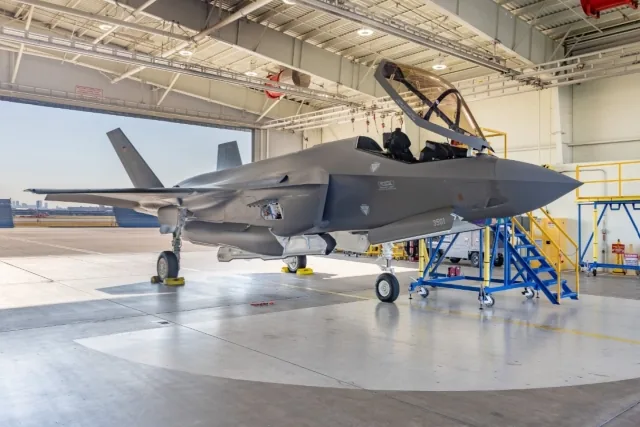
The Pentagon and Lockheed Martin announced a 10-year framework agreement covering at least 850 F-35 Lightning II fighters for the U.S. military, with production continuing at 156 aircraft per year across lots 21 through 30 for U.S. and international customers. Lockheed will self-fund at least $7 billion in program initiatives. No total value or per-jet price was disclosed, and the deal requires congressional authorization and appropriations before terms, pricing and schedules are finalized. Lockheed shares rose after the company also raised its full-year profit forecast.
 Illustration
Editorial responsibility
- No named human review is recorded for this page.
- Reports are grouped by semantic similarity and deterministic rules. Language models may assist titles, summaries, translation and cross-source analysis; the page reads the event directly, while its address stays stable when the title changes.
- Summary covers the current reports
Cross-source coverage
Common ground
- The deal is a framework agreement, not a binding contract, and it depends on Congress passing multiyear procurement authority and appropriations that haven't happened yet.
- The market reacted to a press release, not a legally certain deal, which is a problem.
- The undefined 'performance' metrics are a major flaw because Lockheed keeps savings without clear government verification.
- The Pentagon should publish the failure-case unit price and define 'performance' in writing before Congress votes.
- The timing of the announcement, during a stalled appropriations cycle, was likely deliberate to pressure Congress.
Points of contention
- Whether the framework is just normal advocacy or a manipulative end-run around Congress.
- Whether the failure scenario is a 'hostage note' or just a structural feature of all multiyear buys.
- Whether the real risk is the demand assumption (geopolitics and allied orders) or the definitional vagueness of 'performance'.
- Whether the $2 trillion cost figure is meaningful without comparing it to alternatives like extending the legacy fleet.
Blind spots
- The impact on allied nations whose orders are part of the 156-jets-a-year assumption, and whose legislatures haven't voted either.
- What happens to unit prices and readiness accounts if multiyear authority fails, since Lockheed's escalator protects them but not the taxpayer.
- The lack of any public comparative cost analysis against alternatives like extending the legacy fleet.
- The fact that this framework, unlike a subscription, has no cancellation terms.
WorldAttention’s read
The roundtable agreed that the announced F-35 deal is not a real contract but a press release designed to pressure Congress into granting multiyear procurement authority. The biggest problem is that 'performance' is undefined, so Lockheed keeps savings without clear accountability. The group also agreed that the Pentagon should publish the failure-case unit price and define performance in writing before any vote. They disagreed on whether the framework is normal advocacy or a manipulative end-run, and on whether the failure scenario is coercion or just structural. Key blind spots include allied orders, the lack of cancellation terms, and the missing comparison to alternatives. The bottom line: don't vote until the numbers and definitions are public.
Reporting timeline
Lockheed Martin Shares Jump on Raised Forecast and F-35 Framework Deal
Lockheed Martin, one of the world's largest defense and aerospace contractors, saw its U.S. stock price rise nearly 9% after the market opened and was up more than 6% at the time of reporting, after the company raised its full-year profit forecast. The company announced a multi-year production and sustainment framework agreement with the U.S. Department of War for the F-35 Lightning II fighter, covering 850 aircraft to be procured by the United States over the next 10 years, along with initial spare parts, modification kits and maintenance support, and including international customer orders for Lots 21 through 30. The plan aims to maintain production of 156 aircraft per year. If the U.S. Congress approves multi-year procurement authorization and related appropriations, the two sides will further finalize contract terms, pricing and delivery schedules. The company expects long-term pricing and bulk-purchase discounts to save billions of dollars over the F-35 lifecycle.
Read sourcePentagon and Lockheed Agree to 10-Year Framework for 850 F-35 Jets
The Defense Department and Lockheed Martin announced a 10-year framework agreement covering at least 850 F-35 Lightning II fighters for the U.S. military, pending congressional approval and funding. The deal includes initial spare parts, 10 years of modification kits and sustainment, and foreign orders, with production continuing at 156 aircraft per year. In exchange, Lockheed will self-fund at least $7 billion in program initiatives. No total value or per-jet price was disclosed; terms, pricing and schedules would be set in a formal contract if Congress approves a multiyear buy. The framework averages 85 U.S. jets annually, matching the Pentagon's fiscal 2027 request, and follows Air Force testimony that it needs 1,509 combat-coded fighters by 2035. Lockheed says the deal will save taxpayers billions and support 317,000 U.S. jobs, while the Pentagon cites performance-based incentives it did not describe.
Read sourcePentagon, Lockheed Agree to 10-Year Framework for 850 F-35 Jets
The Defense Department and Lockheed Martin announced a 10-year framework agreement that the Pentagon says guarantees at least 850 F-35 Lightning II fighters for the U.S. military, pending congressional approval and funding. The deal includes initial spare parts plus 10 years of modification kits and sustainment, and covers foreign orders, with production continuing at 156 aircraft per year. In exchange, Lockheed will self-fund at least $7 billion in F-35 initiatives. No total value or per-jet price was disclosed; terms, pricing and schedules would be set in a formal contract if Congress approves a multiyear buy. The framework averages 85 U.S. jets annually, matching the Pentagon's fiscal 2027 request, and follows an Air Force report seeking 1,509 combat-coded fighters by 2035. It still faces hurdles: the annual defense policy bill remains stalled in the Senate, and a stopgap funding law bars new multiyear buys.
Read sourceShow 2 older updatesHide older updates
Pentagon and Lockheed Agree on 10-Year F-35 Framework, Pending Congress
The Pentagon and Lockheed Martin announced a framework agreement on Oct. 22 to buy F-35 Joint Strike Fighters over 10 years, covering lots 21 through 30. Lockheed would build 156 jets per year for U.S. and international customers, with the U.S. military buying at least 850 of 1,560 aircraft, plus spare parts, modification kits, and fleet sustainment. The deal, called "landmark" by the Pentagon, requires Congress to authorize multiyear procurement and pass fiscal 2027 appropriations; pricing, schedules, and variant mix remain undecided. Lockheed agreed to invest at least $7 billion of its own money. CEO Jim Taiclet said fixed-price escalation contracts would let industry retain savings from performance and investment, and he reiterated interest in adding sixth-generation technologies to the F-35.
Pentagon and Lockheed Agree on 10-Year F-35 Framework Pending Congress
The Pentagon and Lockheed Martin announced on Oct. 22 a framework agreement to buy F-35 Joint Strike Fighters over 10 years, covering lots 21 through 30. Lockheed would build 156 jets annually for U.S. and international customers, with the U.S. military buying at least 850 of the 1,560 aircraft, plus spare parts, modification kits, and global fleet sustainment. The Pentagon called the deal "landmark," but it requires Congress to grant multiyear procurement authority and appropriations, and pricing and schedules remain to be finalized. Lockheed pledged at least $7 billion of its own investment. CEO Jim Taiclet said the fixed-price escalation structure lets industry retain savings from performance improvements, and predicted better mission-capable rates and supply chain resilience. Taiclet also reiterated interest in adding sixth-generation technologies to the F-35.