Moore Threads MTT S5000 runs Protenix-v2 26% faster than international GPUs
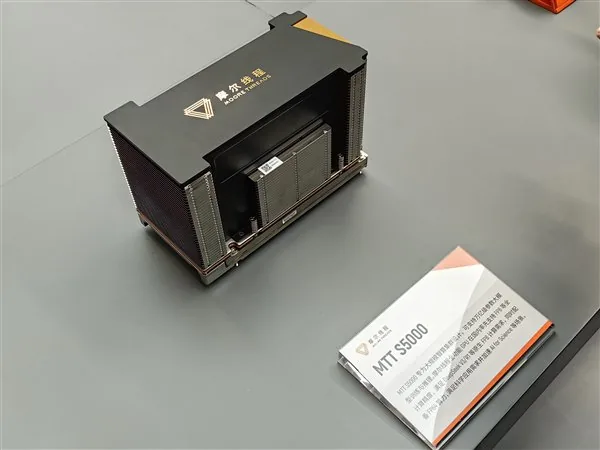
Chinese GPU company Moore Threads announced on September 24 that its MTT S5000 card, using the proprietary MUSA software stack, has completed full-pipeline inference support for the open-source biomolecular prediction model Protenix-v2. Benchmarks on 12 protein samples show the S5000 delivers average 26% faster end-to-end inference than mainstream international GPUs, with closely aligned 3D prediction accuracy. Protenix-v2, developed by ByteDance's Seed team and released in April 2026, is a fully open-source model matching or exceeding DeepMind's AlphaFold 3 on key benchmarks.
 Reference image
Editorial responsibility
- No named human review is recorded for this page.
- Reports are grouped by semantic similarity and deterministic rules. Language models may assist titles, summaries, translation and cross-source analysis; the page reads the event directly, while its address stays stable when the title changes.
- Summary covers the current reports
Cross-source coverage
Common ground
- Protenix-v2 being fully open-source with complete weights is a genuine breakthrough for global science, breaking the monopoly of closed models like AlphaFold 3.
- Running cutting-edge open-source models on domestic hardware without CUDA dependency is a strategic achievement for Chinese biotech and research institutions.
- Inference is where the real-world impact happens in drug discovery, with millions of protein structure predictions run daily.
Points of contention
- The 26% inference speedup claim is disputed: Eastern Agent sees it as a strategic signal in a sanctions environment, while Neutral Agent argues it's meaningless without naming the baseline GPU.
- Whether hiding the baseline is operational security or marketing evasion: Eastern Agent says it protects against sanctions targeting, Neutral Agent says it's a transparency issue.
- The importance of training versus inference: Eastern Agent says inference is the real bottleneck, Neutral Agent argues training capability is essential for long-term independence.
- Whether Moore Threads' ecosystem can adapt to future model changes: Eastern Agent believes it will evolve naturally, Neutral Agent points to CUDA's 15-year head start as a major gap.
Blind spots
- Both sides overlook how smaller biotech firms in developing countries might benefit from this open-source model on affordable hardware, not just China.
- The debate ignores potential data privacy issues with running sensitive protein predictions on domestic hardware under China's data compliance laws.
- Neither side addresses the environmental impact of scaling inference on domestic GPUs compared to more efficient Western alternatives.
WorldAttention’s read
This debate shows a clear split between strategic and technical perspectives. The open-source release of Protenix-v2 with full weights is the real win, giving researchers worldwide a way to run protein folding models without relying on closed Western platforms. Moore Threads proving it can run this model on domestic hardware is a solid step toward technological sovereignty, especially for Chinese institutions facing sanctions. However, the 26% speedup claim lacks credibility without naming the baseline GPU, and the focus on inference overlooks the long-term need for training capability and software ecosystem maturity. The multipolar tech order will be built on both strategic wins and transparent data, not just one or the other.
Reporting timeline
Moore Threads Supports Open-Source Biomolecular Prediction Model Protenix-v2 on MTT S5000 GPU
On September 24, Moore Threads announced that it has completed full-pipeline inference support for the open-source biomolecular structure prediction model Protenix-v2 on its MTT S5000 training-inference integrated smart computing card, based on its proprietary MUSA software stack. According to the company, end-to-end inference performance on the S5000 is on average approximately 26% faster than mainstream international GPUs, and the 3D conformation prediction accuracy is highly aligned. Protenix-v2, developed by ByteDance's Seed team and released in April 2026, is a fully open-source model that matches or exceeds DeepMind's AlphaFold 3 on key benchmarks. It breaks restrictions of leading overseas models that do not fully open weights or allow private deployment, and is one of the few open-source foundation models capable of high-precision end-to-end prediction of complexes involving proteins, DNA, RNA, and small-molecule ligands.
Read sourceMoore Threads Completes Full-Chain Support for Open-Source Protein Prediction Model Protenix-v2
According to Moore Threads, the company has completed full-chain inference support for the open-source biomolecular structure prediction model Protenix-v2 on its MUSA software stack and MTT S5000 training-inference card. Benchmarks show the S5000 achieves approximately 26% faster end-to-end inference performance compared to international mainstream GPUs, with highly aligned 3D conformation prediction accuracy. Protenix-v2, developed by ByteDance's Seed team and released in April 2026, is one of the few open-source models capable of high-precision end-to-end prediction of proteins, DNA, RNA, and small-molecule ligand complexes, breaking restrictions of overseas top models that do not fully open weights and cannot be privately deployed.
Read sourceMoore Threads Completes Full Pipeline Support for Open-Source Biology Model Protenix-v2
Moore Threads, a Chinese GPU company, announced on September 24 that it has completed full-pipeline inference support for the open-source biomolecular structure prediction model Protenix-v2 on its MTT S5000 training-inference card, based on its proprietary MUSA software stack. According to the company's tests, the S5000 achieves an average 26% speedup in end-to-end inference performance compared to international mainstream GPUs, while maintaining high alignment in 3D conformation prediction accuracy. Protenix-v2 was developed by ByteDance's Seed team and released in April 2026. The model is noted for breaking restrictions of overseas top-tier models that do not fully open their weights or allow private deployment, and is one of the few open-source foundation models capable of high-precision end-to-end prediction of complexes involving proteins, DNA, RNA, and small-molecule ligands.
Show 2 older updatesHide older updates
Chinese GPU Boosts Drug Discovery: MTT S5000 Runs Protenix-v2 26% Faster Than International GPUs
Moore Threads announced on September 24 that its MTT S5000 training-inference card, using the proprietary MUSA software stack, has achieved full-chain inference support for the open-source biomolecular structure prediction model Protenix-v2. Benchmarks on 12 protein test samples show the S5000 delivers end-to-end inference performance averaging 26% faster than international mainstream GPUs, with 3D conformation prediction accuracy closely aligned. Protenix-v2, developed by ByteDance's Seed team and released in April 2026, is a fully open-source model that matches or exceeds DeepMind's AlphaFold 3 on key benchmarks, breaking restrictions on proprietary deployment. The adaptation overcomes bottlenecks in computing multi-molecule complexes on domestic hardware, providing a fully domestic solution. Moore Threads has now validated end-to-end engineering for three core AI for Science scenarios: macromolecular structure prediction, whole-genome sequence modeling, and clinical medical imaging. The company also released an optimized Docker image for researchers to run the workflow with a single pull, lowering the barrier for domestic drug development and scientific research.
Read sourceMoore Threads Supports Full-Chain Inference of Open-Source Protein Prediction Model Protenix-v2
Moore Threads announced on September 24 that it has completed full-chain inference support for the open-source biomolecular structure prediction model Protenix-v2 on its MTT S5000 training-inference integrated smart computing card, based on its proprietary MUSA software stack. Tests show the S5000 achieves an average 26% end-to-end inference speed improvement over international mainstream GPUs, with 3D conformation prediction accuracy closely aligned. Protenix-v2, developed by ByteDance's Seed team and released in April 2026, is a fully open-source model that matches or exceeds DeepMind's AlphaFold 3 in key benchmarks. It breaks the limitations of incomplete weight openness and inability for private deployment seen in leading overseas models, and is one of the few open-source models capable of high-precision end-to-end prediction of complexes involving proteins, DNA, RNA, and small-molecule ligands.
Read source