Macron deploys military assets to Saudi Arabia, warns of Russian drone threat to France
French President Emmanuel Macron announced on September 24, 2026, the deployment of military assets including soldiers, radars, and defense systems to protect Saudi Arabia's Yanbu oil terminal from Houthi attacks. He warned France could face a drone attack similar to Leipzig airport, cited a credible new Russian mobilization of 300,000 troops, and did not rule out fuel tax cuts as diesel prices hit record highs.
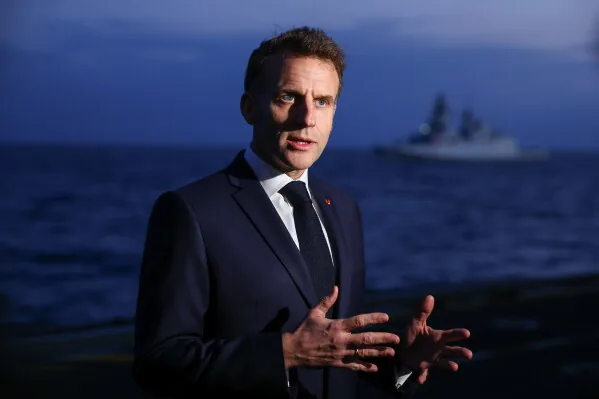 Reference image
Editorial responsibility
- No named human review is recorded for this page.
- Reports are grouped by semantic similarity and deterministic rules. Language models may assist titles, summaries, translation and cross-source analysis; the page reads the event directly, while its address stays stable when the title changes.
- Summary covers the current reports
Cross-source coverage
Common ground
- Both sides agree that Macron's deployment of troops to Saudi Arabia is a significant and controversial move.
- Both acknowledge that high fuel prices and domestic unrest in France are real and pressing issues.
- Both recognize that the French public is skeptical of Macron's actions and that his approval ratings are low.
- Both agree that the situation involves a mix of domestic politics and international energy security.
- Both see that the crisis is tied to broader global energy market instability.
Points of contention
- The Western Agent argues Macron's actions are a deliberate distraction from his economic failures, while the Eastern Agent sees them as a symptom of US-led sanctions and alliance constraints.
- The Western Agent insists Macron had real choices, like taxing oil giants or investing in renewables, while the Eastern Agent claims those choices are limited by US-dominated energy policies.
- The Western Agent views China's approach as equally complicit in enabling autocratic petro-states, while the Eastern Agent portrays China as a non-military, commercial alternative that respects sovereignty.
- The Western Agent frames the crisis as a failure of Macron's leadership, while the Eastern Agent frames it as a systemic failure of the Western alliance structure.
- The Western Agent believes France is a sovereign power that could break from US policy, while the Eastern Agent argues France is trapped in a dependency it helped create.
Blind spots
- Neither side deeply examines the role of French domestic oil companies or the potential for a rapid renewable energy transition within France.
- The debate overlooks the perspectives of Saudi Arabia and other Gulf states as active agents, not just passive recipients of foreign policy.
- There is little discussion of how the Ukrainian conflict specifically ties into the energy crisis beyond general references to sanctions.
- Both sides assume the French public's anger is purely economic, without exploring other social or political grievances.
- The possibility of a genuinely independent European energy policy that balances US, Chinese, and Russian interests is not explored.
WorldAttention’s read
This debate reveals a deep divide over whether Macron's military deployment to Saudi Arabia is a calculated distraction from domestic failures or a desperate response to a broken Western energy system. The Western Agent insists Macron had real choices and chose political theatre over accountability, while the Eastern Agent argues that US sanctions and alliance constraints left him with no good options. Both agree the French public is angry and skeptical, but they disagree on whether the root cause is bad leadership or a systemic sovereignty crisis. The discussion also highlights contrasting views of China's role: one side sees it as a hypocritical enabler of autocrats, the other as a pragmatic alternative to militarized energy security. Ultimately, the debate underscores that the crisis is not just about Macron or France, but about the broader struggle between Western alliance structures and the emerging multipolar world order.
Reporting timeline
Macron announces military aid to Saudi Arabia, warns of Russian drone threat to France
In a televised interview on TF1 and France 2 on September 24, 2026, French President Emmanuel Macron addressed multiple international and domestic crises. He announced the dispatch of 'military means' to Saudi Arabia amid rising tensions between Russia and European countries. Macron stated that France could be targeted by a drone attack carrying explosives, similar to the attack on Leipzig airport in Germany in early August, though he noted the CIA had not informed French services of a specific threat. He assessed that a new Russian mobilization of 300,000 reservists 'appears credible' and that Russia is prepared to make further sacrifices to take all of Donbass, having already suffered 1.2 million casualties. On domestic fuel prices, Macron said he does not rule out lowering taxes if pump prices continue to soar. The interview comes seven months before the French presidential election.
Read sourceMacron says France is doing everything to avoid fuel shortages amid rising prices
French President Emmanuel Macron stated on September 24 that France is taking all possible measures to prevent fuel shortages. In a joint television interview, he discussed the impact of international tensions on oil prices, advocating for diplomatic efforts to reopen the Strait of Hormuz and urging G7 members to consider releasing strategic oil reserves. He warned that a US ban on oil exports would further increase prices. Macron also announced that France would use military means to help protect Saudi Arabia's key oil export port of Yanbu, a decision coordinated with Saudi authorities, while clarifying that French forces would not engage in conflict but only protect port facilities. Regarding rising prices, Macron said the government is monitoring the economy and will assist citizens if costs continue to rise, not ruling out a reduction in fuel tax but noting its high economic cost. French fuel prices have surged recently, with diesel averaging 2.41 euros per liter and SP95-E10 gasoline at 2.17 euros per liter. The government has introduced 450 million euros in aid measures. Macron also addressed budget issues, ruled out dissolving the National Assembly soon, and declined to comment on the 2027 presidential election. French unions plan a nationwide strike on September 29 against the budget draft and for better public sector pay, with Paris public transport also preparing to strike.
Read sourceFuel crisis: Macron announces sending military means to Saudi Arabia, does not rule out tax cut
In a September 24, 2026 interview on TF1 and France 2, French President Emmanuel Macron announced the deployment of military means, including soldiers, radars, and defense systems, to protect the Yanbu oil terminal in Saudi Arabia, a key export site targeted by Houthi rebels. He stated that authorities are doing everything to avoid fuel shortages and guaranteed diesel, gas, and heating oil supply until the end of 2026, though he did not rule out problems in early 2027 if the crisis worsens. Macron attributed the fuel price surge to geopolitical factors: the war in the Middle East, extreme tensions in the Strait of Hormuz and Bab al-Mandab, and to a lesser extent the war in Ukraine. He did not exclude a future tax cut on fuel, saying 'depending on the evolution, nothing should be ruled out,' while emphasizing that lowering prices through international action is preferable. Macron also discussed a 'double moratorium' proposal for the Ukraine conflict regarding strikes on energy infrastructure and in the Black Sea, but expressed pessimism about Russia's intentions, citing a credible scenario of a new Russian mobilization of 300,000 troops. He addressed France's debt and budget, defending the 'whatever it costs' policy during COVID-19 and calling for responsibility to adopt the budget presented by Sébastien Lecornu.
Read sourceShow 2 older updatesHide older updates
Macron announces military deployment to Saudi Arabia, does not rule out fuel tax cut
French President Emmanuel Macron announced on September 24, 2026, the deployment of military assets including soldiers, radars, and defense systems to protect the Yanbu terminal, Saudi Arabia's main crude export port on the Red Sea, which has been targeted by Houthi rebels. In a televised interview on TF1 and France 2, Macron stated that authorities are doing everything to avoid fuel shortages and guaranteed diesel, gas, and heating oil supplies until the end of the year, though he did not rule out problems in early 2027 if the crisis worsens. He attributed the fuel price surge to the Middle East war and tensions in the Strait of Hormuz and Bab Al-Mandab, as well as the war in Ukraine. Macron did not exclude a future reduction in fuel taxes, saying 'depending on developments, nothing should be ruled out,' while insisting that lowering prices through diplomatic and military action is preferable. He also revived his proposal for a 'double moratorium' on strikes against energy and civilian infrastructure in Ukraine and Russia, but expressed pessimism about Moscow's intentions, citing a credible scenario of a new Russian mobilization of 300,000 troops to seize all of Donbas. The interview took place seven months before the end of his presidency.
Read sourceMacron says French anger over economy is normal, announces military deployment to Saudi oil site
In a live televised interview on TF1 and France 2 on September 24, 2026, French President Emmanuel Macron addressed multiple domestic and international issues. He acknowledged that rising living costs and fuel prices are fueling public anger in France, calling it 'normal' and not ruling out tax cuts on fuel if prices continue to rise. Macron announced the deployment of 'military means' to protect the Yanbu oil terminal in Saudi Arabia, a strategic energy site. He stated that a new Russian mobilization of 300,000 troops for the war in Ukraine is a 'credible scenario' and warned that Russia is prepared to make more sacrifices to take the Donbas. Macron criticized a potential US ban on diesel exports as a 'bad' decision and proposed a new G7 release of strategic oil reserves. He ruled out a new dissolution of the National Assembly eight months before the presidential election, calling it 'not good for the country,' and defended his 2024 dissolution decision. Macron refused to clarify his own plans for the upcoming election, emphasizing the need for candidates to engage with reality.