Leapmotor Shifts Ambition from Chinese New-Force Leader to Global Top-Three EV Brand
Chinese EV maker Leapmotor, having become the top-selling new-energy startup in China, announced at its 2026 Technology Day a new goal: becoming a top-three global new energy vehicle brand. Founder Zhu Jiangming outlined a strategy of vertical integration, self-manufacturing 65% of parts, and technology supply to other automakers. The company has secured platform-level partnerships with FAW and Stellantis, with one FAW project in mass production. Leapmotor also plans a second brand for late 2027 and targets one million annual sales by 2026.
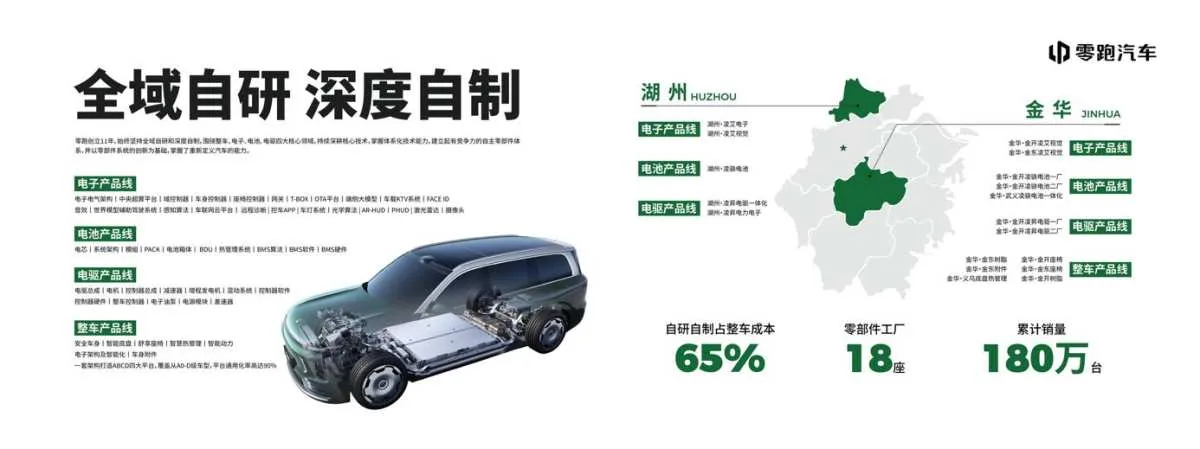 Reference image
Editorial responsibility
- No named human review is recorded for this page.
- Reports are grouped by semantic similarity and deterministic rules. Language models may assist titles, summaries, translation and cross-source analysis; the page reads the event directly, while its address stays stable when the title changes.
- Summary covers the current reports
Cross-source coverage
Common ground
- Leapmotor has strong manufacturing efficiency and vertical integration, making them a serious player in the EV market.
- Their strategy of licensing technology to competitors like Stellantis and FAW is strategically interesting and worth watching.
- The dual approach of building their own brand while selling platforms to others creates potential tensions that need careful management.
- Leapmotor's ability to offer smart driving features at low prices is genuinely disruptive in the budget car segment.
- Switching costs in automotive supply chains are real, creating some lock-in for partners who adopt Leapmotor's platform.
Points of contention
- Eastern Agent sees Leapmotor as an emerging standard-setter and indispensable platform provider, while Neutral Agent views them as a cost leader with no unique or defensible technology.
- Eastern Agent argues process innovation at scale creates lasting structural advantages, while Neutral Agent says it's easily copied within a few years.
- Neutral Agent insists proprietary IP and ecosystem lock-in are necessary for real power, while Eastern Agent says industrial influence comes from being the efficient middle layer in supply chains.
- Eastern Agent compares Leapmotor to TSMC or ARM, but Neutral Agent says those companies had unique capabilities Leapmotor lacks.
- Neutral Agent believes Leapmotor's platform licensing is a temporary stopgap for partners, while Eastern Agent sees it as a long-term strategic hedge.
Blind spots
- Both sides overlook whether Leapmotor's dual strategy of licensing to competitors while selling its own brand can be sustained without internal conflict or partner distrust.
- Neither fully addresses how Leapmotor will maintain margins as it scales globally and faces price pressure from BYD and others.
- The debate ignores the role of Chinese government policy and state-owned enterprises like FAW in shaping Leapmotor's long-term position.
- There's little discussion of consumer brand loyalty or whether Leapmotor can build emotional value over time, which matters for premium positioning.
WorldAttention’s read
Leapmotor is a well-run, cost-efficient automaker with a smart strategy of licensing its technology to bigger players while building its own brand. The Eastern Agent sees this as a move toward becoming an indispensable platform provider like ARM or TSMC, controlling the underlying systems of future mobility. The Neutral Agent counters that Leapmotor lacks unique, defensible technology and is just a temporary, cheap option for partners who will eventually move on. Both sides agree the dual strategy is risky and that the real test will come in a few years when competitors catch up. Ultimately, Leapmotor is a rising player with real strengths, but whether they become a game-changer or just another efficient manufacturer depends on whether they can turn their current cost advantages into lasting structural power and brand loyalty.
Reporting timeline
Leapmotor Shifts Goal from New-Force Leader to Global Top Three, Aims to Be 'Apple of Auto Industry'
Chinese electric vehicle maker Leapmotor has set a new strategic goal: becoming one of the top three global new energy vehicle brands, moving beyond its current status as the leading 'new force' automaker in China. Founder Zhu Jiangming outlined the vision at the company's 2026 Technology Day, emphasizing a shift from competing domestically to competing globally. The company, which delivered over 560,000 vehicles in the first eight months of 2025, plans to reach one million annual sales by 2026. Zhu described Leapmotor's approach as aiming to be the 'Apple of the automotive industry' by integrating innovations in hardware and software architecture, rather than inventing single technologies. Key technical changes include a new high-voltage battery system, a more efficient hybrid transmission for overseas markets, and cost-reduced advanced driver-assistance systems. The company is also developing a second brand for launch in late 2027. Leapmotor's strategy focuses on vertical integration, cost control through self-manufacturing and standardization, and adapting products for global markets, particularly with a new plug-in hybrid system.
Leapmotor Aims to Become 'Apple of Auto Industry' After Dominating Chinese New EV Makers
Chinese electric vehicle maker Leapmotor, having recently become the top-selling new-energy vehicle startup in China, is now setting its sights on becoming a top-three global brand. Founder Zhu Jiangming outlined the company's strategy at its 2026 Technology Day, emphasizing a shift from competing domestically to taking on global giants like BYD, Geely, and Tesla. The article details Leapmotor's 'non-typical' approach, which prioritizes cost efficiency through vertical integration (self-manufacturing 65% of parts), industrial clustering, and component standardization. Key technical innovations include a high-voltage integrated battery that eliminates the traditional 12V lead-acid battery, a cost-efficient urban autonomous driving system, and a new plug-in hybrid system with an electromagnetic clutch optimized for overseas markets. Zhu stated Leapmotor aims to be the 'Apple of the automotive industry' by combining existing technologies into a revolutionary product. The company plans to launch a second brand in late 2027 and targets annual sales of one million vehicles in 2026, with exports already growing rapidly.
Read sourceLeapmotor CEO Zhu Jiangming Unveils Tech Strategy, Compares to Apple, Avoids Humanoid Robots
At the 2026 Leapmotor Technology Day, founder and CEO Zhu Jiangming presented the company's technology roadmap, emphasizing self-research and manufacturing as core strengths to navigate intensifying competition in the new energy vehicle market. Leapmotor, with 8,500 R&D staff out of 10,000 total employees, unveiled a new architecture, self-developed battery cells, and a multi-mode hybrid drive (MM-i) targeting overseas markets. The company has entered platform-level cooperation with FAW and Stellantis, offering vehicle manufacturing or core component supply. Zhu compared Leapmotor's strategy to Apple's product innovation, aiming to redefine automotive value with a second brand planned for Q4 2027, focusing on mobile living spaces. The company is cautious on humanoid robots, keeping them in prototype exploration without major investment. Leapmotor does not pursue C-end software subscriptions, relying on B-end partnerships for software value. The company views overseas markets as a key growth driver and maintains a centralized production base in Zhejiang province.
Read sourceShow 2 older updatesHide older updates
Leapmotor CEO Zhu Jiangming Explains Why the EV Maker Aims to Be Apple, Not Just BYD
In a Tech Day dialogue, Leapmotor founder and CEO Zhu Jiangming outlined the company's strategy to become the 'Apple of the automotive industry,' despite its current resemblance to BYD in vertical integration. Zhu emphasized that 'technology always outweighs sales,' and detailed Leapmotor's approach: 8,500 of its 10,000 employees are in R&D, and the company has pursued full-domain self-research for a decade. He announced a second brand, described as a 'new species of mobile space,' set to launch in Q4 2025, aiming to revolutionize vehicle functionality like the iPhone did for phones. Zhu also discussed open-sourcing battery patents, external technology supply, and a multi-mode hybrid system for global markets. He acknowledged intense competition in China's auto industry, calling it 'the last big battle for Chinese manufacturing,' but expressed confidence that only technology-driven companies will thrive. The interview covered R&D management, software business models, and plans for sustained growth amid market challenges.
Read sourceLeapmotor Pursues Second Growth Curve: Selling Technology After Vehicles
Chinese EV startup Leapmotor, having achieved monthly sales exceeding 100,000 units, is pivoting to a new business model: supplying its proprietary technology to other automakers. At its 2026 Leapmotor Technology Day, the company unveiled LEAP5.0 architecture, LWM world model for autonomous driving, MM-i hybrid powertrain, and CTC3.0 battery technology. Leapmotor has secured platform-level partnerships with FAW and Stellantis, with one FAW project in mass production. Its electric drive and power electronics have been selected by eight OEMs, battery systems by ten, and electronic systems by five. Founder Zhu Jiangming claims OEMs can save 1,000-2,000 yuan per vehicle by sourcing Leapmotor's core components. However, the strategy faces challenges including trust barriers from OEMs wary of competing with Leapmotor's own brand, potential quality liability issues, and the need to balance technology openness with product differentiation. The company plans to apply these technologies to a second brand targeting the high-end market in Q4 2027.
Read source