Private Chinese rocket firms enter large-scale LEO broadband constellation market
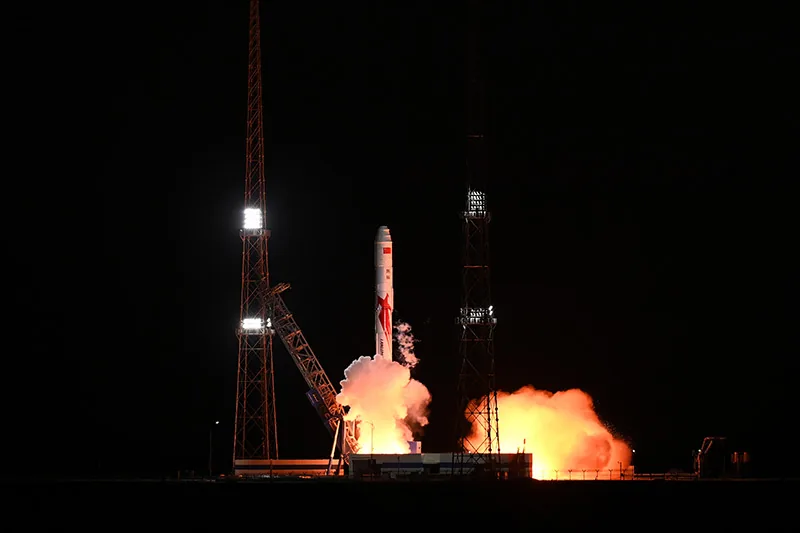
Between September 14 and 20, 2024, China conducted six orbital launches deploying over 30 satellites. For the first time, private firms LandSpace and Orienspace launched 18 satellites for the Qianfan low-Earth orbit broadband constellation on consecutive days, a task previously handled only by state-owned Long March rockets. The launches included LandSpace’s Zhuque-2 improved variant and Orienspace’s Gravity-1 sea launch. The Qianfan constellation now has 256 satellites in orbit, targeting 324 by end of 2026.
 Reference image
Editorial responsibility
- No named human review is recorded for this page.
- Reports are grouped by semantic similarity and deterministic rules. Language models may assist titles, summaries, translation and cross-source analysis; the page reads the event directly, while its address stays stable when the title changes.
- Summary covers the current reports
Cross-source coverage
Reporting timeline
China Launches Over 30 Satellites in One Week as Commercial Space Enters Dense Launch Phase
According to an Xinhua report, China conducted six rocket launches between September 14 and September 20, placing over 30 satellites into orbit. State-owned and private commercial rocket companies jointly executed missions from both inland and sea launch sites. Notable launches included LandSpace's Zhuque-2 improved variant, which deployed 10 satellites for the Qianfan constellation, marking the first time a private Chinese firm handled a major satellite internet constellation task. Orienspace's Gravity-1 and CAS Space's Lijian-1 also launched satellites for the same constellation and scientific experiments. The article notes that leading commercial rocket firms have developed multi-model, batch-production capabilities. CAS Space stated its Lijian-1 rocket annual capacity has reached 30 units, with launch schedules planned through 2027. The Qianfan constellation now has 256 satellites in orbit, targeting 324 by 2026. China SatNet has approximately 200 satellites in orbit, with a plan to launch about 1,300 by end-2029. Jiusi Research forecasts China's commercial space industry could grow to nearly 10 trillion yuan by around 2030. The report attributes these developments to policy support and capital market acceleration.
Read sourceChina completes 6 orbital launches in a week; private rocket debuts in large constellation deployment
Between September 15 and 20, 2026, China executed six successful orbital launches from four sites (Dongfeng, East China Sea offshore platform, Hainan, and Taiyuan), deploying satellites for the Qianfan constellation, satellite internet, and other payloads. Notably, LandSpace's Zhuque-2 improved variant (Yao-7) became the first Chinese private rocket to undertake a large-scale low-orbit constellation deployment, launching 10 Qianfan satellites. Orienspace's Gravity-1 (Yao-3) also conducted a sea launch for 8 Qianfan satellites and an EUHT test satellite. Analysts Chen Ziyi and Li Jiahui (SFC HK licensed) assess that commercial rocket demand is shifting from one-off verification to batch-based constellation services with recurring revenue. They note that Qianfan has deployed 256 satellites toward a year-end target of 324, requiring 4-7 more launches in Q4 2026. The analysts expect the commercial space sector to transition from a narrative driven by maiden flights to one driven by stable, large-scale orders, though they caution that launch failures or scheduling conflicts could disrupt the pace.
Read sourceChina Launches Over 30 Satellites in One Week, Entering High-Density Commercial Space Era
According to an article in China Securities Journal, China conducted six rocket launches between September 14 and 20, placing over 30 satellites into orbit. The launches involved both state-owned and private commercial rocket companies, including LandSpace's Zhuque-2 improved variant, Orienspace's Gravity-1, and CAS Space's Kinetica-1. For the first time, a private company (LandSpace) handled a large satellite internet constellation deployment, and two private firms launched satellites for the same constellation (Qianfan) on consecutive days. The article notes that head commercial rocket firms have developed multi-model parallel production and batch delivery capabilities. Kinetica-1 now has an annual production capacity of 30 rockets, with launch schedules planned through 2027. The Qianfan constellation now has 256 satellites in orbit, while China SatNet has about 200. Satellites launched include communication, remote sensing, and 6G test payloads. The article cites a Jiuxing Research report forecasting China's commercial space industry could grow to nearly 10 trillion yuan by 2030, with over 93,000 market entities and 600+ companies with industrialization capabilities. Leading firms have entered or completed IPO filings.
Read sourceShow 2 older updatesHide older updates
Private Chinese rocket firms enter large low-orbit broadband constellation market
On September 15 and 16, 2024, Chinese private rocket companies LandSpace and Orienspace successfully launched a total of 18 satellites for the Qianfan low-Earth orbit broadband internet constellation, marking the first time private firms have undertaken large-scale networking missions for such a constellation. LandSpace's Zhuque-2 improved variant deployed ten Qianfan satellites, while Orienspace's Gravity-1 launched eight Qianfan satellites and one EUHT technology test satellite via a mobile sea launch, setting Chinese records for single sea-launch payload weight and orbital altitude. Previously, all scaled-up networking launches for the Qianfan constellation were performed by state-owned Long March rockets. The article notes that this shift in transport capacity sources comes as China's two major low-orbit constellations, Qianfan and GW, accelerate deployment, creating pressure on launch supply. The author argues that while private rockets have now proven multi-satellite deployment capability, sustained success in this market will depend on launch frequency, cost, and reliability. The state-owned Long March 12 also launched satellites for the GW constellation on September 17, illustrating a division of labor where state entities handle national-level constellations and private firms serve large commercial networks.
Private Chinese rocket firms enter large-scale LEO broadband constellation market
On September 15 and 16, 2024, two Chinese private rocket companies, LandSpace and Orienspace, successfully launched satellites for the Qianfan low-Earth orbit broadband internet constellation. LandSpace's Zhuque-2 improved variant deployed 10 Qianfan networking satellites, while Orienspace's Gravity-1 placed 8 Qianfan satellites and one EUHT test satellite into orbit via a sea launch. These missions mark the first time private Chinese commercial space enterprises have undertaken large-scale satellite internet constellation networking tasks, previously handled exclusively by the state-owned Long March rockets. The article notes that private rockets had prior experience with smaller IoT constellations but had not entered the formal networking phase for large-scale broadband constellations. The national team's Long March 12 also launched satellites for the GW constellation on September 17, resulting in three networking launches in three days. The analysis highlights a redivision of labor on the launch supply side, driven by the pressure of simultaneous acceleration of two major low-orbit constellations. The article emphasizes that entering the supply chain requires meeting four hard metrics: payload capacity, price, launch frequency, and continuous reliability. It concludes that while private rockets have passed the multi-satellite deployment hurdle, sustained order acquisition depends on subsequent launch frequency, costs, and success rates, and that the next phase will involve competition over the allocation of networking orders.