China Defends UN 'Enemy Clause' After Japan PM Ishiba Calls for Its Deletion
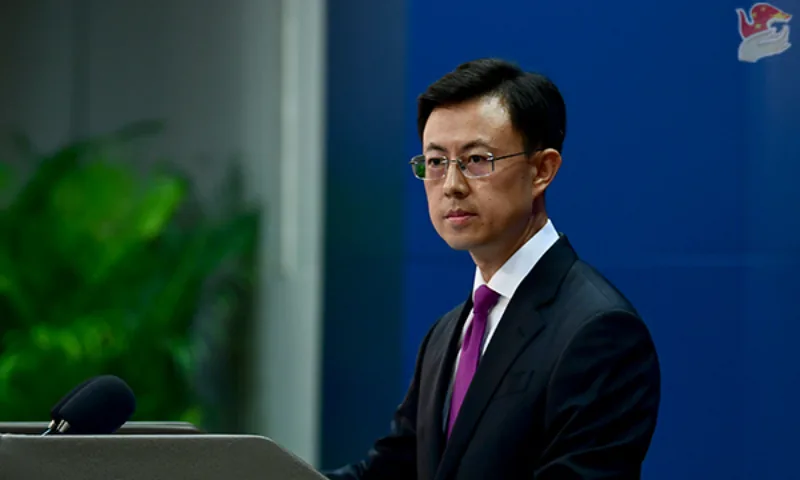
Chinese Foreign Ministry spokesperson Guo Jiakun responded on September 23 to Japanese Prime Minister Shigeru Ishiba's call at the UN General Assembly to delete the 'enemy clause' from the UN Charter. Guo stated Japan joined the UN only after acknowledging its militarist crimes and accepting the full Charter. He argued the clause remains a vital safeguard against fascism and militarism, and accused Japan of denying its aggression history, glorifying war crimes, and accelerating re-militarization. China urged Japan to reflect on history and take concrete actions to earn regional trust.
 Reference image
Editorial responsibility
- No named human review is recorded for this page.
- Reports are grouped by semantic similarity and deterministic rules. Language models may assist titles, summaries, translation and cross-source analysis; the page reads the event directly, while its address stays stable when the title changes.
- Summary covers the current reports
Cross-source coverage
Reporting timeline
China Urges Japan to Reflect on History After PM Calls to Delete UN 'Enemy Clause'
On January 23, 2025, Chinese Foreign Ministry spokesperson Guo Jiakun responded to Japanese Prime Minister Shigeru Ishiba's call to delete the 'enemy clause' from the United Nations Charter. During a regular press briefing, Guo stated that Japan joined the UN on the premise of acknowledging its militarist crimes and accepting the entire UN Charter. He emphasized that the 'enemy clause' is an important institutional arrangement designed to prevent fascism and militarism from threatening international peace and security, and that it serves as a key safeguard for the post-war international order. Guo asserted that the clause still holds significant practical relevance today. He urged Japan to take history as a lesson, engage in deep reflection, and take concrete actions to earn the trust of its Asian neighbors and the international community. The report was sourced from Xinhua News Agency and published via Tonghuashun Finance.
Read sourceChina Responds to Japan PM Ishiba's Call to Delete UN 'Enemy Clause'
On September 23, Chinese Foreign Ministry spokesperson Guo Jiakun responded to a query about Japanese Prime Minister Shigeru Ishiba's speech at the UN General Assembly. Ishiba, speaking on September 22, called for the deletion of the 'enemy clause' from the UN Charter, while asserting Japan's commitment to being a peaceful nation and its policy of exclusive defense. Guo stated that the international community is more focused on Japan's actions than its words. He argued that Japan's post-war peace identity was built on a deep reflection on history and a break from militarism, but accused the current Japanese government of denying its侵略 history, glorifying war crimes, rapidly expanding its military, accelerating 're-militarization', and attempting to abandon its 'Three Non-Nuclear Principles' and revise its pacifist constitution. Guo emphasized that the 'enemy clause' remains a vital institutional safeguard against the resurgence of fascism and militarism, and urged Japan to learn from history and take concrete actions to earn the trust of its Asian neighbors and the international community.
Read sourceChina Defends UN 'Enemy Clause' After Japan PM Calls for Its Deletion
China's Foreign Ministry spokesperson Guo Jiakun responded on September 23 to Japanese Prime Minister Shigeru Ishiba's call to delete the 'enemy clause' from the United Nations Charter. Guo stated that Japan joined the UN on the premise of acknowledging its militarist crimes and accepting the entire UN Charter. He described the 'enemy clause' as an important institutional arrangement designed to prevent fascism and militarism from threatening international peace and security, and as a key safeguard for the post-war international order. Guo asserted that the clause still holds significant practical relevance today. He urged Japan to learn from history, deeply reflect on its past, and take concrete actions to earn the trust of its Asian neighbors and the international community.
Read sourceShow 3 older updatesHide older updates
China Criticizes Japan's Pacifist Claims, Urges Historical Reflection at UN
At a regular press briefing, Chinese Foreign Ministry spokesperson Guo Jiakun responded to a question regarding Japanese Prime Minister Shigeru Ishiba's speech at the United Nations General Assembly on September 22. Ishiba stated that Japan, as a peaceful nation, adheres to its exclusively defense-oriented policy, contributes to international peace and prosperity, promotes a nuclear-weapon-free world, and calls for the deletion of the 'enemy clauses' from the UN Charter. Guo Jiakun remarked that the international community is more concerned with Japan's actions than its words. He argued that Japan's post-war 'peace nation' concept was built on deep reflection on history and a clean break from militarism. However, he accused the current Japanese administration of denying its history of aggression, glorifying war crimes, continuously strengthening its military and accelerating rearmament, plotting to abandon the 'Three Non-Nuclear Principles', revising the 'peace constitution', and openly challenging the post-war international order, making it a prominent factor threatening regional peace and stability. Guo noted that this year marks the 81st anniversary of the UN's founding and the 80th anniversary of the Tokyo Trials. He stated that Japan joined the UN on the premise of admitting its militarist crimes and accepting the entire UN Charter, and that the 'enemy clauses' remain a vital institutional safeguard against fascism and militarism. China urged Japan to learn from history, deeply reflect, and take concrete actions to earn the trust of its Asian neighbors and the international community.
Read sourceJapan PM Sanae Takaichi Urges UN to Delete 'Enemy Clause'; China Responds
On September 23, Japanese Prime Minister Sanae Takaichi, speaking at the United Nations General Assembly, called for the deletion of the 'enemy clause' from the UN Charter. She stated that Japan, as a peace-loving nation, adheres to an exclusively defense-oriented policy and contributes to international peace and prosperity, while also advocating for a nuclear-weapon-free world. In response, Chinese Foreign Ministry spokesperson Guo Jiakun stated that the international community is more concerned with Japan's actions than its words. Guo criticized the current Japanese administration for denying its history of aggression, glorifying war crimes, and accelerating military expansion and rearmament. He accused Japan of attempting to abandon its 'Three Non-Nuclear Principles', revise its pacifist constitution, and challenge the post-war international order, calling Japan a prominent factor threatening regional peace and stability.
Read sourceJapan PM Ishiba Urges UN to Delete 'Enemy Clause' from Charter; China Responds
Japanese Prime Minister Shigeru Ishiba (referred to as 高市早苗 in the source, likely a translation error for Shigeru Ishiba) called on September 22 at the United Nations General Assembly for the deletion of the 'enemy clause' (Articles 53 and 107) from the UN Charter, which targets former Axis powers. He framed Japan as a peace-loving nation committed to exclusive defense and a nuclear-free world. In response, Chinese Foreign Ministry spokesperson Guo Jiakun stated that the international community cares more about Japan's actions than its words. Guo accused the current Japanese government of denying侵略 history, glorifying war crimes, expanding military power, and challenging the post-war international order. He noted that Japan joined the UN only after accepting its war guilt and the full Charter, and argued the 'enemy clause' remains a vital safeguard against fascism and militarism. China urged Japan to learn from history and take concrete actions to earn trust from Asian neighbors and the international community.
Read source