Intel shares plunge nearly 29% as weak Q4 outlook cuts US stake by $11 billion
Intel shares closed down nearly 29% on Friday, October 30, 2026, their worst single-day decline since 1974, after the chipmaker guided fourth-quarter revenue to $15 billion-$16 billion, below the roughly $17 billion analysts expected. The company also projected earnings per share of $0.25 versus forecasts of $0.43 and gross margin falling to 37% from 43%. Intel cited a PC market slump tied to rising memory prices, a roughly $300 million impact from an accident at its Israel factory, and expected PC shipments to fall about 12% this year and another 10% in 2027. The selloff erased nearly $150 billion in market value and shaved more than $11 billion from the US government's 9.9% stake, though that holding remains worth about three times its purchase price.
 Reference image
Editorial responsibility
- No named human review is recorded for this page.
- Reports are grouped by semantic similarity and deterministic rules. Language models may assist titles, summaries, translation and cross-source analysis; the page reads the event directly, while its address stays stable when the title changes.
- Summary covers the current reports
Cross-source coverage
Common ground
- Intel's Q3 results were strong, with revenue up 21% and EPS beating estimates, so the stock drop was mainly about future guidance, not past performance.
- The government's stake in Intel creates a real conflict of interest because the same officials who regulate the company also own a piece of it and talk about its stock price.
- The 29% single-day stock drop was an overreaction to a forecast change, and both the company's guidance and the market's reaction are unreliable numbers that need scrutiny.
- The SK Hynix lease rumor at Intel's Ohio fab is potentially important but unconfirmed, so it should not be treated as solid evidence either way.
Points of contention
- Whether the government's paper profit or loss on its Intel stake is a meaningful measure of policy success or just noise that should be ignored in both directions.
- Whether the $700 million PC chip miss is mostly a one-time supply shock from the Israel plant explosion or a sign of deeper demand problems.
- Whether the core story is about Intel's business fundamentals and guidance or about the governance problem of the government owning and promoting a stock.
- Whether the press is biased toward repeating the government's positive talking points or the opposition's negative ones.
Blind spots
- Nobody fully explored how the government's ownership might change Intel's actual business decisions, like where to build factories or how to price chips.
- The discussion never addressed what happens to other companies in the government's 40-company portfolio if Intel's stock keeps swinging.
- No one examined whether the market's 29% reaction was itself manipulated or amplified by trading algorithms or media hype.
- The debate did not consider how Intel's customers might react to the government being a part-owner, especially foreign customers.
WorldAttention’s read
The roundtable agreed that Intel's Q3 was strong and the stock drop was mostly about soft guidance, not a collapse. They also agreed that the government owning Intel stock while regulating it is a real conflict of interest. The main disagreement was whether the story is about Intel's business timing problem or about the government becoming a stock trader. The biggest blind spot was how government ownership might actually change Intel's decisions and how customers react. Overall, Intel has a real business with a timing and demand-mix problem, but the bigger story is that the state is now a shareholder and the press needs to treat both positive and negative stock numbers with equal skepticism.
Reporting timeline
Intel Shares Plunge 28% on Weak Q4 Outlook, US Government Stake Loses $12 Billion
Intel shares fell about 28% on Friday after the company issued a weaker-than-expected fourth-quarter outlook, reducing the value of the U.S. government's 10% stake by $12 billion. Intel forecast Q4 revenue of $15 billion to $16 billion, below analysts' expectations of about $17 billion, and said gross margin would drop from 43% to 37%, with no positive cash flow expected. CEO Lip-Bu Tan said PC customers are signaling a slowdown due to rising memory prices and supply tightness.
Read sourceIntel stock plunges 28% on weak outlook, cutting US stake by $12B
Intel shares fell about 28% on Friday, one of the company's worst trading days, after it guided fourth-quarter revenue to $15-16 billion versus analyst expectations near $17 billion. It also forecast gross margin falling to 37% from 43% and said heavy investment would leave no positive cash flow. CNBC reported the selloff reduced the value of the U.S. government's roughly 10% stake by $12 billion, though the holding remains profitable, with Intel up more than 70% for the year. Nvidia, which also took a large stake in 2025, slipped slightly as chipmakers broadly sold off. CEO Lip-Bu Tan said customers signaled a PC slowdown tied to memory prices and availability, with rising system prices pressuring IT budgets. Data center revenue grew 78% year over year, but Intel is capacity-constrained until additional fabs come online, with the next Arizona fab not expected until 2028.
Read sourceIntel Stock Plunges Nearly 29% on Weak Outlook, Worst Day Since 1974
Intel shares closed down nearly 29% on Friday, the chipmaker's worst single-day decline since July 1974, after its fourth-quarter guidance fell well short of Wall Street expectations. Although Intel beat estimates for the third quarter with adjusted earnings per share of $0.52 and data center revenue of $7.3 billion, it forecast fourth-quarter revenue of $15 billion to $16 billion versus roughly $17 billion expected, and earnings per share of $0.25 against forecasts of $0.43. The company cited a PC market slump driven by AI data centers soaking up memory chip supply, expecting PC shipments to fall about 12% this year and another 10% in 2027, plus about $300 million in fourth-quarter revenue impact from an accident at its Israel factory. Bernstein analyst Stacy Rasgon called the outlook "terrible" and cut his price target to $75 from $110. The drop erased nearly $140 billion in market value and shaved more than $10 billion off the US government's 9.9% stake, though that stake remains worth about three times its purchase price. CEO Lip-Bu Tan said rebuilding Intel will be a multiyear journey.
Read sourceShow 4 older updatesHide older updates
Intel's Friday Plunge Cuts US Government Stake Value by $11 Billion
Intel shares fell nearly 30% on Friday after the company's Q4 revenue outlook of $15-16 billion missed analysts' $17 billion expectation and PC revenue declined more than anticipated, erasing roughly $150 billion in market value. The drop shaved over $11 billion from the US government's 9.9% equity stake, taken last August at $20.47 per share (433.3 million shares worth about $8.9 billion). After Intel closed Thursday at $92.07, implying a $39.9 billion stake value, Friday's close at $65.76 put the government's paper value at about $28.5 billion. Despite the rout, the investment remains more than three times the original purchase price, and the White House continues to tout the position as profitable for taxpayers.
Read sourceIntel Stock Plunge Cuts $11 Billion From US Government Stake, Still Up 3X
Intel shares fell nearly 30% on Friday, closing at $65.76, after the company's fourth-quarter revenue outlook of $15-16 billion fell short of the $17 billion analysts expected and PC revenue dropped more than anticipated. The decline shaved over $11 billion from the US government's 9.9% equity stake, acquired last August at $20.47 per share (433.3 million shares worth about $8.9 billion). The stake was worth roughly $39.9 billion at Thursday's $92.07 close and about $28.5 billion after Friday's rout, still more than three times the government's purchase price. Intel erased nearly $150 billion in market value at points during the session, briefly putting it on pace for its worst day since 1974. The episode highlights volatility in the Trump administration's growing portfolio of government equity holdings, which spans 40 companies per a CATO Institute tracker.
Intel Q4 Guidance Misses Estimates, Shares Plunge 22% After Hours
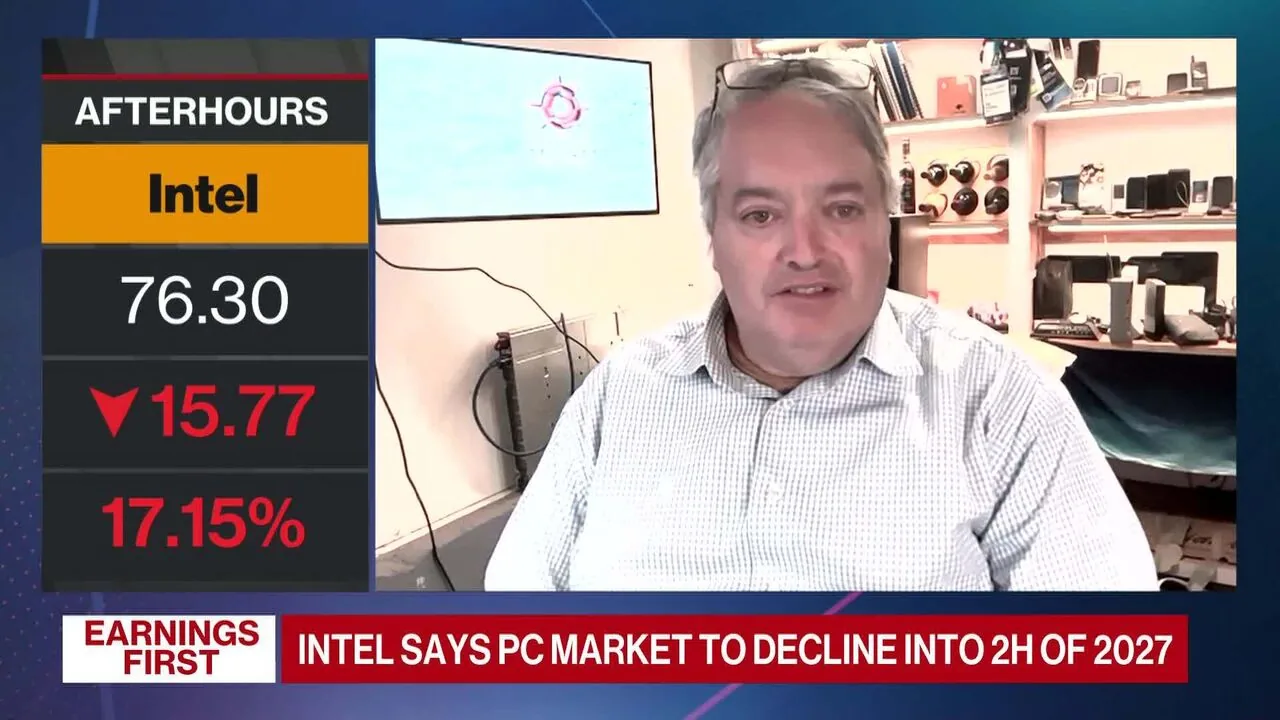
Intel issued fourth-quarter revenue guidance of $15-16 billion, below analysts' average estimate of $17 billion, citing a sharp decline in PC processor demand and difficulty keeping up with surging demand for high-margin data center components. Adjusted earnings per share are projected at 25 cents, versus Wall Street's 43-cent expectation. CEO Lip-Bu Tan said memory price increases are a major challenge and will become a severe problem for the industry by 2027. Intel expects the PC market downturn to persist through at least the first half of 2027, with a further 10% decline next year after a 12% drop in 2026. Following the earnings release, Intel shares fell 22% in after-hours trading.
Intel beats Q3 estimates but Q4 outlook disappoints on weak PC sales, stock plunges
Intel reported third-quarter adjusted earnings of $0.52 per share, beating analyst projections of $0.41, with revenue of $16.5 billion in line with estimates and up 21% year over year. However, the company guided fourth-quarter revenue to $15 billion-$16 billion, well below the $17 billion analysts expected, citing a worse-than-anticipated drop in PC revenue. Intel attributed the shortfall to difficult comparisons with last year's Windows 11 upgrade cycle following Microsoft's end of Windows 10 support, rising PC prices weighing on demand, and a deadly explosion at an Intel plant in Israel expected to account for roughly $300 million of the miss. PC chip sales came in at $8.1 billion versus an $8.8 billion target, while data center sales topped $7.3 billion and Foundry revenue reached $6.7 billion, up 58% year over year. Intel stock fell sharply following the report.
Read source