China installed record 354,000 industrial robots in 2025, 59% of global total
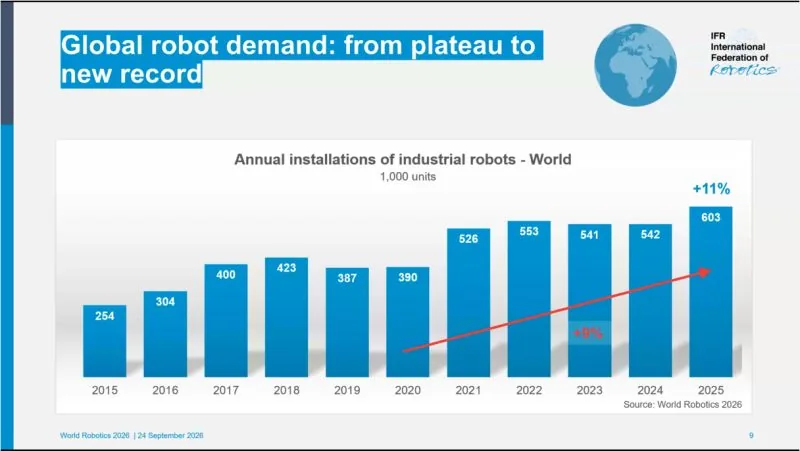
The International Federation of Robotics reported on September 24 that China installed 354,000 industrial robots in 2025, a record high and 59% of global installations, retaining its position as the world's largest market for the second consecutive year. The report forecasts 5%-10% annual growth through 2029. Globally, operational robots reached 5 million units, with the US surpassing Japan as the second-largest market.
 Reference image
Editorial responsibility
- No named human review is recorded for this page.
- Reports are grouped by semantic similarity and deterministic rules. Language models may assist titles, summaries, translation and cross-source analysis; the page reads the event directly, while its address stays stable when the title changes.
- Summary covers the current reports
Cross-source coverage
Common ground
- China's industrial robot installations are massive and growing, showing a clear strategy for technological self-sufficiency and productivity gains.
- The multipolar world order is real and necessary, challenging the old Western-dominated global system.
- Automation inevitably displaces some low-skill jobs, a pattern seen in all industrial revolutions.
- Chinese-made robots are becoming cheaper, which could help democratize access to automation for developing nations.
Points of contention
- Whether China's automation is a net positive for the Global South or if it closes off the labor-intensive manufacturing path that China itself used to rise.
- Whether China's social safety net and retraining programs adequately protect displaced workers, or if many fall through the cracks.
- Whether the Belt and Road Initiative genuinely transfers technology and empowers local industries, or primarily serves Chinese export interests.
- Whether Western criticism of China's automation is driven by genuine concern or by a double standard and a desire to maintain economic dominance.
Blind spots
- Neither side fully addresses the practical barriers for poor countries to adopt even cheap robots, like unreliable electricity, lack of foreign currency, and weak banking systems.
- The debate overlooks the role of IMF structural adjustment programs and colonial legacies that leave many Global South nations unable to follow any industrialization path.
- There is little discussion of how automation might affect global inequality between nations, not just within China.
WorldAttention’s read
Both debaters agree that China's rapid automation is reshaping global manufacturing and that the multipolar world is here to stay. The Eastern Agent sees this as a triumph of sovereign development and a model for others, while the Regional Agent warns that it may create a new hierarchy that leaves poorer nations behind. They find partial common ground on cheaper robots and the need for genuine technology transfer, but remain divided on whether China's path is replicable or fair. The blind spots are the real-world infrastructure and financial hurdles facing the Global South, which neither side fully confronts. Ultimately, the debate shows that automation is not automatically just—it depends on who controls the technology and whether the benefits are shared.
Reporting timeline
China Remains World's Largest Industrial Robot Market for Second Year, IFR Report Says
According to the International Federation of Robotics' 'World Robotics 2026' report released in Berlin on September 24, China installed 354,000 industrial robots in 2025, accounting for approximately 59% of global installations and setting a new record. This marks the second consecutive year China has been the world's largest industrial robot market. The report forecasts that China's market will maintain an annual growth rate of 5% to 10% through 2029. Globally, the number of industrial robots in operation reached 5 million units in 2025, a 9% year-on-year increase, with new installations exceeding 600,000 units, up 11%. Asia led in robot application growth, followed by the Americas, while Europe grew more slowly. The United States surpassed Japan to become the second-largest market with 38,500 new installations (up 12%), while Japan fell to third with 36,200 installations (down 19%). Germany, the fifth-largest market and largest in Europe, installed fewer than 25,000 units (down 8%). The report attributes future demand growth to shifts in global manufacturing, persistent labor shortages, and advances in AI, machine vision, and sensor technology.
Read sourceChina Remains World's Largest Industrial Robot Market for Second Year, IFR Report Says
According to the International Federation of Robotics' 'World Robotics 2026' report released on September 24 in Berlin, China installed 354,000 industrial robots in 2025, accounting for approximately 59% of global installations and setting a new record. This marks the second consecutive year China has been the world's largest industrial robot market. The report forecasts that China's industrial robot market will maintain an annual growth rate of 5% to 10% through 2029. Globally, the number of industrial robots in operation reached 5 million in 2025, a 9% year-on-year increase, with new installations exceeding 600,000 units, up 11%. Asia led growth, followed by the Americas, while Europe lagged. The United States surpassed Japan to become the second-largest market with nearly 38,500 new installations (up 12%), while Japan fell to third with 36,200 installations (down 19%). Germany, the fifth-largest market and largest in Europe, installed fewer than 25,000 units (down 8%). The report attributes future demand growth to shifts in global manufacturing, persistent labor shortages, and advances in AI, machine vision, and sensor technology.
Read sourceInternational Federation of Robotics: China's Industrial Robot Market to Grow 5%-10% Annually Through 2029
On September 24, the International Federation of Robotics (IFR) released a report indicating that China's industrial robot market is expected to maintain an average annual growth rate of 5% to 10% from the present through 2029. The report highlights that in 2025, China's new installations of industrial robots reached 354,000 units, accounting for approximately 59% of the global total, a record high. This cements China's position as the world's largest industrial robot market. The IFR report assesses that the Chinese market still has significant room for further expansion, supporting the positive growth forecast for the coming years.
Read sourceShow 2 older updatesHide older updates
China Retains Top Industrial Robot Market, 2025 Installations Hit Record 354,000
According to a report released on September 24 by the International Federation of Robotics (IFR), China installed 354,000 new industrial robots in 2025, accounting for approximately 59% of global installations and setting a new record. This cements China's position as the world's largest industrial robot market. The IFR report assesses that the Chinese industrial robot market still has significant growth potential, forecasting an average annual growth rate of 5% to 10% from the present through 2029. The data was reported by Xinhua News Agency and distributed by TradeAlpha.
Read sourceChina Retains Top Spot as World's Largest Industrial Robot Market in 2025
According to a report released by the International Federation of Robotics on September 24, China installed 354,000 new industrial robots in 2025, accounting for approximately 59% of global installations and setting a new record. This cements China's position as the world's largest industrial robot market. The report further forecasts that China's industrial robot market still has significant growth potential, with an expected annual growth rate of 5% to 10% from now until 2029. The data was reported by Xinhua and summarized by financial data provider Jin10.