Huawei Ascend 960 supernode cuts power 550 kW using NPO optical engines, targets 2027 deployment
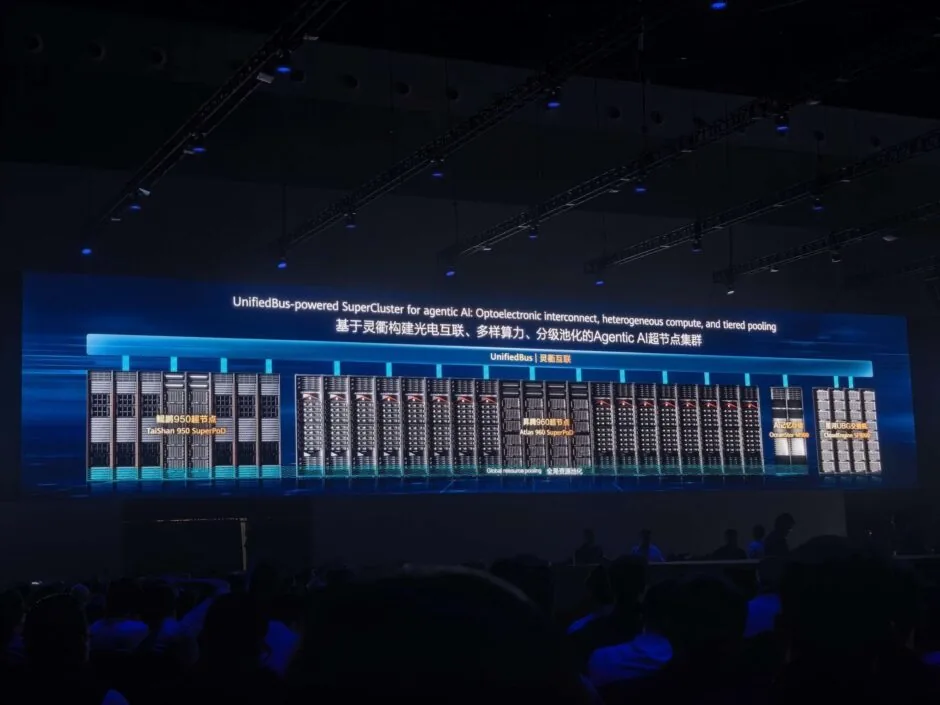
At Huawei Connect 2026, Huawei unveiled the Ascend 960 supernode, the first to use Near-Packaged Optics (NPO) technology. It replaces 48,000 800G optical modules with 5,500 Hi-ONE optical engines, cutting power by over 550 kW and achieving 99.8% system availability. The Atlas 960 liquid-cooled version is scheduled for Q3 2027, and the Atlas 860 air-cooled for Q2 2027. Huawei has led the OPEN NPO project and proposed an NPO standard to the OIF. Chinese suppliers Zhongji Innolight, Eoptolink, and Accelink can supply NPO engines. Analysts expect small-scale volume in 2027 and mass production in 2028.
 Illustration
Editorial responsibility
- No named human review is recorded for this page.
- Reports are grouped by semantic similarity and deterministic rules. Language models may assist titles, summaries, translation and cross-source analysis; the page reads the event directly, while its address stays stable when the title changes.
- Summary covers the current reports
Cross-source coverage
Reporting timeline
Huawei Ascend 960 Uses 5,500 Optical Engines to Replace 48,000 800G Modules, Cutting Power by 550 kW
At the HUAWEI CONNECT conference, Huawei Vice Chairman Wang Tao unveiled the Ascend 960 supernode, the world's first to adopt NPO (Near-Packaged Optics) technology. The system replaces approximately 48,000 traditional 800G optical modules with 5,500 Hi-ONE optical engines, reducing power consumption by over 550 kW and achieving 99.8% system availability. Each Hi-ONE engine delivers 7.2T transmission capacity and is the first mass-produced NPO product with built-in light sources. Chinese optical module makers including Zhongji Innolight, Eoptolink, and Accelink are already capable of supplying NPO optical engines. Huawei has proposed an NPO standard to the OIF, accelerating ecosystem development. Separately, optical module company Nazhen Technology listed on the Hong Kong Stock Exchange, raising approximately HK$5.445 billion, with over half allocated to NPO/CPO and high-end optical chip R&D. Analysts at Huachuang Securities expect NPO to increase value share for optical engines, switch chips, and liquid cooling. Guosheng Securities sees a buying opportunity in Q4 as macro pressures ease and optical communication fundamentals remain strong. The ChiNext AI ETF (159243) has over 50% weight in optical module stocks, reflecting strong industry alignment.
Read sourceHuawei Ascend 960 Uses 5,500 Optical Engines to Replace 48,000 800G Modules, Cutting Power by 550 kW
At the Huawei Connect conference, Huawei launched the Ascend 960 supernode, the industry's first supernode using NPO (Near-Packaged Optics) technology. According to Huawei's official website, the system replaces approximately 48,000 800G optical modules with 5,500 Hi-ONE optical engines, reducing power consumption by over 550 kW and achieving 99.8% system availability. The Hi-ONE engine delivers 7.2T per unit and is the first mass-produced NPO product with built-in light sources. Chinese optical module makers including Zhongji Innolight, Eoptolink, and Accelink are already capable of supplying NPO optical engines. Brokerages such as Huachuang Securities note that NPO increases the value share of optical engines, switch chips, and liquid cooling. Separately, optical module maker Nazhen Technology listed on the Hong Kong Stock Exchange, raising approximately HK$5.445 billion, with over half of proceeds earmarked for NPO/CPO and high-end optical chip R&D. Meanwhile, 1.6T optical module products from leading vendors are entering volume production. Guosheng Securities suggests a buying opportunity in Q4, citing easing macro pressures and strong Q3 earnings expectations. The article also notes that the ChiNext AI Index ETF (159243) has over 50% weight in optical module-related components.
Read sourceHuawei Partners with Xi'an Institute of Optics, Advances NPO Optical Interconnect for AI Infrastructure
Huawei has signed a strategic cooperation agreement with the Xi'an Institute of Optics and Precision Mechanics (Xi'an Guangji Suo), designating 'AI + Optics' as the core direction and promising priority allocation of computing resources and AI teams. This move follows Huawei's September 2026 launch of the Ascend 960 supernode, the world's first to use near-package optics (NPO), replacing 48,000 pluggable modules with 5,500 self-developed Hi-ONE optical engines. Huawei's rotating chairman Wang Tao stated NPO offers better maintainability and performance than co-packaged optics (CPO). To standardize the technology, Huawei led the OPEN NPO project under the Global Computing Consortium (GCC) and Open AI Infra Community (OAII), releasing China's first NPO optical interconnect multi-source agreement. Morgan Stanley forecasts that Huawei's 'Tao's Law' combined with NPO and 3D folding will drive AI optical transceiver hardware integration over 100x by 2035. Huawei's investment arm, Hi-Tech Capital, has also invested in optical chip makers Mier Optical Semiconductor and Zonghui Xinguang to secure upstream supply. TrendForce predicts the combined NPO and CPO market will grow from about $100 million in 2025 to over $39 billion by 2030, with NPO dominating from 2026 to 2028.
Read sourceShow 2 older updatesHide older updates
Huawei Unveils Ascend 960 Supernode with NPO; Analysts See Mass Production by 2028
At Huawei Connect 2026, Huawei unveiled the Ascend 960 Supernode, the industry's first supernode adopting NPO (Near-Packaged Optics) technology. The integrated NPO product, named Hi-ONE, achieves a transmission capacity of 7.2T per engine through balanced design across optical, mechanical, electrical, magnetic, and thermal elements. Within the series, the Atlas 960 liquid-cooled supernode is scheduled for Q3 2027, and the Atlas 860 air-cooled supernode for Q2 2027. Multiple securities firms commented on NPO's prospects. Tianfeng International Securities stated NPO may be the optimal solution for AI computing clusters based on supernodes, addressing bandwidth density, power consumption, and maintainability bottlenecks of traditional pluggable modules. Zhongtai Securities noted NPO serves as a realistic engineering transition platform. Wanlian Securities expects small-scale volume ramp-up in 2027 and large-scale mass production in 2028. However, challenges remain including non-unified interface specifications, insufficient product compatibility, and low supply chain coordination efficiency. Zhongtai Securities emphasized that upgrading to 6.4T and 7.2T implies a comprehensive generational shift in electrical, optical, packaging, and testing systems.
Huawei Unveils Ascend 960 Supernode with NPO; Mass Production Expected by 2027-2028
At Huawei Connect 2026, Huawei introduced the Ascend 960 Supernode, the industry's first supernode using Near-Packaged Optics (NPO) technology. The integrated NPO product, named Hi-ONE, delivers 7.2T transmission capacity per engine and is expected to be the first mass-produced NPO product. The Atlas 960 liquid-cooled supernode is scheduled for Q3 2027, and the Atlas 860 air-cooled version for Q2 2027, indicating large-scale commercial deployment within a year. According to TF Securities International, NPO optical modules may be the optimal solution for AI computing clusters based on supernodes, addressing performance bottlenecks of traditional pluggable modules. Zhongtai Securities noted NPO's advantages in bandwidth density, power consumption, and maintainability. Analysts from Guolian Minsheng Securities and Wanlian Securities see NPO industrialization shifting from technical verification to customer adoption, with small-scale volume ramp-up expected in 2027 and large-scale mass production in 2028. Challenges remain, including non-uniform interface specifications and supply chain coordination.
Read source