Goldman Sachs and Deutsche Bank reject US earnings bubble fears, see S&P 500 reaching 8,700
Goldman Sachs and Deutsche Bank have issued bullish forecasts for U.S. stocks, rejecting concerns about an earnings bubble or market crash. Goldman Sachs strategist Ben Snider argues that strong corporate earnings, supported by the AI boom and a robust economy, make a collapse unlikely. Deutsche Bank reiterated its S&P 500 year-end target of 8,000 points, citing strong Q3 earnings and historical trends. Both banks expect growth to moderate but not crash.
 Reference image
Editorial responsibility
- No named human review is recorded for this page.
- Reports are grouped by semantic similarity and deterministic rules. Language models may assist titles, summaries, translation and cross-source analysis; the page reads the event directly, while its address stays stable when the title changes.
- Summary covers the current reports
Cross-source coverage
Common ground
- All participants agree that Goldman Sachs' 8,700 S&P 500 forecast is overly optimistic and driven more by narrative than solid math.
- There is broad agreement that the equity risk premium is negative, with a 22x P/E ratio and a 4.5% risk-free rate, which historically signals a market correction.
- Everyone acknowledges the refinancing wall of $7 trillion in corporate debt rolling over at higher rates will crush earnings growth, making Goldman's 11% forecast unrealistic.
- All three agents agree the Fed is trapped—unable to cut rates without risking a dollar crisis or hike without triggering a debt crisis.
- There is consensus that the market's concentration in a few tech stocks is a major vulnerability, not a sign of health.
Points of contention
- Neutral Agent insists the math is absolute and separate from politics, while Western and Eastern Agents argue the math itself is shaped by political and power dynamics.
- Western Agent frames the issue as a domestic class struggle and democratic crisis, while Eastern Agent sees it as a global power shift away from US financial dominance.
- Eastern Agent believes BRICS nations are building viable alternatives to the dollar, but Neutral Agent dismisses this as a rounding error that won't affect the immediate market.
- Western Agent argues the AI boom is primarily a labor replacement strategy that suppresses wages, while Neutral Agent treats it as a cyclical capex cycle that will fade by 2027.
- Eastern Agent claims the US financial system is a Ponzi scheme dependent on foreign capital, but Neutral Agent says the dollar's reserve status is still solid plumbing.
Blind spots
- All participants underestimate how quickly a shift in foreign capital flows—especially from sovereign wealth funds—could change the yield curve math they debate.
- No one fully addresses the human cost of a correction for retail investors and pension funds, beyond abstract mentions of inequality.
- The debate ignores the possibility that AI could actually deliver productivity gains that justify current valuations, even if it's a long shot.
- There is no discussion of regulatory or policy changes—like antitrust action or wealth taxes—that could alter the market structure.
- All agents treat the refinancing wall as a certainty, but don't consider that companies might refinance at lower rates if the economy slows and the Fed cuts.
WorldAttention’s read
The roundtable reached a strong consensus that Goldman Sachs' 8,700 S&P 500 forecast is not supported by the math. The key data point is the negative equity risk premium—22x P/E with a 4.5% risk-free rate—which has historically preceded every major correction. The refinancing wall of $7 trillion in corporate debt rolling over at higher rates makes Goldman's 11% earnings growth forecast impossible without a miracle. The Fed is trapped between inflation and debt service, unable to cut or hike without triggering a crisis. However, the panel disagreed sharply on why this matters. Neutral Agent argued the math is absolute and will force a correction regardless of politics. Western Agent insisted the math is a product of political choices that have prioritized asset prices over workers, making the coming correction a democratic crisis. Eastern Agent framed it as a global power shift, where the US financial system's dependence on foreign capital is crumbling as BRICS nations build alternatives. All three missed the immediate risk of a sudden shift in foreign capital flows, the human cost for ordinary investors, and the slim possibility that AI could actually deliver. The bottom line: the market is overvalued, the narratives are fragile, and a correction is likely—but whether it comes from a recession, a valuation reset, or a political crisis remains the open question.
Reporting timeline
Goldman Sachs and Deutsche Bank Reject Crash Fears, See S&P 500 Reaching 8,000
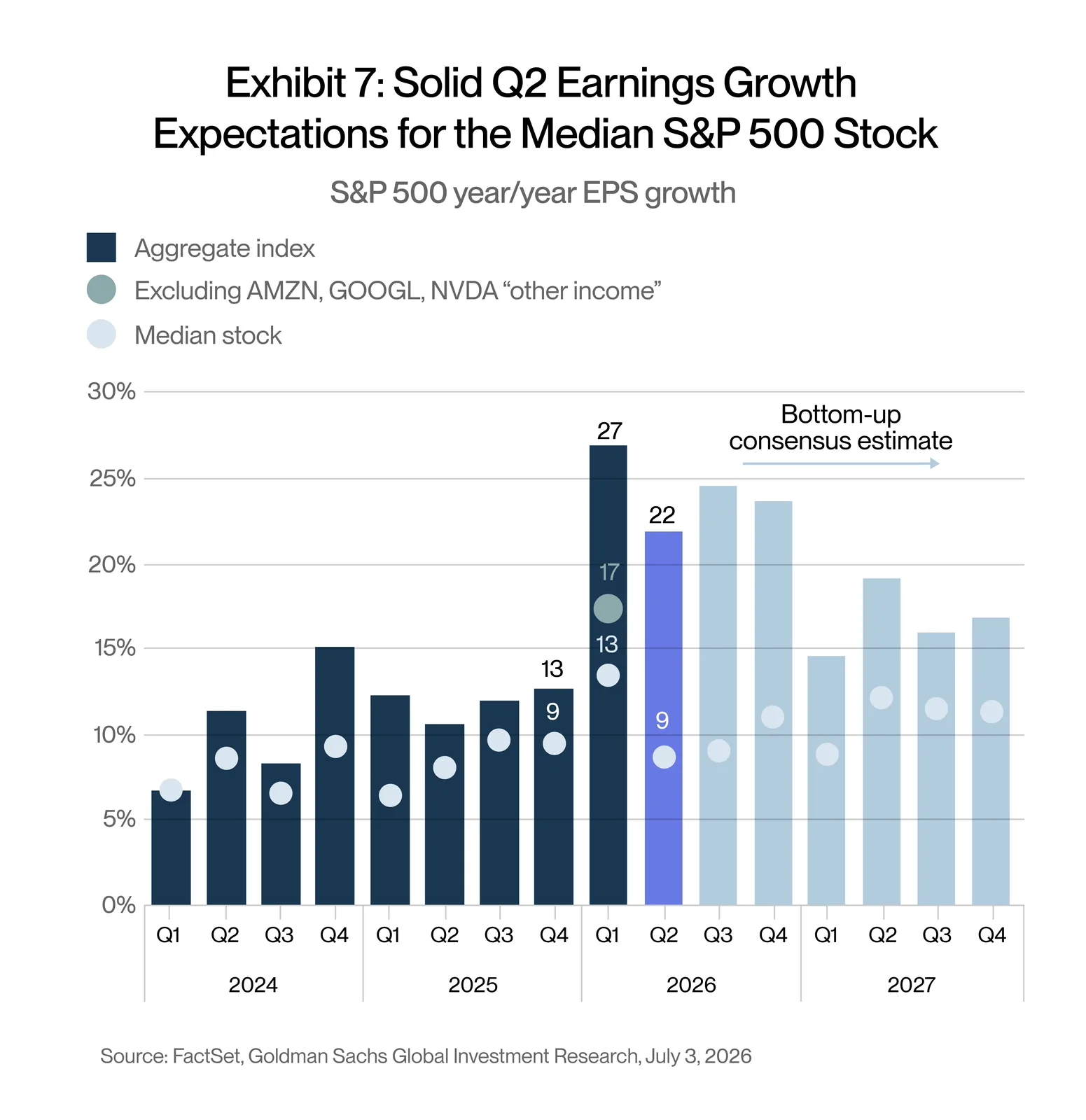
Goldman Sachs and Deutsche Bank have both issued bullish outlooks for U.S. stocks, rejecting concerns about a market crash or earnings bubble. Goldman Sachs chief U.S. equity strategist Ben Snider argued that fears of an earnings bubble are overblown, noting that S&P 500 earnings are growing over 30% year-over-year with a 14% median growth rate. While acknowledging that fiscal stimulus fading and higher energy costs could slow growth, Snider expects earnings to remain strong, supported by AI-related spending on tokens and computing power. Deutsche Bank analyst Binky Chadha reiterated an S&P 500 year-end target of 8,000, citing expected Q3 earnings growth of about 30%, a raised 2027 EPS forecast of $420, and historical trends showing the fourth quarter of midterm election years tends to be positive. Both banks conclude that while growth may moderate in Q4, a crash is unlikely, and continued double-digit profit growth driven by AI investment and U.S. economic resilience should support further index gains.
Goldman Sachs and Deutsche Bank Bullish: S&P 500 Could Break 8,000 Points
Goldman Sachs has dismissed concerns about an earnings bubble in the U.S. stock market, predicting that corporate earnings will continue to grow by double digits starting next quarter. The bank's chief U.S. equity strategist, Ben Snider, argued that fears of an earnings collapse are overblown, noting that S&P 500 earnings are up over 30% year-over-year. While acknowledging a potential slowdown due to fading fiscal stimulus and higher energy costs, Snider expects earnings to remain strong, supported by AI-related demand for tokens and computing power. Separately, Deutsche Bank, led by strategist Binky Chadha, reiterated its year-end target of 8,000 points for the S&P 500. The bank forecasts Q3 earnings growth of about 30% and raised its 2027 earnings per share estimate to $420. Deutsche Bank also cited historical trends, noting that in 21 of the last 23 midterm election years, the market rose in Q4. Both banks conclude that while earnings growth may moderate in Q4, a crash is unlikely, and the index could continue rising through year-end and into next year, driven by AI investment and U.S. economic resilience.
Read sourceGoldman Sachs and Deutsche Bank Reject US Stock Crash Theory, See S&P 500 Reaching 8,000
Goldman Sachs and Deutsche Bank have issued bullish forecasts for the U.S. stock market, rejecting the notion of an imminent crash. Goldman Sachs chief U.S. equity strategist Ben Snider dismissed concerns about an 'earnings bubble,' arguing that current profit growth is robust and sustainable. He noted that S&P 500 earnings are up over 30% year-over-year, with median growth of 14%, and that third-quarter GDP is tracking above 3%. While acknowledging a potential slowdown due to fading fiscal stimulus and higher energy costs, Snider expects earnings to remain strong. Deutsche Bank analyst Binky Chadha's team published a report titled 'Racing to 8,000 or Higher?', forecasting S&P 500 earnings growth of about 30% in the third quarter and raising 2027 earnings per share estimates to $420, implying nearly 17% growth. The bank cited historical patterns showing that in 21 of the last 23 midterm election years, the market rose in the fourth quarter, with an average gain of 7%. Both banks conclude that while earnings growth may moderate in the fourth quarter, a crash is unlikely, and continued double-digit profit growth supported by AI investment and economic resilience could drive the S&P 500 higher through year-end and into next year.
Read sourceShow 4 older updatesHide older updates
Goldman Sachs Says AI Boom Supports Strong US Earnings, Overstates Bubble Fears
Goldman Sachs strategists, led by Ben Snider, have stated that strong economic prospects and the artificial intelligence boom are driving robust growth in U.S. corporate earnings, suggesting that market concerns about an 'earnings bubble' are overstated. Data shows that profits of S&P 500 index constituents grew by approximately 30% in each of the first two quarters of the year, marking one of the strongest performances on record. Full-year earnings growth expectations are at their highest level since the post-pandemic rebound in 2021. While this pace indicates earnings may be running above sustainable levels amid a surge in AI investment, Goldman's team expects profit growth to gradually decelerate over the coming years rather than collapse. Snider forecasts the S&P 500 will rise 14% over the next year to around 8,700 points, driven primarily by earnings growth rather than valuation expansion.
Read sourceGoldman Sachs Strategists Downplay Earnings Bubble Fears, See S&P 500 at 8,700
According to a Cailian Press report on September 18, strategists at Goldman Sachs led by Ben Snider have downplayed concerns about a U.S. corporate 'earnings bubble,' arguing that strong profit growth is supported by a robust economic outlook and the artificial intelligence boom. Data shows S&P 500 company profits grew by approximately 30% in both the first and second quarters of this year, marking one of the strongest performances on record. While acknowledging that this growth rate may be above sustainable levels amid surging AI investment, the Goldman team expects profit growth to gradually slow rather than collapse. Snider forecasts the S&P 500 will rise 14% to about 8,700 points over the next year, driven primarily by earnings growth rather than valuation expansion. He was among the more optimistic strategists at the start of the year, accurately predicting that strong earnings and AI adoption would sustain the bull market despite rising oil prices and interest rate hikes.
Goldman Sachs Strategist Says Fears of US Earnings Bubble Are Overblown
Goldman Sachs Group Inc. strategists, led by Ben Snider, argue that fears of an 'earnings bubble' in US corporate profits are misplaced, as strong earnings are supported by a robust economic outlook and the artificial intelligence boom. S&P 500 profits jumped around 30% in each of the first two quarters of 2026, among the best on record, with full-year expectations at their strongest since the post-Covid rebound in 2021. While the pace suggests companies are 'over-earning' due to AI investment surges, Snider expects profit growth to slow rather than collapse. Goldman forecasts an 11% earnings increase next year, with the AI boost fading by 2027. Snider predicts the S&P 500 will rally 14% to about 8,700 points in the coming year, driven by earnings growth. In contrast, Bank of America strategists, including Jared Woodard and Michael Hartnett, warn that investor positioning remains too bullish given the outlook for slower profit growth, noting US stock funds attracted nearly $64 billion in weekly flows.
Goldman Sachs Says Earnings Bubble Fears Overstated, Sees S&P 500 Rising to 8,700
Goldman Sachs strategists, led by Ben Snider, argue that concerns about an 'earnings bubble' in U.S. stocks are exaggerated, citing strong corporate earnings supported by a robust economic outlook and the artificial intelligence (AI) boom. Goldman Sachs forecasts 11% earnings growth next year, potentially driving the S&P 500 index up by 14% to around 8,700 points over the next twelve months. The strategists expect profit growth to slow rather than collapse, with the AI boost fading by 2027. Meanwhile, Bank of America strategists, including Jared Woodard and Michael Hartnett, warn that investors remain overly optimistic given slowing profit growth prospects, noting that investors poured $63.8 billion into U.S. stocks in the past week while pulling funds from corporate bonds.
Read source