Germany commits to phase out fossil fuels by 2045, targets 80% renewable power by 2030
Germany published a roadmap on September 23, 2025, committing to phase out fossil fuels by 2045, becoming the third major European economy after France and the Netherlands to do so. The plan targets raising renewable electricity to at least 80% by 2030, adding 12 GW of onshore wind and 215 GW of solar capacity. Environment Minister Carsten Schneider presented the roadmap at the UN General Assembly, citing energy security and climate goals. The plan also reaffirms a coal phase-out by 2038, with a possible acceleration to 2035.
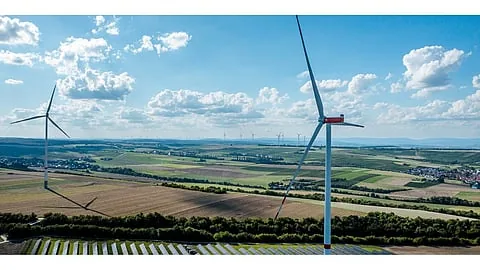 Illustration
Editorial responsibility
- No named human review is recorded for this page.
- Reports are grouped by semantic similarity and deterministic rules. Language models may assist titles, summaries, translation and cross-source analysis; the page reads the event directly, while its address stays stable when the title changes.
- Summary covers the current reports
Cross-source coverage
Common ground
- Germany's roadmap is a political document that signals intent but lacks a detailed technical plan to solve hard problems like grid congestion, industrial heat, and hydrogen costs.
- The roadmap is silent on key issues like climate finance, supply chain justice, and Germany's own fossil fuel financing abroad, which undermines its credibility.
- Building LNG terminals now while claiming a 2045 fossil fuel phase-out is a strategic contradiction that locks in gas imports for decades.
- Germany's permitting system is selective—fast-tracking LNG while slowing wind farms—revealing that bureaucracy serves strategic interests, not just democratic safeguards.
Points of contention
- One side argues the roadmap's main failure is strategic incompetence and engineering gaps, while the other says it's primarily a moral failure rooted in colonial entitlement and historical debt.
- There is disagreement on whether technical problems like grid congestion and industrial heat can be separated from historical and political choices, or if they are the same story.
- One side sees the roadmap as a necessary step despite flaws, while the other views it as a tool to maintain Germany's global position without real climate justice.
Blind spots
- The debate overlooks how Germany's roadmap affects specific regions in the Global South, such as Mozambique or Senegal, where German export credits fund fossil fuel projects.
- There is little discussion of the workforce and training needed for the transition, like the 500,000 additional electricians required for heat pump installations.
- The role of rare earth and lithium supply chains in the Congo and Chile, and their impact on local communities, is mentioned but not deeply explored.
WorldAttention’s read
Germany's roadmap is a necessary but flawed political document that fails on both technical and moral grounds. It sets ambitious targets like 80% renewable electricity by 2030 and a 2045 fossil fuel phase-out, but it lacks binding milestones, clear financing for the €760 billion needed, and solutions for industrial heat, grid congestion, and hydrogen costs. At the same time, it ignores climate finance, supply chain justice, and Germany's own fossil fuel investments abroad, like LNG terminals and export credits for coal plants in the Balkans. The real test isn't 2045—it's whether Germany can hit its 2030 goals while keeping the lights on and paying its debts to the Global South. Without addressing both the engineering gaps and the political choices behind them, this roadmap remains more of a press release than a credible plan.
Reporting timeline
Germany Accelerates Energy Transition, Aims to Phase Out Fossil Fuels by 2045
Germany has formally committed to phasing out fossil fuels by 2045, according to a government roadmap released Wednesday. The plan, announced by Environment Minister Carsten Schneider, sets specific targets: increasing renewable energy's share of electricity generation from 55% to 80% by 2030, adding 12 GW of onshore wind capacity, and achieving 215 GW of solar capacity by 2030. Germany also reaffirmed its coal phase-out by 2038, with a possible acceleration to 2035, and pledged to cut methane emissions by 30% by 2030 under the Global Methane Pledge. The roadmap comes amid ongoing debate over green policies and follows similar plans by France and the Netherlands. Former climate envoy Jennifer Morgan warned that the roadmap is only a starting line and must be paired with faster electrification of transport and heating. The announcement coincides with UN General Assembly discussions on climate action, where UN Secretary-General António Guterres has been a vocal advocate, though his term ends in December. The article notes that the UK has not yet published its phase-out plan and will assume the G20 presidency in December.
Read sourceGermany submits roadmap to phase out fossil fuels by 2045, targets 80% green power by 2030
On September 23, the German government submitted a fossil fuel exit roadmap at the UN General Assembly, becoming the third major economy after France and the Netherlands to do so. The roadmap commits Germany to phasing out fossil fuels by 2045. Environment Minister Carsten Schneider described it as both a climate and economic policy strategy, noting that Germany spent about 760 billion euros on fossil fuel imports in 2024, with 98% of oil, 95% of gas, and 100% of hard coal imported. The roadmap targets raising renewable electricity to at least 80% by 2030. In heating, heat pump sales rose 55% in 2025, capturing 48% of the market, and are forecast to exceed 70% of new systems. The Heating Planning Law requires at least 30% of heating networks to use renewables or unavoidable waste heat by 2030, rising to 80% by 2040 and full climate neutrality by 2045. In transport, pure electric passenger cars made up 32.4% of new registrations in 2025, with a target of 100% by 2035. Industry decarbonization will rely on electricity, hydrogen, efficiency, and carbon capture. Hydrogen demand is projected at 360-500 TWh by 2045. Schneider cited extreme weather and the Iran-regional situation driving oil and gas price spikes as underscoring the need to reduce fossil fuel dependence. The German Federal Environment Agency estimates renewables avoided about 265 million tonnes of greenhouse gas emissions in 2025, generating about 26 billion euros in economic benefits.
Germany Accelerates Energy Transition, Plans to Phase Out Fossil Fuels by 2045
Germany has committed to phasing out fossil fuels by 2045, according to a government roadmap published Wednesday. The plan, announced by the German government, sets specific targets including raising the share of renewable energy in electricity generation from 55% to 80% by 2030, adding 12 GW of onshore wind capacity, and achieving 215 GW of solar capacity by 2030. The roadmap also aims to increase electric vehicle adoption and leverage the EU emissions trading system to push industrial emitters away from fossil fuels. Germany reaffirmed its goal to phase out coal by 2038, with a possible acceleration to 2035, and to cut methane emissions by 30% by 2030. German Environment Minister Carsten Schneider cited the war in Ukraine and extreme weather events as underscoring the need for action. Former German climate envoy Jennifer Morgan warned that the roadmap is just a starting line and must be paired with faster green electrification. Germany is the third major developed economy, after France and the Netherlands, to publish such a plan. The announcement comes as world leaders meet at the UN General Assembly to discuss scaling up climate action.
Read sourceShow 2 older updatesHide older updates
Germany unveils roadmap to phase out fossil fuels by 2045 amid energy crisis
Germany has published a roadmap to gradually eliminate fossil fuels by 2045, aiming to reduce its vulnerability to global energy market shocks. The framework, released on Wednesday during the UN General Assembly and New York Climate Week, integrates existing policies and low-carbon technology strategies. German Environment Minister Steffi Lemke stated at a UN climate action event that the plan will significantly cut fossil fuel imports and reduce dependence on supply chains susceptible to geopolitical crises. Germany becomes the third major European economy, after France and the Netherlands, to adopt such a fossil fuel exit roadmap.
Germany Unveils Roadmap to Phase Out Fossil Fuels by 2045, Reducing Import Dependence
Germany has published a roadmap to gradually phase out fossil fuels by 2045, aiming to reduce its vulnerability to global energy market shocks. The framework, released by the German government on Wednesday, coincides with the United Nations General Assembly annual meeting and Climate Week in New York. It primarily consolidates existing policies and incorporates strategies using low-carbon technologies to demonstrate how Germany will achieve its 2045 target. German Environment Minister Schneider stated at a UN climate action event in New York that the plan will significantly reduce Germany's fossil fuel imports and lessen dependence on supply chains susceptible to geopolitical crises. With this move, Germany becomes the third major European economy, after France and the Netherlands, to establish a roadmap for exiting fossil fuels.
Read source