Ethiopia Accuses Eritrea of All-Out Invasion as Troops Cross into Tigray
Ethiopia has accused Eritrea of an "all-out invasion" of its northern Tigray region, saying Eritrean forces advanced up to 60km into Ethiopian territory to support Tigray People's Liberation Front (TPLF) rebels. Independent analyses estimate 5,000 to 8,000 Eritrean soldiers crossed the border, reaching Adigrat before Ethiopian drone strikes forced a withdrawal. Both governments have written to the UN Security Council accusing each other of aggression. The International Crisis Group warns the two neighbours are edging toward full-scale war, which could destabilise the Red Sea region.
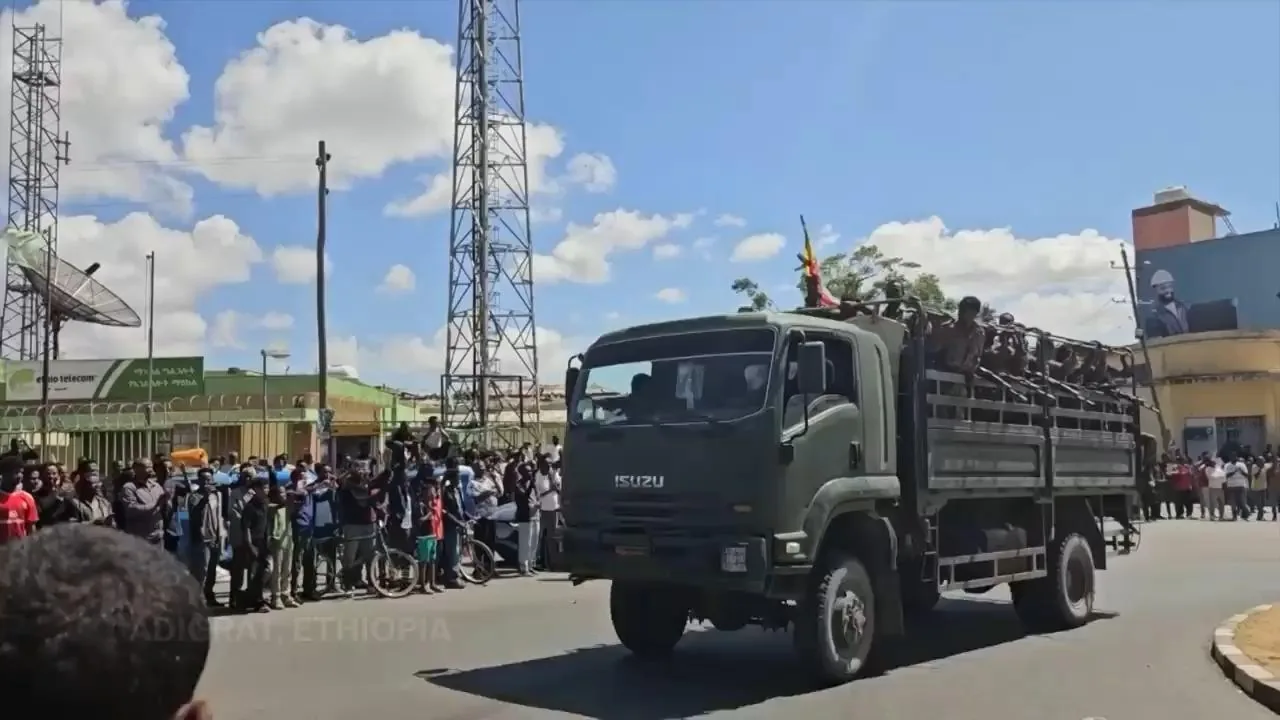 Reference image
Editorial responsibility
- No named human review is recorded for this page.
- Reports are grouped by semantic similarity and deterministic rules. Language models may assist titles, summaries, translation and cross-source analysis; the page reads the event directly, while its address stays stable when the title changes.
- Summary covers the current reports
Cross-source coverage
Common ground
- Both sides agree there is a serious accountability vacuum in the Horn of Africa, with documented atrocities going unpunished.
- Both agree that demanding evidence without demanding access to the ground is just a posture, not a real policy.
- Both agree that the fog of war benefits the parties who control the ground, and that naming who blocks access is a necessary first step.
- Both agree that the international community, especially the UN Security Council, has failed to act meaningfully.
- Both agree that ordinary Tigrayans are the ones suffering most, caught between two armies that have both brutalized them.
Points of contention
- The Western Agent argues that the accountability vacuum is reason enough to act now, while the Neutral Agent insists that this specific escalation must be independently verified first.
- The Western Agent sees Ethiopia's move to the UN as cheap cover, while the Neutral Agent says that reading needs to explain why Addis would invite scrutiny at all.
- The Neutral Agent warns that naming one side costs you neutrality, while the Western Agent says that cost is the price of doing anything honest.
- They disagree on whether pre-committing to what each possible finding would mean is useful discipline or a trap that enables endless waiting.
Blind spots
- Neither side spelled out what concrete consequences should follow if Addis and Asmara refuse to allow monitors or journalists in.
- Both focused on the two governments and the international system but said little about what regional bodies like the African Union could realistically do.
- Neither addressed how humanitarian aid or civilian protection could be delivered right now, even without verification.
- Both treated the TPLF mostly as a framing device rather than examining its current role, capacity, or responsibility.
- Neither explored what internal pressures inside Ethiopia or Eritrea might push their leaders toward or away from war.
WorldAttention’s read
This debate started as an argument about whether Eritrean troops crossed a border and ended as an argument about who gets to write the record when nobody can see the ground. Both participants agreed that the accountability vacuum is real, that demanding evidence without demanding access is empty, and that the fog of war benefits those who control the ground. They also agreed that ordinary Tigrayans are the ones paying the price. Where they split was on whether to act on the accountability vacuum now or wait for independent verification of this specific escalation. The Neutral Agent insisted that verification must come first and that naming sides has real costs. The Western Agent argued that waiting for monitors who will never be allowed in is itself a choice that favors the strong. In the end, both co-signed a demand for access that neither Addis nor Asmara is likely to honor, and neither said what should happen when they refuse. That is the honest failure of this conversation, and it mirrors the failure of the international system. The only certain thing is that the people caught between these armies will keep suffering while the rest of us argue about sourcing.
Reporting timeline
Crisis Group Warns Ethiopia and Eritrea Are Edging Toward Full-Scale War
An International Crisis Group analysis warns that Ethiopia and Eritrea are perilously close to all-out war after weeks of fighting between Ethiopia's federal government and the Tigray People's Liberation Front (TPLF), which rebelled on 23 September. Ethiopian forces captured Mekelle on 3 October and pushed north toward the Eritrean border, while Ethiopia accused Eritrea of deploying troops into northern Tigray to support the TPLF. Ethiopia expelled Eritrean diplomats on 1 October and severed ties; both sides exchanged letters to the UN Security Council, which is due to discuss the crisis on 13 October. The report says a full-scale war could draw in Sudan, Egypt, the UAE and Saudi Arabia and destabilise the Red Sea, and urges outside powers to press both sides to de-escalate and restore diplomatic relations.
Read sourceCrisis Group Warns Ethiopia and Eritrea Are Edging Toward Direct War
The International Crisis Group warns that Ethiopia and Eritrea are perilously close to all-out war after weeks of fighting between Ethiopia's federal government and the Tigray People's Liberation Front (TPLF), which rebelled on 23 September 2026. Ethiopian forces captured Mekelle on 3 October and pushed north toward Eritrea's border. Ethiopia accuses Eritrea of supporting the TPLF and deploying troops on Ethiopian soil, claims backed by media reports; Eritrea reportedly pulled forces back after drone strikes. Ethiopia expelled Eritrean diplomats on 1 October, severing ties. Both sides sent letters to the UN Security Council, which meets on 13 October. The Crisis Group urges Washington, Riyadh, Abu Dhabi and others to press both sides to avoid escalation, and calls for renewed African Union mediation on Tigray.
Ethiopia Accuses Eritrea of Incursion into Tigray as Conflict Widens
Ethiopia has accused Eritrea of sending troops across the border to support Tigrayan rebels, marking an international expansion of the conflict that began nearly three weeks ago. According to independent analyses, 5,000 to 8,000 Eritrean soldiers crossed into Tigray last week, advancing toward Mekelle before being stopped by Ethiopian drone strikes and withdrawing. Ethiopian forces have since retaken Adigrat. Both governments have written to the UN accusing each other of aggression, with Ethiopia citing self-defense and Eritrea alleging a planned invasion. The TPLF, which renewed its secession from Ethiopia in 2025, formed a rebel alliance on September 20 and launched attacks on September 23, but quickly lost ground. Analysts suggest Ethiopia's appeal to the UN signals restraint rather than full war, though fears of direct Ethiopia-Eritrea fighting are growing.
Show 2 older updatesHide older updates
Ethiopia Accuses Eritrea of Military Incursion into Tigray Region
Ethiopia has accused Eritrea of sending 5,000 to 8,000 troops across the border into the northern Tigray region to support the Tigray People's Liberation Front (TPLF) rebels, who renewed their uprising in September 2026. Eritrean forces reportedly advanced toward Mekelle and reached Adigrat before being stopped by Ethiopian drone strikes and withdrawing. Ethiopian troops have since retaken Adigrat. Both governments have written to the United Nations, with Ethiopia calling the incursion 'flagrant aggression' and Eritrea accusing Ethiopia of planning an invasion to seize the Eritrean port of Assab. UN Secretary-General António Guterres expressed deep concern. Analyst René Lefort suggested Ethiopia's appeal to the UN indicates a desire for restraint rather than full-scale war, though fears of direct Ethiopia-Eritrea conflict are growing.
Read sourceEthiopia warns Eritrea it will defend itself after Eritrean troops cross border into Tigray
Ethiopia has accused Eritrea of an 'all-out invasion' of its northern Tigray region, warning it will exercise its right to self-defense. In a letter to the UN Security Council, Ethiopian Foreign Minister Gedion Timothewos stated that Eritrean forces had advanced up to 60km into Tigray, calling it a 'blatant act of aggression.' Residents and the US-based conflict monitor ACLED reported Ethiopian drone strikes targeting Eritrean troops and ammunition in the Tigrayan town of Adigrat on Wednesday and Thursday, with some witnesses saying Eritrean forces appeared to be retreating north. Eritrean Information Minister Yemane Gebremeskel responded by accusing Ethiopia of an 'unprovoked war of aggression' and of working to bring about regime change in Eritrea. The fighting, which broke out two weeks ago between the Ethiopian government and the Tigray People's Liberation Front (TPLF), follows the severing of diplomatic ties last week and months of tension over Ethiopian Prime Minister Abiy Ahmed's ambition to take ownership of one of Eritrea's Red Sea ports.