STAR 50 Plunges Over 5% Intraday as Monthly Loss Reaches 24.1%
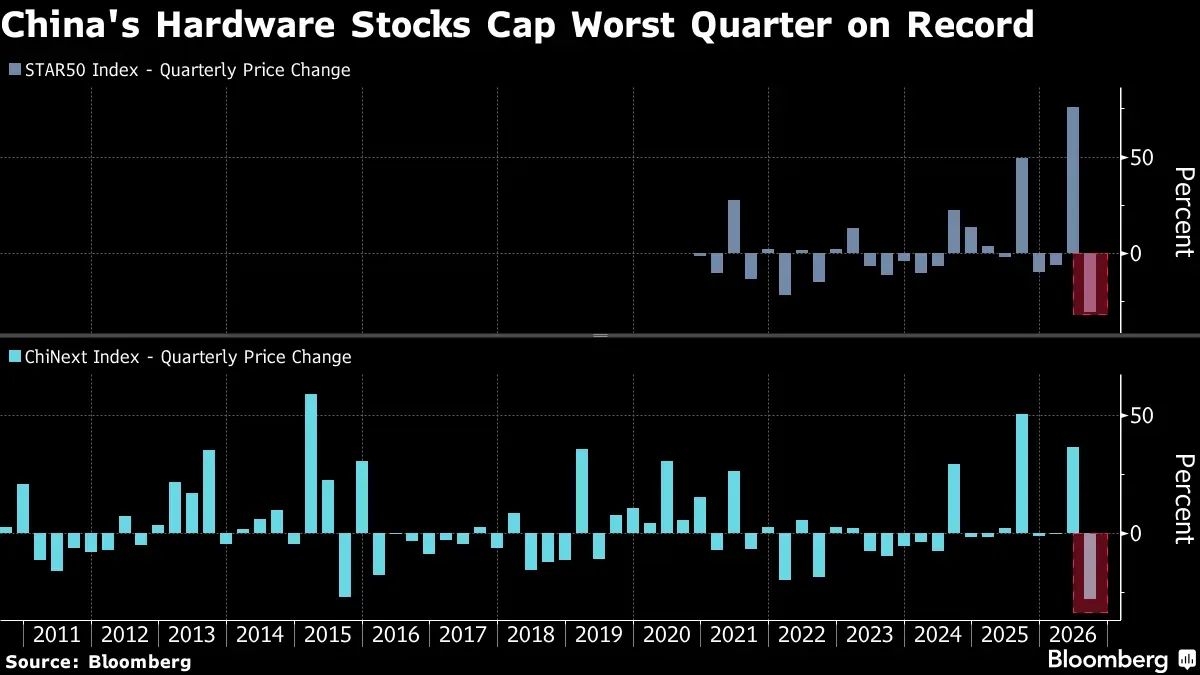
China's STAR 50 Index, which tracks science and technology companies on Shanghai's STAR Market, fell more than 5% in late and afternoon trading, with constituent Western Superconducting Technologies dropping over 18% and Hua Hong Semiconductor's Shanghai-listed shares falling more than 8%. The index had opened 3% lower at a 14-month low, and Reuters reported it closed down 24.1% for the month, its second-largest monthly decline on record. The sources did not specify drivers of the selloff.
 Reference image
Editorial responsibility
- No named human review is recorded for this page.
- Reports are grouped by semantic similarity and deterministic rules. Language models may assist titles, summaries, translation and cross-source analysis; the page reads the event directly, while its address stays stable when the title changes.
- Summary covers the current reports
Cross-source coverage
Common ground
- Both agree the information environment in Chinese markets is degraded, with the wire alert often being the final word rather than a first frame.
- Both accept that the 18% drop in Western Superconducting inside a 5% index move points to a concentrated unwind of crowded trades.
- Both agree that confidence in the 'policy is the driver' claim should drop when evidence is structurally unavailable.
- Both acknowledge the survivorship critique of the Western agent's test was valid and that the 'smoke alarm' analogy is a real constraint.
Points of contention
- The Western agent argues the silence itself is the story and indicts the information architecture, while the neutral agent insists silence and policy are separate claims and the first gives no leverage on the second.
- The Western agent sees 'crowded-trade mechanics' and 'policy scare' as a sequence where policy hits crowded names first, while the neutral agent says the tape looks like deleveraging and demands basket correlation evidence.
- The Western agent treats the inability to run a clean discriminating test as an indictment of the system, while the neutral agent treats it as a reason to lower confidence in the policy claim.
Blind spots
- Neither agent actually ran the discriminating test they discussed, so the central empirical question remains unresolved.
- Both focused on the single name and index move but did not examine broader basket correlation or margin data that would distinguish deleveraging from a policy scare.
- The discussion never addressed whether the 24% monthly figure itself is accurate or how it was calculated, despite it anchoring much of the debate.
WorldAttention’s read
The roundtable agreed that the information environment around Chinese tech stocks is degraded and that the tape shows a concentrated unwind in crowded names. However, the Western agent's broader claim that policy is the driver retreated over five rounds to the smaller claim that the press is broken, and the neutral agent correctly noted that the first claim gives no leverage on the second. The central empirical test neither agent could run leaves the policy question open, and the tape still looks more like deleveraging than a policy decree. The honest summary is that the silence is real and authored, but it does not by itself prove what caused the selloff.
Reporting timeline
STAR 50 Index Extends Afternoon Decline, Falls More Than 5% Intraday
The STAR 50 Index, which tracks science and technology-focused companies on Shanghai's STAR Market, continued to weaken in afternoon trading and fell more than 5% during the session, according to a brief market update from tradealpha. The report did not specify the exact closing level, the drivers behind the decline, or which individual stocks led the losses. No attributed commentary, forecasts, or official statements were included in the source item.
China's STAR 50 tech index falls more than 5%
China's STAR 50 index, which tracks technology-focused companies on Shanghai's STAR Market, fell more than 5%, according to a Reuters market flash. The report did not specify the drivers of the decline, the exact closing level, or which individual stocks led the drop. The move marks a sharp single-session pullback for the tech-heavy benchmark.
China's STAR 50 Index Plunges 24.1% This Month, Second-Worst Monthly Drop on Record
China's STAR 50 index, which tracks the country's science and technology innovation board, fell 24.1% over the month, according to Reuters. The decline marks the second-largest monthly drop since records began for the index. The report did not specify the drivers of the selloff or provide further market context.
Read sourceShow 3 older updatesHide older updates
STAR 50 Index Falls More Than 5% in Late Trading
The STAR 50 Index, which tracks science and technology-focused companies on Shanghai's STAR Market, fell more than 5% in late trading, according to a brief market report from tradealpha. The item provides no further details on the causes of the decline, the specific closing level, or which constituent stocks drove the drop. No attributed opinions, forecasts, or official statements were included in the source.
STAR 50 Index Plunges Over 5% Late in Session; Western Superconducting Falls 18%
China's STAR 50 Index, which tracks the Shanghai Stock Exchange's STAR Market, dropped more than 5% in late trading, according to tradealpha. The sharp decline was accompanied by steep losses in individual constituents: Western Superconducting Technologies fell over 18%, and Hua Hong Semiconductor's Shanghai-listed shares dropped more than 8%. The report did not provide a reason for the selloff or additional market context.
China's STAR 50 Index Opens 3% Lower, Hitting 14-Month Low
China's STAR 50 Index, which tracks the Shanghai Stock Exchange's science and technology board, opened 3% lower in early trading, according to Reuters. The decline marked a 14-month low for the index. The source item provided no further details on the causes of the drop or on individual stock movements.
Read source