PBOC reports 24.6% drop in China interbank lending, 14.8% fall in bond repo turnover
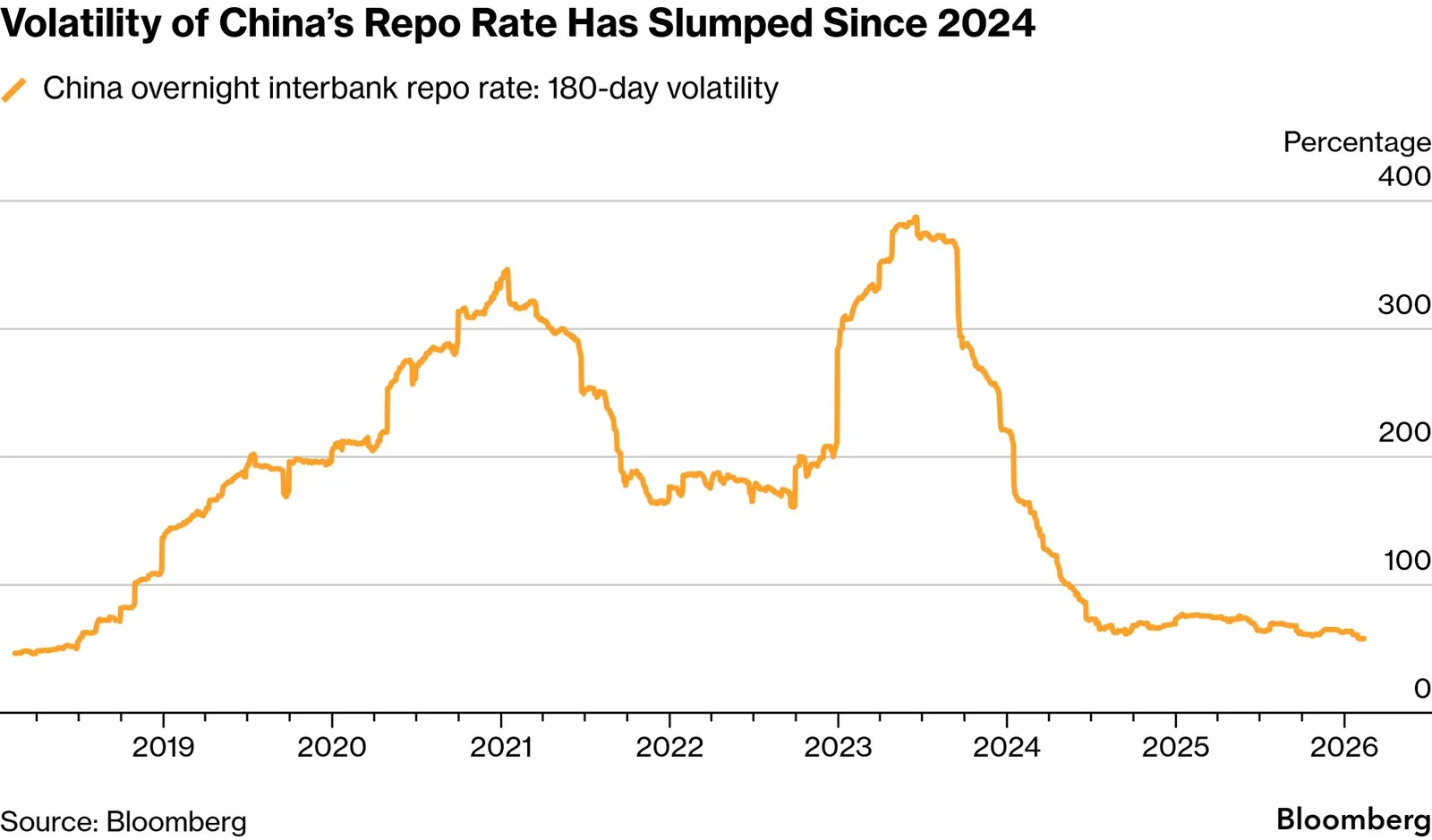
The People's Bank of China reported a sharp contraction in short-term liquidity activity for August 2026. Average daily interbank lending fell 24.6% year-on-year to 316.06 billion yuan, while bond repo turnover dropped 14.8% to 6.5 trillion yuan. Short-term interest rates edged down, with DR007 at 1.40%. Government bond net financing decreased, but corporate bond issuance rose. Gold trading surged, and stock indices gained despite lower trading volumes.
 Illustration
Editorial responsibility
- No named human review is recorded for this page.
- Reports are grouped by semantic similarity and deterministic rules. Language models may assist titles, summaries, translation and cross-source analysis; the page reads the event directly, while its address stays stable when the title changes.
- Summary covers the current reports
Cross-source coverage
Common ground
- Both sides agree that the drop in interbank lending and bond repo turnover does not signal a liquidity crisis, as short-term rates like DR001 and DR007 remain low and stable.
- There is agreement that the shadow banking cleanup in China is real and has reduced wealth management products significantly since 2020.
- Both acknowledge that some corporate bond issuance, especially in infrastructure and manufacturing, is funding new capital projects like high-speed rail and 5G networks.
Points of contention
- The Neutral Agent argues the lower volumes reflect weak demand from households and private enterprises, while the Eastern Agent insists it is deliberate policy calibration to shift credit toward productive sectors.
- The Neutral Agent sees banks sitting on reserves as precautionary hoarding due to unclear policy signals, but the Eastern Agent views it as coordinated balance sheet optimization following PBOC guidance.
- The Eastern Agent frames the interbank contraction as a sign of healthy maturation and strategic resilience, while the Neutral Agent warns it could mask a credit slowdown that threatens growth.
Blind spots
- Both sides overlook how the interbank data might be a lagging indicator, not fully capturing real-economy credit conditions or the impact of off-balance-sheet activity.
- The debate lacks a deep look at whether the 137 billion yuan corporate bond jump is truly funding new investment or just refinancing, despite the Eastern Agent's sectoral claims.
- Neither side fully addresses how global factors, like US rate hikes or geopolitical tensions, might be influencing China's domestic interbank behavior beyond de-dollarization.
WorldAttention’s read
The roundtable shows that while the drop in interbank volumes is not a liquidity crisis—given stable low rates—the real disagreement is about what it means. The Neutral Agent sees it as a warning of weak demand and cautious banks, while the Eastern Agent views it as a deliberate, successful shift toward productive lending and strategic stability. Both agree on some facts, like the shadow banking cleanup and targeted infrastructure bonds, but they interpret the same data differently based on their frameworks. The blind spots include whether the data fully captures real-economy credit flows and the role of global pressures. Ultimately, the system appears stable, but the debate leaves open whether that stability is masking a deeper slowdown or reflecting a well-managed transition.
Reporting timeline
China's Central Bank Reports August Financial Market Operations, Showing Mixed Trends
On September 21, the People's Bank of China (PBOC) released its report on financial market operations for August 2026. The report covers money, bond, derivatives, bill, gold, foreign exchange, and stock markets. In the money market, interbank lending and bond repo volumes fell year-on-year, while short-term interest rates (DR001, DR007, R001) edged down. Government bond net financing decreased, but corporate bond net financing rose. The bond market saw increased cash market turnover but a slight drop in turnover rate. The 10-year government bond yield stood at 1.69%, with the yield curve flattening. The derivatives market saw increased turnover, and the gold market experienced significant price and volume increases. The renminbi appreciated slightly against the US dollar. Stock indices rose, but daily trading volume fell. The report also detailed the holder structure of the interbank bond market, noting concentration among major institutions. The data provides a comprehensive snapshot of China's financial system activity for the month.
Read sourceChina's August interbank bond repo daily turnover falls 14.8% year-on-year to 6.5 trillion yuan
According to data released by the People's Bank of China (PBOC) on September 21, 2026, the daily average turnover of interbank bond repurchase agreements in August 2026 was 6.5 trillion yuan, a year-on-year decrease of 14.8%. The daily average turnover of interbank lending was 316.06 billion yuan, down 24.6% year-on-year. The report also showed that the Shanghai Composite Index closed at 3,986.3 points at the end of August, up 4.0% month-on-month, while the Shenzhen Component Index closed at 14,015.0 points, up 3.2%. The average daily turnover of the two stock markets was 2.24145 trillion yuan, down 16.5% month-on-month. In the bond market, net financing of government bonds was 1.00973 trillion yuan, a year-on-year decrease of 357.46 billion yuan, while net financing of corporate bonds was 271.25 billion yuan, an increase of 137.4 billion yuan. The total outstanding balance of the bond market reached 209.0 trillion yuan at the end of August. The report also covered derivatives, bills, gold, and foreign exchange markets, noting a 0.41% appreciation of the yuan against the US dollar and a 0.31% depreciation of the CFETS RMB index.
Read sourceChina Central Bank Reports 14.8% Drop in Interbank Bond Repo Daily Turnover
The People's Bank of China (PBOC) released financial market data for August 2026, showing a significant decline in interbank market activity. According to the report, the average daily turnover of interbank bond repurchase agreements fell to 6.5 trillion yuan, a decrease of 14.8% compared to the same period last year. Meanwhile, the average daily turnover of interbank lending dropped to 316.06 billion yuan, down 24.6% year-on-year. As of the end of August 2026, the outstanding balance of interbank lending stood at 0.9 trillion yuan, while the outstanding balance of interbank bond repurchase agreements was 9.6 trillion yuan. The data indicates a notable contraction in short-term liquidity activity within China's interbank market during the month.
Read sourceShow 2 older updatesHide older updates
China's August interbank lending volume falls 24.6% year-on-year, central bank data shows
The People's Bank of China (PBOC) released financial market data for August 2026, showing a significant contraction in interbank lending activity. The average daily turnover of interbank lending reached 316.06 billion yuan, a year-on-year decrease of 24.6%. Meanwhile, the average daily turnover of bond repurchase agreements in the interbank market was 6.5 trillion yuan, down 14.8% from the same period last year. As of the end of August, outstanding interbank lending stood at 0.9 trillion yuan, while outstanding bond repurchases totaled 9.6 trillion yuan. In terms of interest rates, the monthly weighted average rate for the deposit institution overnight pledged repo (DR001) was 1.38%, down 1 basis point month-on-month. The DR007 rate averaged 1.40%, down 3 basis points from July. The broader overnight pledged repo rate (R001) averaged 1.40%, down 2 basis points. The average daily spread between DR001 and the PBOC's 7-day reverse repo rate was -2 basis points, while the spread between R001 and DR001 averaged 2 basis points.
China's Interbank Lending Daily Average Falls 24.6% Year-on-Year in August 2026
According to data released by the People's Bank of China (PBOC) on September 21, 2026, and reported by Jin10, the daily average turnover of interbank lending in China reached 316.06 billion yuan in August 2026, a decrease of 24.6% compared to the same period last year. Meanwhile, the daily average turnover of bond repurchases in the interbank market was 6.5 trillion yuan, down 14.8% year-on-year. As of the end of August 2026, the outstanding balance of interbank lending stood at 0.9 trillion yuan, while the outstanding balance of bond repurchases in the interbank market was 9.6 trillion yuan. These figures indicate a significant contraction in short-term liquidity activity within China's banking system during the reported month.
Read source