Merz Faces Internal CDU Revolt After Historic State Election Defeat
German Chancellor Friedrich Merz faces mounting internal CDU criticism after the party failed to enter the Mecklenburg-Vorpommern state parliament for the first time and lost its majority in Berlin. Merz acknowledged a "deep caesura" but refused to resign. Hesse premier Boris Rhein reportedly called his post-election language "the empathy-free language of the 1990s." Merz caused further confusion with remarks on health insurance, which his spokesperson later clarified. The SPD pledged coalition loyalty but rejected planned social cuts.
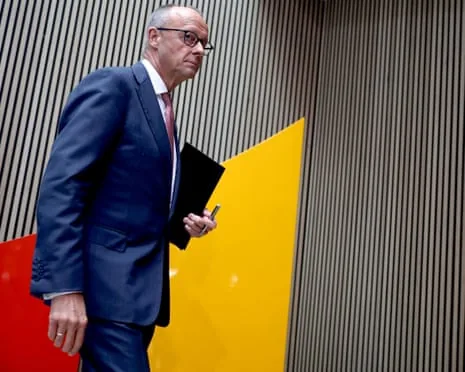 Reference image
Editorial responsibility
- No named human review is recorded for this page.
- Reports are grouped by semantic similarity and deterministic rules. Language models may assist titles, summaries, translation and cross-source analysis; the page reads the event directly, while its address stays stable when the title changes.
- Summary covers the current reports
Cross-source coverage
Reporting timeline
Wüst Asked If He Wants to Be Chancellor; Merz Clarifies Health Insurance Remarks
This live ticker from Die Welt covers key political developments in Germany on September 21, 2026, following state elections in Berlin and Mecklenburg-Vorpommern. NRW Minister-President Hendrik Wüst, often seen as a potential chancellor candidate, was asked directly if he wants to become chancellor. He replied that he wants to remain minister-president 'as far as it goes' and avoided commenting on whether he would hide Chancellor Friedrich Merz during the upcoming NRW election campaign. Chancellor Friedrich Merz caused confusion with remarks about reforming the private and public health insurance system, which his spokesperson later clarified as not a fundamental change but addressing perceived inequities. Internal CDU criticism of Merz emerged, with Hesse's Minister-President Boris Rhein reportedly calling his language 'the unempathetic language of the 1990s.' The CDU failed to re-enter the Mecklenburg-Vorpommern state parliament, leading to the resignation of state party leader Daniel Peters. A YouGov poll shows only a third of Germans still view the CDU as a people's party. Coalition negotiations are expected to begin in Berlin between the Left, Greens, and SPD.
Read sourceHesse premier Rhein reportedly criticizes Merz's 'empathy-free language of the 1990s' after election losses
According to reports from Stern and Spiegel, Hesse's Minister President Boris Rhein sharply criticized Chancellor Friedrich Merz during a CDU presidium meeting, calling his post-election statement 'the empathy-free language of the 1990s.' This comes after the CDU failed to enter the parliament in Mecklenburg-Vorpommern and lost its majority in Berlin. Meanwhile, confusion arose over Merz's remarks on health insurance; a spokesman clarified the chancellor does not plan to fundamentally change the dual public-private system, though Merz had signaled addressing perceived inequities. CDU state leader Daniel Peters resigned in Mecklenburg-Vorpommern. A YouGov poll shows only a third of Germans still view the CDU as a catch-all party. Foreign Minister Johann Wadephul urged coalition stability, while CSU's Klaus Holetschek rejected Merz's health insurance proposal. Berlin's Left party aims to start coalition talks with Greens and SPD next week.
Read sourceAfter State Election Debacle, Merz Tries to Steer Course, SPD Pledges Loyalty
Following the CDU's historic failure to pass the 5% threshold in Mecklenburg-Vorpommern's state election, German Chancellor Friedrich Merz (CDU) acknowledged a 'deep caesura' but refused to resign as chancellor or party leader. He announced a period of self-reflection for the CDU on its profile and program, despite having adopted a new, rightward-shifting platform in 2024. The SPD, led by Lars Klingbeil and Bärbel Bas, pledged to maintain the coalition but rejected Merz's planned social cuts, calling for a 'reality and fairness check' on reforms. Manuela Schwesig (SPD), the successful state premier, criticized Merz for misreading the situation and deflecting blame. Merz, in turn, thanked the SPD for its loyalty and acknowledged public perceptions of injustice, citing the dual public-private health insurance system as a problem. Internal party voices, such as Stefan Nacke (CDU) and Hakan Demir (SPD), called for the CDU to become a broader 'people's party' and for the SPD to move left, respectively. Merz also reiterated plans for a federal law against housing expropriation.
Show 6 older updatesHide older updates
Merz Makes Next Blunder as His CDU Fears for 'Survival' After Election Debacle
On the first day following the CDU's worst electoral defeat, German Chancellor Friedrich Merz has caused confusion and irritation with remarks about health insurance. The article, published by Die Welt on September 21, 2026, reports that the gaffe further undermines Merz's authority within the Union parties. The CDU is described as concerned about its 'survival' in the wake of the election debacle. The reactions from within the party highlight the precarious state of Merz's leadership and the internal turmoil facing the conservative bloc.
Read sourceRoland Koch Says Merz Is the Right Man for the Time, Urges CDU Firmness
In an article published by Die Welt on September 21, 2026, former CDU politician Roland Koch voiced strong support for Chancellor Merz amid ongoing discussions about his political future. Koch stated unequivocally that 'personnel changes bring nothing here,' dismissing calls for a leadership change within the party. He argued that the CDU must remain steadfast in the coalition government, particularly in the area of economic policy. The comments come after recent state elections, which have apparently fueled debate about Merz's leadership. Koch's intervention is a clear signal of support for the current chancellor from a prominent party elder, urging the CDU to maintain its course rather than entertain internal upheaval. The article presents Koch's perspective as a defense of Merz's position and a call for party unity and policy consistency.
Merz Aims to Stay in Lead with Trump Card as Centrifugal Forces Grow in CDU
According to an article in Die Welt, German Chancellor Friedrich Merz (CDU) is facing growing centrifugal forces within his party following a double electoral defeat. The article states that Merz has made it clear that a rebellion within the CDU's own ranks has been called off, despite simmering discontent in the Union parliamentary group. The report notes that Merz can exploit an advantage, described as a 'trump card,' to maintain his leadership position. The situation highlights internal party tensions and Merz's strategy to stay at the helm amid the fallout from the election losses.
Read sourceHistorian says Merz can overcome crisis through bold leadership, minority government an option
In an article for Die Welt, historian Andreas Rödder argues that German Chancellor Friedrich Merz (CDU) has the opportunity to become a chancellor of long-term significance. Rödder states that Merz can free himself from his 'existential crisis' through 'courageous leadership.' The historian suggests that forming a minority government must be considered as an option, because Germany faces a 'historic task' that requires decisive action. The commentary frames the current political situation as a critical moment for Merz to demonstrate bold leadership and secure his legacy.
CDU Member Warns Merz: Those Who Do Not Implement Agreed Reform Agenda Will Be Removed
In a guest contribution for Die Welt, CDU member Baha Jamous warns that Chancellor Friedrich Merz has been lulled into complacency by a political apparatus focused solely on managing the status quo. Jamous argues that Merz still has a last chance to act decisively. The article, published on September 15, 2026, asserts that individuals who do not implement the agreed-upon reform agenda will be removed. The piece reflects internal party criticism of Merz's leadership and calls for a more aggressive push for reforms rather than maintaining the current political equilibrium.
Read sourceCommentary: Merz Faces His 'Schröder Moment' on Reforms, Author Argues
In a guest commentary for WELT, author Harald Christ draws a direct parallel between former German Chancellor Gerhard Schröder's risky Agenda 2010 reforms and the current political situation facing CDU leader Friedrich Merz. The article argues that Schröder risked his majority, his party, and ultimately his office by pushing through difficult economic reforms. Christ asserts that Merz must now dare to do the same, implying that the current political leader needs to take similarly bold and potentially unpopular actions to address Germany's challenges. The piece frames this as a critical moment for Merz, suggesting that his political future and the success of his agenda depend on his willingness to take such a risk.