BYD Plans Three Assembly Plants and One Battery Factory in Europe, Adviser Says
BYD's European adviser Alfredo Altavilla stated on September 16 in Turin that the company will need three vehicle assembly plants and one battery factory in Europe to support growth and comply with EU local content rules. BYD's first European plant in Hungary is in initial production, and a second site in Spain or France is expected by year-end 2026. BYD prefers acquiring and retrofitting existing facilities.
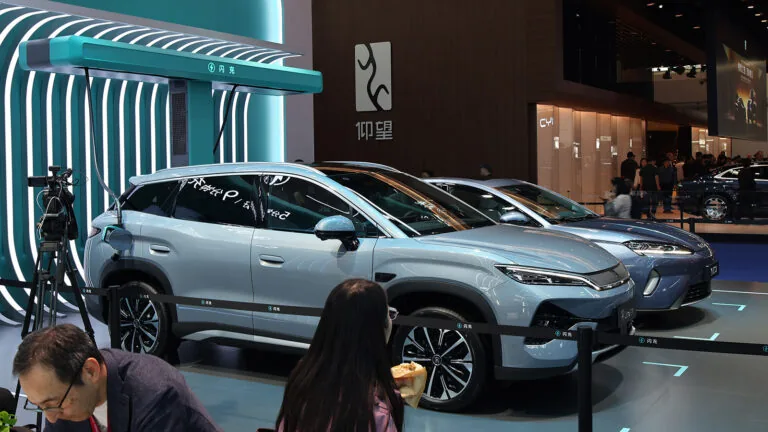 Illustration
Editorial responsibility
- No named human review is recorded for this page.
- Reports are grouped by semantic similarity and deterministic rules. Language models may assist titles, summaries, translation and cross-source analysis; the page reads the event directly, while its address stays stable when the title changes.
- Summary covers the current reports
Cross-source coverage
Common ground
- BYD is rapidly building factories in Europe to get ahead of upcoming EU local content rules.
- European automakers have lost the technology race to Chinese EV makers like BYD.
- The battery supply chain is the real strategic leverage point, not just assembly plants.
- European governments failed to invest in their own EV industry over the past fifteen years.
- Workers in struggling industrial towns see BYD's investment as a lifeline for jobs.
Points of contention
- Whether EU local content rules are necessary protectionism or a hypocritical double standard against free trade.
- Whether Chinese state support for BYD is fundamentally different from European subsidies for automakers.
- Whether BYD's factory acquisitions are a strategic threat to European autonomy or a market-driven solution.
- Whether European subsidies are more democratically accountable than Chinese industrial policy.
- Whether the risk of Chinese geopolitical leverage (like in Piraeus) applies to BYD's consumer auto factories.
Blind spots
- The debate largely ignored the long-term impact on workers' rights and union organizing under Chinese management.
- No one fully addressed how European consumers' demand for affordable EVs drives the market dynamics.
- The possibility of technology transfer or joint ventures as a middle ground was not explored.
- The role of other Chinese automakers (like SAIC or Geely) in Europe was barely mentioned.
WorldAttention’s read
All three viewpoints agree that BYD's European factory push is a direct response to EU tariffs and local content rules, and that European automakers have already lost the technology race. The Western Agent warns this is a strategic penetration that undermines European democratic oversight and worker rights, citing examples like Piraeus. The Neutral Agent focuses on the battery supply chain as the real leverage point, arguing BYD's superior technology makes regulatory walls futile. The Regional Agent highlights the hypocrisy of European trade policy and the desperate need of workers in abandoned industrial towns. The core tragedy is that European governments failed to build a competitive EV industry for fifteen years, leaving workers with a painful choice between slow decline and Chinese-controlled jobs. No one fully resolved whether this investment is a lifeline or a long-term threat to European autonomy.
Reporting timeline
BYD Plans Three European Assembly Plants and One Battery Factory, Advisor Says
BYD Europe advisor Alfredo Altavilla, a former Fiat Chrysler executive, revealed that BYD plans to build three vehicle assembly plants and one battery factory in Europe, preferring to acquire and retrofit existing facilities to accelerate local production. Altavilla stated that Spain and France are the most feasible locations for the second passenger car plant, with a decision expected by year-end. The battery factory is seen as critical to comply with the EU's Industrial Accelerator Act (IAA), which requires that battery cells and three key components be produced in Europe within six months of the act's effect, and five EU-origin components within three years, to qualify as 'EU Made'. BYD's European sales reached nearly 188,000 vehicles in 2025, up 270% year-on-year, and overseas revenue surpassed domestic revenue for the first time in the first half of 2026. The company's Hungarian plant in Szeged is in trial production, while a planned Turkish factory has been搁置 due to uncertainty over EU trade rules and local battery supply chain gaps. Altavilla noted that Italy is a 'Plan B' as it currently lacks competitive conditions.
BYD Plans Three European Assembly Plants and One Battery Factory, Adviser Says
BYD is expanding its European production footprint beyond its upcoming Hungarian factory. Alfredo Altavilla, BYD's special adviser for Europe, stated on September 16 in Turin that the company needs three vehicle assembly plants and one battery plant in Europe to support growth and comply with local regulations. The first factory in Szeged, Hungary, is entering the production startup phase. Altavilla said the second plant's location will be chosen by the end of 2026, with a preference for acquiring and retrofitting an existing facility. France and Spain are the most viable options, with Italy as a backup. He noted that suitable Italian factories are not currently for sale. BYD has been in talks with Stellantis and other European automakers about purchasing underutilized plants. The company's executive vice president, Li Ke, confirmed in June 2025 that the Hungarian plant is the priority and that work on a Turkish factory has been paused. The article also reviews the capacity and plans of several Spanish factories, noting that no public deal with BYD has been announced.
BYD plans four factories in Europe as core hubs for regional expansion, advisor says
Chinese electric vehicle manufacturer BYD Co., Ltd. plans to build four factories in Europe over the long term, according to Alfredo Altavilla, a former Fiat Chrysler executive who now advises BYD's European business. Speaking at an event in Turin on Wednesday evening, Altavilla revealed the company intends to construct three vehicle assembly plants and one electric vehicle battery plant in Europe. He stated that while this is not an immediate short-term implementation, it is necessary to achieve sales targets and comply with gradually introduced EU regulations on domestic manufacturing. BYD is currently in discussions with European automakers and national governments regarding the potential acquisition of underutilized idle factories in countries such as France, Spain, and Italy. The move aims to attract more consumers and meet local manufacturing requirements.
Read sourceShow 2 older updatesHide older updates
Chinese automakers scour Europe for factories ahead of EU local content rules, says BYD adviser
Chinese automakers are actively searching for existing car assembly plants in Europe to acquire and refurbish, anticipating upcoming EU local content rules that will set minimum local content limits for electric vehicles sold in the bloc. BYD's European adviser, Alfredo Altavilla, told Reuters that he frequently encounters rival executives in airport lounges on the same mission. Altavilla identified Spain and France as the 'most actionable' options for BYD due to simpler situations, while Italy has become a 'plan B' because Stellantis is unwilling to sell any plants. BYD, which prefers to buy, fully own, and refurbish an existing factory, is in the initial stage of production at its first European passenger car plant in Hungary and expects to select a site for a second facility by the end of the year. Altavilla stated that BYD would eventually need three assembly plants and one battery plant in Europe to support growth and meet EU rules.
BYD special advisor says automaker will need three assembly plants and one battery plant in Europe
Alfredo Altavilla, a special advisor to Chinese automaker BYD, stated on September 16 in Turin, Italy, that the company will ultimately need to build three complete vehicle assembly plants and one battery plant in Europe to support its growth plans and comply with EU regulations. BYD is currently starting production at its first European factory in Hungary and expects to decide on the location of its second manufacturing base by the end of this year. Altavilla noted that the company prefers to acquire and renovate existing facilities rather than build new factories from scratch, with Spain and France among its priority locations. He emphasized that this expansion will not happen overnight but is necessary to achieve the company's volume targets while adhering to European regulations.