US Mk 48 torpedo launched from Royal Navy unmanned sub in historic AUKUS test
On September 13, 2026, the U.S. and U.K. successfully test-launched a U.S. Mk 48 Heavyweight Torpedo from the Royal Navy's experimental extra-large unmanned underwater vehicle (XLUUV) XV Excalibur at the British Underwater Test & Evaluation Centre in Scotland. The trial, conducted under AUKUS Pillar 2, validated the mechanical, electrical, and software integration of a U.S. kinetic payload onto an allied autonomous vessel, marking a historic first for allied undersea warfare.
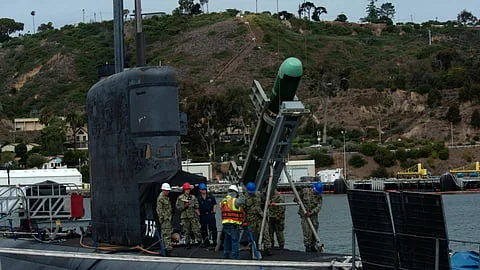 Reference image
Editorial responsibility
- No named human review is recorded for this page.
- Reports are grouped by semantic similarity and deterministic rules. Language models may assist titles, summaries, translation and cross-source analysis; the page reads the event directly, while its address stays stable when the title changes.
- Summary covers the current reports
Cross-source coverage
Reporting timeline
U.S. and U.K. Test Launch Torpedo from Royal Navy Unmanned Submarine for AUKUS
On September 13, the U.S. and U.K. successfully test launched a U.S. Mk 48 Heavyweight Torpedo from the Royal Navy's experimental extra-large unmanned underwater vehicle (XLUUV), XV Excalibur, at the British Underwater Test & Evaluation Centre in Scotland. The U.S. Navy announced the event on Tuesday, describing it as a proof of concept trial under AUKUS Pillar 2, specifically under Project Broadsword and Trial Iron. The milestone validated the mechanical, electrical, and software integration of the U.S. torpedo with the British unmanned submarine, marking a major operational achievement for the AUKUS partnership. The test demonstrates progress in integrating advanced undersea warfare capabilities between the two allies.
Read sourceU.S. and U.K. Test Launch Torpedo from Royal Navy Unmanned Submarine for AUKUS Pillar 2
The U.S. and U.K. successfully test launched a U.S. Mk 48 Heavyweight Torpedo from a Royal Navy extra-large unmanned underwater vehicle (XLUUV) on September 13, as announced by the U.S. Navy on Tuesday. The trial, conducted at the British Underwater Test & Evaluation Centre in Scotland under Project Broadsword and Trial Iron, marks a major operational achievement for AUKUS Pillar 2. The event validated the mechanical, electrical, and software integration of the U.S. torpedo with the Royal Navy's experimental XLUUV, XV Excalibur. This proof-of-concept trial demonstrates progress in allied unmanned underwater warfare capabilities and deepens defense technology cooperation under the AUKUS pact.
Read sourceU.S. and U.K. Test Launch Torpedo from Royal Navy Unmanned Submarine in AUKUS Pillar 2 Trial
The U.S. and U.K. successfully test launched a U.S. Mk 48 Heavyweight Torpedo from the Royal Navy's experimental extra-large unmanned underwater vehicle (XLUUV) XV Excalibur on September 13, according to a U.S. Navy announcement on Tuesday. The launch took place at the British Underwater Test & Evaluation Centre in Scotland. The milestone was achieved under Project Broadsword and Trial Iron, and marks a major operational achievement for AUKUS Pillar 2. The event validated the mechanical, electrical and software integration of the U.S. torpedo with the British unmanned submarine, demonstrating a proof of concept for integrating advanced undersea capabilities between the two allies under the AUKUS security pact.
Read sourceShow 3 older updatesHide older updates
Royal Navy launches US Mk 48 torpedo from uncrewed submersible in AUKUS trial
On September 13, 2026, the Royal Navy successfully launched a U.S. Navy Mk 48 Heavyweight Torpedo from a British Excalibur uncrewed underwater vehicle (UUV) at the British Underwater Test & Evaluation Centre in Scotland. This test, conducted under AUKUS Pillar 2, marks a significant step toward allied operational fleets of uncrewed vehicles and validates the mechanical, electrical, and software integration of a U.S. kinetic payload onto an allied autonomous vessel. Adm. Daryl Caudle, Chief of Naval Operations, called it 'a historic first for allied undersea warfare,' proving 'true interchangeability.' The Mk 48 MOD 7 torpedo, optimized for traditional and emerging missions, was launched from a cradle attached to the hull of the 40-foot Excalibur UUV, as the submersible lacks torpedo tubes. The test is a proof of concept, with follow-on acceleration under Project CUTLASS planned using the Anduril Dive-XL platform to further mature uncrewed undersea capabilities.
Read sourceRoyal Navy launches US Mk 48 torpedo from uncrewed submersible in AUKUS trial
On September 13, 2026, the Royal Navy successfully launched a U.S. Navy Mk 48 Heavyweight Torpedo from the British Excalibur uncrewed underwater vehicle (UUV) at the British Underwater Test & Evaluation Centre in Scotland. This test, conducted under AUKUS Pillar 2, marks a historic first for allied undersea warfare, validating the mechanical, electrical, and software integration of a U.S. kinetic payload onto an allied autonomous vessel. Adm. Daryl Caudle, Chief of Naval Operations, stated that the test proves 'true interchangeability' and increases the flexibility and combat power of combined forces. The Mk 48 MOD 7 torpedo, optimized for traditional and emerging missions, was launched from a cradle attached to the hull of the 40-foot Excalibur, as the UUV lacks torpedo tubes. This proof of concept is the first step under AUKUS Pillar 2, with follow-on acceleration under Project CUTLASS using the Anduril Dive-XL platform to further mature uncrewed undersea capabilities.
Royal Navy launches US Mk 48 torpedo from uncrewed submersible in AUKUS test
On September 13, 2026, the Royal Navy successfully launched a U.S. Navy Mk 48 Heavyweight Torpedo from a British Excalibur uncrewed underwater vehicle (UUV) at the British Underwater Test & Evaluation Centre in Scotland. The test, conducted under AUKUS Pillar 2, validated the mechanical, electrical, and software integration of a U.S. kinetic payload onto an allied autonomous vessel, demonstrating weapon interchangeability. Adm. Daryl Caudle, Chief of Naval Operations, called it 'a historic first for allied undersea warfare,' stating it validates a shared vision for true interchangeability and increases combat power. The Mk 48 MOD 7 torpedo, optimized for traditional and emerging missions, was launched from a cradle attached to the hull of the 40-foot Excalibur, which lacks torpedo tubes. The proof of concept is the first step, with follow-on acceleration under Project CUTLASS using the Anduril Dive-XL platform to mature uncrewed undersea capabilities.