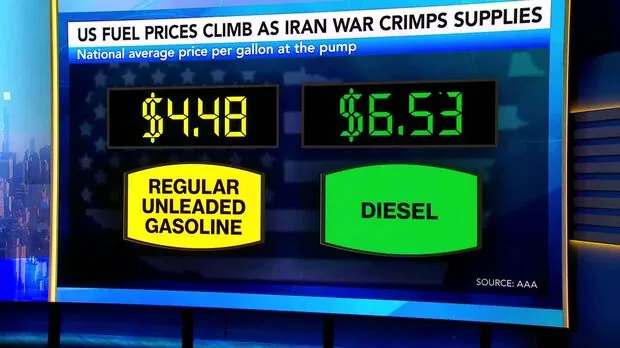
Trump backs diesel export ban as US prices hit record $6.53 per gallon
President Donald Trump has voiced support for banning US diesel exports to combat record-high domestic prices of $6.53 per gallon, a 70% year-on-year increase. Treasury Secretary Scott Bessent confirmed the administration is evaluating a full or partial ban. The proposal has divided the White House, with Energy Secretary Chris Wright and Interior Secretary Doug Burgum opposing it. Analysts warn of temporary price relief but long-term economic harm. The policy could be enacted via executive order under the International Emergency Economic Powers Act.
 Illustration
Editorial responsibility
- No named human review is recorded for this page.
- Reports are grouped by semantic similarity and deterministic rules. Language models may assist titles, summaries, translation and cross-source analysis; the page reads the event directly, while its address stays stable when the title changes.
- Summary covers the current reports
Cross-source coverage
Common ground
- Both agree the diesel export ban is a bad policy that could backfire economically and geopolitically.
- Both recognize the ban is driven by short-term political panic ahead of midterms, not sound strategy.
- Both acknowledge the US has a history of using energy policy for domestic political gain, not just under Trump.
- Both see the ban as self-defeating when combined with bombing Iranian refineries, as it reduces global supply while blocking US exports.
Points of contention
- Western Agent sees the ban as a deliberate betrayal of allies and a destruction of US credibility, while Neutral Agent frames it as clumsy, self-sabotaging policy rather than a moral crisis.
- Western Agent argues the damage to trust will have long-term geopolitical costs, while Neutral Agent insists the real harm is to US refiners' market share and investment stability.
- Neutral Agent says the rules-based order was already a fiction, but Western Agent counters that breaking promises to allies is different from past strategic hypocrisy.
- Western Agent claims the ban threatens the dollar's reserve status over time, while Neutral Agent calls that an overreach and says the dollar's dominance depends on other factors.
Blind spots
- Neither fully addresses the impact on Latin American countries like Brazil and Chile, which rely heavily on US diesel imports.
- Both overlook the strategic irony of banning exports while destroying enemy supply, which actually helps Iran by raising global diesel prices.
- The debate misses how the 24-month electoral cycle makes long-term energy policy impossible for any administration, not just Trump's.
WorldAttention’s read
The diesel export ban is a short-sighted, politically driven policy that risks harming US refiners, allies, and global market stability. While Western Agent emphasizes the moral and credibility costs of breaking promises to allies, Neutral Agent focuses on the economic self-harm and historical precedent of similar bans. Both agree the ban is self-defeating, especially alongside military actions that reduce global supply. The deeper issue neither fully resolves is that US energy policy is trapped by electoral cycles, making long-term commitments unreliable regardless of who is in power. The real cost may not be immediate but will show up over years as allies diversify and US refining investment stalls.
Reporting timeline
Trump Backs Diesel Export Ban as US Prices Hit Record, Threatening Refinery Stocks
Former President Donald Trump announced support for a diesel export ban, citing record-high US diesel prices of $6.53 per gallon, up over 70% year-on-year. Treasury Secretary Scott Bessent confirmed the government is evaluating a full or partial ban. The shift marks a reversal from Trump's previous free-market stance and comes amid political pressure ahead of the November midterm elections, with Republican lawmakers citing harm to farmers and consumers. The proposal has divided the White House: Energy Secretary Chris Wright warned of product gluts and refinery cutbacks, while Interior Secretary Doug Burgum cautioned against retaliatory measures from energy exporters. Analysts warn a ban could end the historic rally in refinery margins and stock prices, with Jefferies downgrading Valero Energy and Marathon Petroleum. Global impacts would be severe, as US diesel exports to Europe have surged nearly 50% since the Iran war began in February. The policy path remains unclear, with options including legislative or executive action under the Emergency Powers Act.
Read sourceTrump Backs Diesel Export Ban as US Prices Hit Record; Analysts Warn of Gasoline Supply Risk
US diesel prices have reached a record high of $6.53 per gallon, prompting President Donald Trump to voice support for a diesel export ban during a meeting with Ukrainian President Volodymyr Zelenskyy. Trump stated he is encouraging his staff to back the ban, aiming to lower domestic fuel costs ahead of midterm elections. However, analysts and officials warn the move could backfire. Energy Secretary Chris Wright and Interior Secretary Doug Burgum oppose the ban, arguing it would reduce refinery runs and gasoline output. Rapidan Energy President Bob McNally called diesel the economy's 'real lifeblood,' while GasBuddy analyst Patrick De Haan described record prices as a 'silent killer' for the economy, adding that Americans now spend $700 million more per day on fuel than a year ago. The article notes that Middle East supply losses from the US-Iran war have removed more diesel from global markets than the Russia-Ukraine conflict, with an average daily loss of 770,000 barrels from March to August versus 350,000 barrels from Russia. US refiners, including Marathon Petroleum, Valero, and ExxonMobil, posted combined profits of $24.7 billion in Q2, operating near full capacity.
Read sourceTrump backs ban on diesel exports as fuel prices hit record highs
Former President Donald Trump has expressed support for a ban on diesel exports from the United States, according to multiple news reports aggregated by Google News. The announcement comes as diesel fuel prices reach record highs at the pump, putting financial pressure on consumers and industries. The Trump administration is reportedly examining the feasibility of such a ban, as stated by the Treasury Secretary. The proposal aims to keep more diesel fuel within the domestic market to lower prices for American consumers. However, the feasibility and potential economic consequences of an export ban are under review, with questions about its impact on global supply chains and domestic refinery operations. The story is covered by outlets including Axios, CNBC, The Globe and Mail, BBC, and The Washington Post, indicating broad interest in the policy proposal.
Read sourceShow 3 older updatesHide older updates
Donald Trump says he would back US diesel export ban to lower fuel prices
Former President Donald Trump has stated he would support a ban on US diesel exports, according to multiple news reports including the Financial Times, Axios, and the Wall Street Journal. The proposal comes amid soaring fuel prices and is aimed at increasing domestic supply to lower costs for American consumers. The reported stance has already created a split among Republican senators, with some supporting the idea as a way to address affordability and others opposing it as government overreach. Separately, Representative Tim Burchett has introduced two bills in the House to address fuel affordability. The development signals a potential major shift in US energy policy if Trump were to return to office, though the exact details and timeline of any potential ban remain unspecified.
Read sourceTrump says administration is weighing diesel export restrictions to curb prices
President Donald Trump said on September 22, 2026, that his administration is considering diesel export restrictions as a tool to combat soaring diesel prices, which have become a major midterm election issue for Republicans. Speaking at the UN General Assembly, Trump stated he personally supports the idea but noted no consensus has been reached. Treasury Secretary Scott Bessent confirmed the administration is studying the feasibility of a full or partial ban. The White House could impose restrictions under the International Emergency Economic Powers Act without congressional approval. The proposal faces opposition from the oil industry and Gulf Coast lawmakers, who argue it would harm refining capacity and global standing. Analysts, including former Bush adviser Bob McNally, predict any price relief would be temporary and localized, potentially raising prices in the Northeast and West Coast. Republican senators in tight races, such as Dan Sullivan of Alaska and Chuck Grassley of Iowa, have called for a temporary ban to help farmers and consumers ahead of winter.
Read sourceTrump administration examines feasibility of diesel export ban to lower prices
The Trump administration is examining whether a diesel export ban is feasible, according to Treasury Secretary Scott Bessent, as reported by CNBC. President Donald Trump has stated he supports banning diesel exports to bring down domestic fuel prices, which have soared. The Wall Street Journal reports that Trump is weighing a diesel export ban as fuel prices rise. Representative Tim Burchett has introduced two bills in the House to address fuel affordability. However, CNN warns that such a ban could have a 'boomerang' effect on the US, potentially causing unintended consequences for the domestic market and international relations. The feasibility study is in its early stages, and no final decision has been made.
Read source