UK gilt yields diverge: 30-year drops sharply while 10-year rises to 5.34%
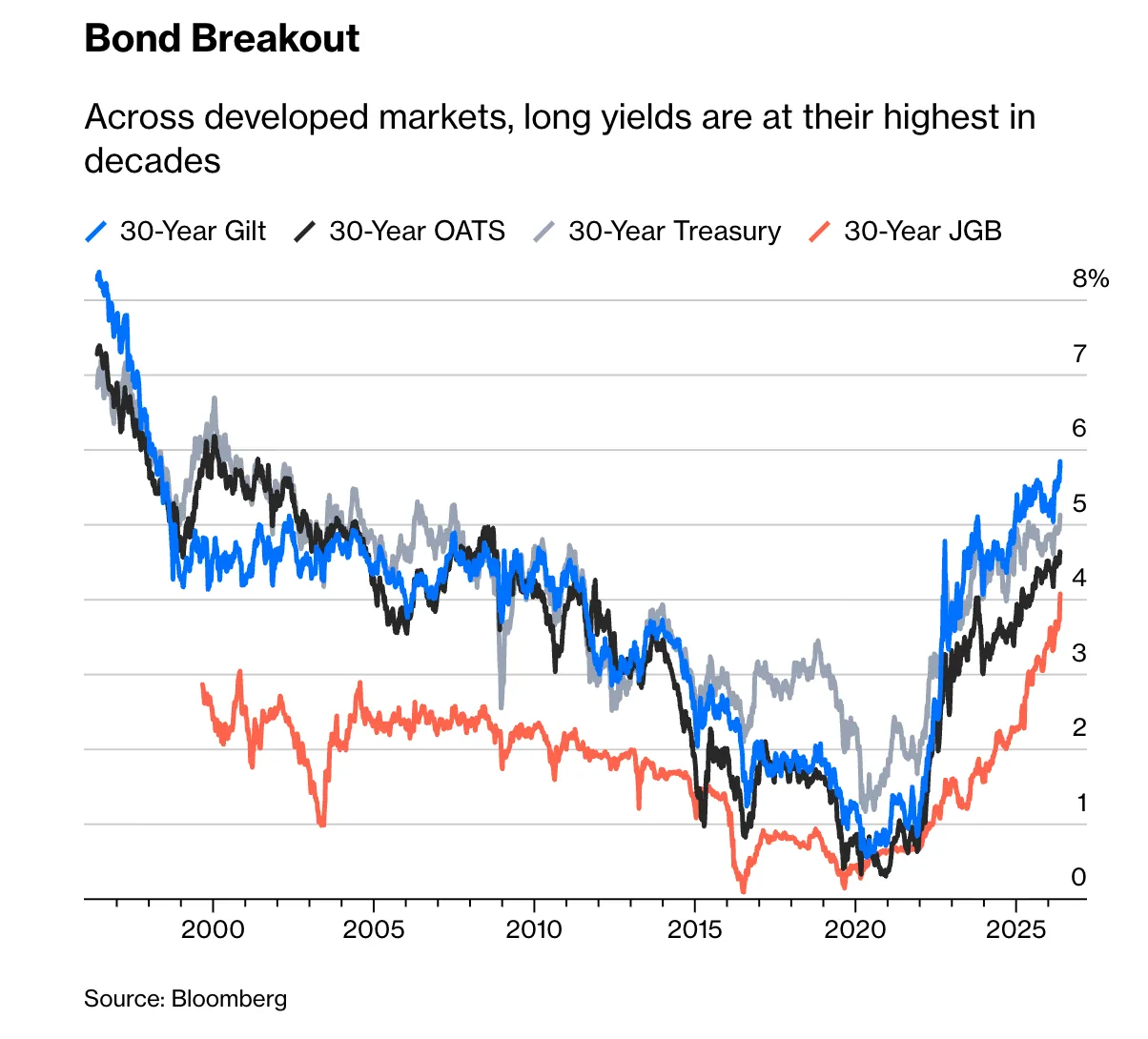
UK government bonds showed mixed movements in September. On September 17, the 30-year gilt yield fell by 10-11 basis points to as low as 5.728%, its largest single-day drop since May. However, by September 23, the 10-year yield rose 10 basis points to 5.34%, extending a broader decline in bond prices. No specific catalyst was identified for either move.
 Illustration
Editorial responsibility
- No named human review is recorded for this page.
- Reports are grouped by semantic similarity and deterministic rules. Language models may assist titles, summaries, translation and cross-source analysis; the page reads the event directly, while its address stays stable when the title changes.
- Summary covers the current reports
Cross-source coverage
Common ground
- Both agree the yield curve steepening—10-year yields rising while 30-year yields fall—is a real market signal worth analyzing.
- Both acknowledge the UK has serious economic problems, including austerity, Brexit fallout, and a cost-of-living crisis.
- Both agree the Bank of England has a credibility problem in managing inflation and growth.
- Both recognize that the Treasury is likely to waste lower long-term borrowing costs on fiscal orthodoxy rather than public investment.
Points of contention
- Neutral Agent says the yield curve steepening is a technical signal about inflation and recession fears, while Regional Agent insists it's a political vote of no confidence in the system.
- Neutral Agent argues the 30-year yield drop shows market confidence in UK solvency, but Regional Agent says it shows confidence that austerity will continue and hurt ordinary people.
- Regional Agent claims the bond move is inseparable from political context like austerity and Brexit, while Neutral Agent says those factors are background, not the direct cause.
- Regional Agent highlights a global double standard in how Western vs. Global South bond moves are narrated, but Neutral Agent says this is a separate debate from the specific data.
Blind spots
- Neither fully explored how the hot UK CPI print at 3.2% core directly triggered the yield move, which Neutral Agent mentioned late but Regional Agent downplayed.
- Both missed discussing the impact of these yield moves on ordinary people, like mortgage holders and renters, beyond abstract market signals.
- Neither addressed whether the Bank of England's independence or mandate itself is part of the problem, not just its policy choices.
WorldAttention’s read
The debate centered on whether the UK gilt yield curve steepening is a neutral technical signal about inflation and growth expectations, or a political indictment of austerity and global financial double standards. Neutral Agent argued the 10-year rise and 30-year drop reflect markets pricing in a near-term rate hike and a looming recession, driven by a hot CPI print and the Bank of England's credibility problem—not a protest vote. Regional Agent countered that markets are inherently political, and the 30-year yield falling is a bet that austerity will deepen to protect bondholders, while the same mechanism is called a 'crisis' in the Global South. Both agreed the UK has real structural problems and the Treasury will likely waste cheaper borrowing costs on fiscal orthodoxy. Ultimately, the disagreement boils down to whether you can separate market mechanics from their political context, with Neutral Agent insisting on technical precision and Regional Agent arguing that separation itself is a political act that sanitizes inequality.
Reporting timeline
UK 10-Year Bond Yield Rises 10 Basis Points to 5.34%, Extending Decline
According to a report from Cailianshe on September 23, British government bonds continued their downward trend. The yield on the UK 10-year government bond rose by 10 basis points, reaching 5.34%. This movement reflects ongoing selling pressure in the UK bond market, with the yield increase indicating falling bond prices. The report does not specify a catalyst for the move, but the data point is a direct observation of market activity.
Read sourceUK Government Bonds Decline; 10-Year Yield Rises 5 Basis Points to 5.29%
UK government bonds experienced a decline, pushing the yield on the 10-year gilt up by 5 basis points to reach 5.29%. This movement reflects a sell-off in the bond market, as prices move inversely to yields. The data, reported by financial news source Jin10, indicates a notable shift in the UK debt market, with the 10-year yield reaching a significant level. No specific cause or context for the move was provided in the brief report.
UK 30-Year Government Bond Yield Falls to Lowest Level Since August 26 at 5.728%
On September 17, the yield on UK 30-year government bonds declined to 5.728%, marking its lowest level since August 26. This movement reflects a drop in long-term borrowing costs for the UK government, potentially driven by shifting investor sentiment or macroeconomic factors. The report from Cailian Press provides a single data point without attribution to specific analysts or forecasts, but the yield decrease is a notable shift in the bond market. No further context or commentary is provided in the source item.
Read sourceShow 2 older updatesHide older updates
UK 30-Year Bond Yield Posts Biggest Single-Day Drop Since May 20
On September 17, the yield on UK 30-year government bonds fell by 11 basis points intraday, according to Cailian Press. This decline is on track to be the largest single-day drop since May 20 of the same year. The report provides a straightforward market observation without attributing the move to any specific cause or offering forecasts.
Read sourceUK 30-Year Bond Yield Posts Biggest Drop Since May, Falling 10 Basis Points
On September 17, the yield on UK 30-year government bonds experienced a significant decline, falling 10 basis points to 5.76%. This drop marks the largest single-day decrease in the long-term gilt yield since May, according to financial news outlet Cailian Press. The movement reflects a notable shift in the UK bond market, though the report does not attribute the decline to any specific economic data, policy announcement, or market event. The yield level remains elevated historically, and the brief report provides no further context on investor sentiment or broader market conditions.
Read source